- At a glance
- Which version, and the 1020.230 citation
- The form, with hotspots
- Lines 1 to 4d: who opens the account
- Section I: owners of 25 percent or more
- Section II: the control person
- The certification and signature
- Page 3: the second to fourth owners
- After it is signed: verify, screen, keep
- Mistakes the form invites
- What the 2026 proposal would change
- How it connects
- Questions compliance teams ask
- Sources
- Who completes it
- The person opening an account for a legal entity
- Due
- At account opening (first account, since FIN-2026-R001)
- Filed with
- Kept by the institution, not filed
- Form revision
- Rev. 7.0 Mar. 2019, OMB 1506-0070
- Pages
- 3 (instructions, certification, owners 2 to 4)
Appendix A to 31 CFR 1010.23031 CFR 1010.230Code of Federal Regulations, eCFR (Rev. 7.0 Mar. 2019) and 31 CFR 1010.230(i)(2)31 CFR 1010.230Code of Federal Regulations, eCFR.
At a glance
The Certification Regarding Beneficial Owners of Legal Entity Customers is FinCEN's optional form for the customer due diligence rule. The person opening an account for a business names the business's beneficial owners on it and certifies that the list is right. The bank or other covered institution keeps it.
- Who completes it. “This form must be completed by any person opening a new account on behalf of a legal entity with any of the following U.S. financial institutions: (i) a bank or credit union; (ii) a broker or dealer in securities; (iii) a mutual fund; (iv) a futures commission merchant; (v) an introducing broker in commodities.”
- When. At account opening: the rule says the institution must “Identify the beneficial owner(s) of each legal entity customer at the time a new account is opened” (31 CFR 1010.230(b)(1))31 CFR 1010.230Code of Federal Regulations, eCFR. Since Feb. 13, 2026, FinCEN's order FIN-2026-R001 lets the institution do it “when a legal entity customer first opens an account with a covered financial institution” and then on triggers, rather than at every new account.
- Where it goes. “When completed, this form is provided to the financial institution where the account is opened. DO NOT SEND TO FinCEN.”
- Optional. “This is an optional form provided for your convenience. The required information may be provided in other formats.” FinCEN's FAQs agree: “There is no requirement that covered financial institutions use the Certification Form.”
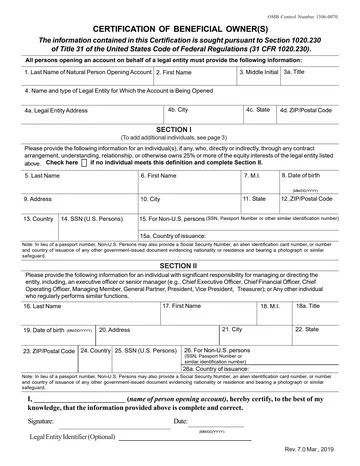
- The form. FinCEN posts a fillable PDF (Rev. 7.0 Mar. 2019, the version shown below) and a Word version on its filing information page.
Which version, and the 1020.230 citation
The fillable PDF is the current revision: “Rev. 7.0 Mar., 2019”, “OMB Control Number 1506-0070”. It has three pages: the general instructions, the certification with numbered lines 1 to 26a, and a page for the second, third and fourth owners. FinCEN's Word version is an older layout. Its file name reads R6.7 and it is dated Sept. 14, 2017; it has lettered parts a to d instead of numbered lines (part b is the “Name, Type, and Address of Legal Entity for Which the Account is Being Opened:”) and prints no revision, OMB number or CFR section. The information asked for is the same, and both carry the same certification sentence. Either works, as does the institution's own form.
The citation is wrong on the PDF. The PDF's first page is headed “31 CFR § 1020.230”, and page 2 says “The information contained in this Certification is sought pursuant to Section 1020.230 of Title 31 of the United States Code of Federal Regulations (31 CFR 1020.230).” The rule is 31 CFR 1010.23031 CFR 1010.230Code of Federal Regulations, eCFR. FinCEN printed the form in the 2016 final rule as “APPENDIX A to § 1010.230”, and the rule itself refers to “a certification in the form of appendix A of this section” (31 CFR 1010.230(b)(1)). Part 1020, the bank rules, has no section 1020.230 at all: in eCFR's text of Nov. 6, 2026 its program sections end at 1020.220, the bank CIP rule. The CFR section governs; the form's reference is a printing error and changes nothing about what is required. If an auditor or a customer asks, cite 31 CFR 1010.23031 CFR 1010.230Code of Federal Regulations, eCFR and its Appendix A.
FinCEN has proposed to move the form's content into the rule (below). Until a final rule changes it, Rev. 7.0 is the form to use.
Tap a box once for its note, again to jump to the line. Zoom in to read the small print.
Lines 1 to 4d: who opens the account
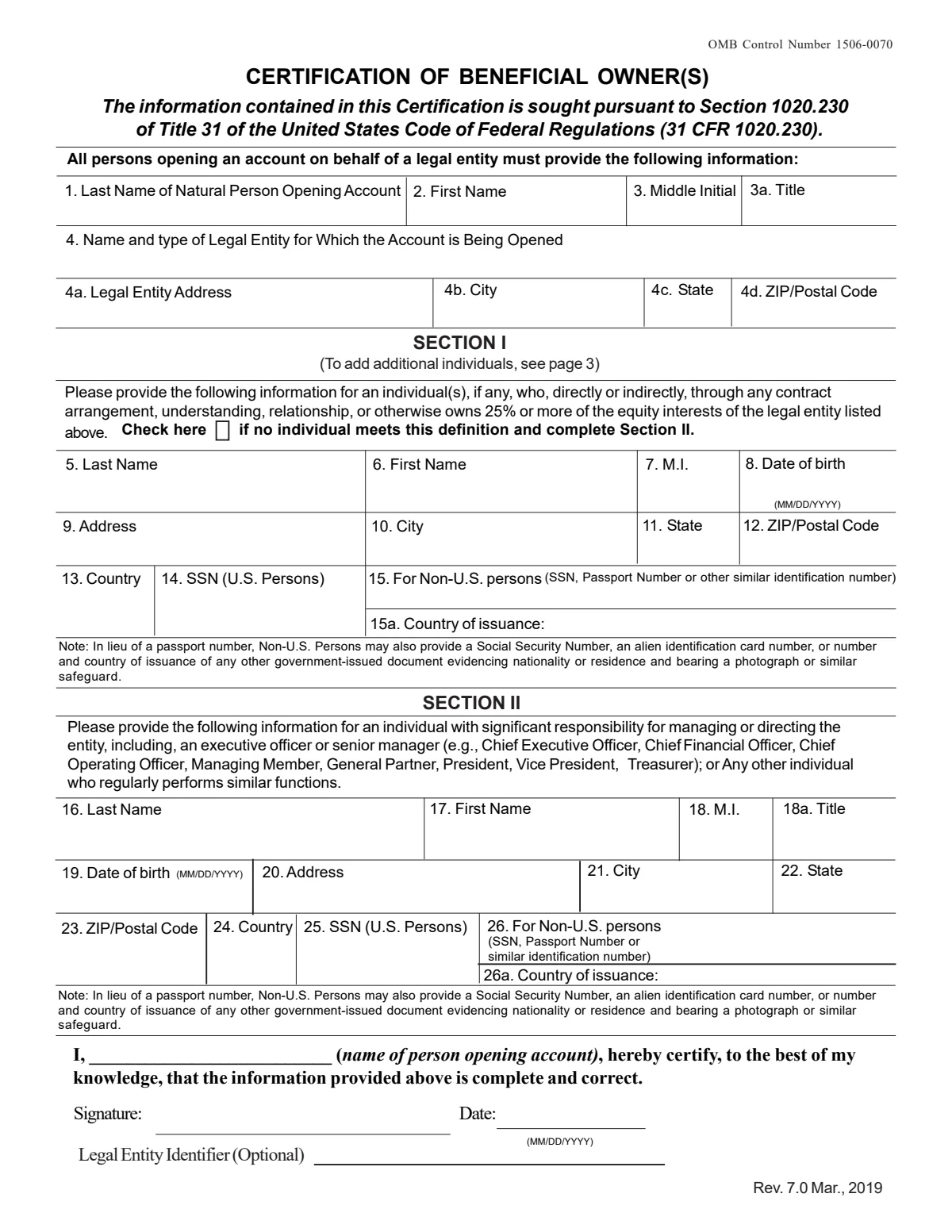
The top block names two parties: the individual at the counter or on the screen (lines 1 to 3a) and the legal entity that will own the account (lines 4 to 4d). The form tells the opener: “All persons opening an account on behalf of a legal entity must provide the following information:”
| Line | Label | What goes there |
|---|---|---|
| 1 | Last Name of Natural Person Opening Account | The person opening the account, who is also the person certifying. FinCEN's 2016 FAQs: the rule requires the information to come “from the individual seeking to open a new account at the covered financial institution on behalf of the legal entity customer”. “This individual could, but would not necessarily, be a beneficial owner.” |
| 2 | First Name | First name of the same person. Lines 1 to 3a identify the person who certifies, not a beneficial owner. |
| 3 | Middle Initial | Middle initial, if any. |
| 3a | Title | The opener's own title. The control person's title goes on line 18a, which may be the same person. FinCEN's Word version of the form asks for the “Name and Title of Natural Person Opening Account:” in one line; Rev. 7.0 splits it into lines 1 to 3a. |
| 4 | Name and type of Legal Entity for Which the Account is Being Opened | The legal entity customer. For this form a legal entity “includes a corporation, limited liability company, or other entity that is created by a filing of a public document with a Secretary of State or similar office, a general partnership, and any similar business entity formed in the United States or a foreign country”. It says “Legal entity does not include sole proprietorships”, unincorporated associations, or natural persons opening accounts for themselves. Some legal entities are excluded from the rule altogether (regulated financial institutions, listed companies and others in 31 CFR 1010.230(e)(2)31 CFR 1010.230Code of Federal Regulations, eCFR); see legal entity customer. |
| 4a | Legal Entity Address | The form gives no rule for this line. The bank CIP rule asks a business customer for “a principal place of business, local office, or other physical location” (31 CFR 1020.220(a)(2)(i)(A)(3)(iii))31 CFR 1020.220Code of Federal Regulations, eCFR, and most institutions reuse that address here. |
| 4b | City | City of the address on line 4a. |
| 4c | State | State, or the province or region for a foreign address. |
| 4d | ZIP/Postal Code | ZIP code, or the postal code for an address outside the United States. |
Section I: owners of 25 percent or more
Section I is the ownership prong. The test is equity, 25 percent or more, held directly or indirectly. The form's own note on numbers: “Thus, a completed form will contain the identifying information of at least one individual (under section (2)), and up to five individuals (i.e., one individual under section (2) and four 25 percent equity holders under section (1))”. Page 2 holds the first owner; page 3 holds the rest.
Appendix A (Rev. 7.0 Mar. 2019); 31 CFR 1010.230(d)31 CFR 1010.230Code of Federal Regulations, eCFR; CDD FAQs (2016), Question 12.
| Line | Label | What goes there |
|---|---|---|
| None | Check here if no individual meets this definition and complete Section II. | The ownership prong may have no one in it: the rule covers “Each individual, if any, who, directly or indirectly, through any contract, arrangement, understanding, relationship or otherwise, owns 25 percent or more of the equity interests of a legal entity customer” (31 CFR 1010.230(d)(1))31 CFR 1010.230Code of Federal Regulations, eCFR. The form's instructions: “up to four individuals (but as few as zero) may need to be identified”. FinCEN's Word version asks for the words “(If no individual meets this definition, please write ‘Not Applicable.’)” instead of a check box. |
| 5 | Last Name | An individual, never a company: when another company owns the stake, trace the chain up to the people and add their indirect shares (CDD FAQs 2018, Question 3; our beneficial owner calculator does the arithmetic). FinCEN intends that the customer “identify its ultimate beneficial owner or owners and not ‘nominees’ or ‘straw men.’” When a trust holds 25 percent or more, the owner on this line is “the trustee” (31 CFR 1010.230(d)(3))31 CFR 1010.230Code of Federal Regulations, eCFR. |
| 6 | First Name | First name of the same owner. |
| 7 | M.I. | Middle initial, if any. |
| 8 | Date of birth (MM/DD/YYYY) | Date of birth in the printed format, MM/DD/YYYY. FinCEN's 2016 FAQs list the data the institution must collect: “the name, date of birth, address, and social security number or other government identification number” (Question 11). |
| 9 | Address | The owner's street address. FinCEN: “For an individual beneficial owner, covered financial institutions must obtain either a residential or a business street address.” If neither is available, an APO or FPO box number or the street address of next of kin or another contact may be used (CDD FAQs 2018, Question 5). |
| 10 | City | City of the address on line 9. |
| 11 | State | State, or the province or region for a foreign address. |
| 12 | ZIP/Postal Code | ZIP or postal code. |
| 13 | Country | Country of the address on lines 9 to 12. |
| 14 | SSN (U.S. Persons) | The form asks a U.S. person for a Social Security number. The bank CIP rule asks customers for “For a U.S. person, a taxpayer identification number”, a wider term. FinCEN's Nov. 19, 2026 proposal, which is not final, would write the SSN into the rule: “The proposal also specifies that an Individual Taxpayer Identification Number (ITIN) is not an acceptable substitute for a Social Security number.” Comments are due Jan. 19, 2027 (91 FR 74514)91 FR 74514Federal Register, govinfo. |
| 15 | For Non-U.S. persons (SSN, Passport Number or other similar identification number) | The note under the line: “In lieu of a passport number, Non-U.S. Persons may also provide a Social Security Number, an alien identification card number, or number and country of issuance of any other government-issued document evidencing nationality or residence and bearing a photograph or similar safeguard.” This tracks the CIP rule's list for non-U.S. persons (31 CFR 1020.220(a)(2)(i)(A)(4)(ii))31 CFR 1020.220Code of Federal Regulations, eCFR. |
| 15a | Country of issuance | The issuing country of the passport or other document on line 15. A passport number without its country is incomplete. |
Section II: the control person
Section II is the control prong. It is never blank: every legal entity customer names one individual here, even one with no 25 percent owner, and even a nonprofit, which gives only a control person (31 CFR 1010.230(e)(3))31 CFR 1010.230Code of Federal Regulations, eCFR.
| Line | Label | What goes there |
|---|---|---|
| 16 | Last Name | Exactly one person, every time: “Regardless of the number of individuals identified under section (1), you must provide the identifying information of one individual under section (2).” The rule: “A single individual with significant responsibility to control, manage, or direct a legal entity customer, including:” an executive officer or senior manager, or “Any other individual who regularly performs similar functions.” FinCEN expects “a high-level official in the legal entity, who is responsible for how the organization is run” (2016 FAQs, Question 13). |
| 17 | First Name | First name of the same person. |
| 18 | M.I. | Middle initial, if any. |
| 18a | Title | The title that makes this person the control person. The same individual may also appear in Section I: “It is possible that in some circumstances the same individual might be identified under both sections (e.g., the President of Acme, Inc. who also holds a 30% equity interest).” |
| 19 | Date of birth (MM/DD/YYYY) | Date of birth in the printed format. |
| 20 | Address | Street address, under the same rule as line 9: residential or business, with APO, FPO or next-of-kin addresses only as substitutes. |
| 21 | City | City of the address on line 20. |
| 22 | State | State, province or region. |
| 23 | ZIP/Postal Code | ZIP or postal code. |
| 24 | Country | Country of the address. |
| 25 | SSN (U.S. Persons) | As on line 14: an SSN for a U.S. person. The proposal's ITIN exclusion would cover the control person too, if adopted. |
| 26 | For Non-U.S. persons (SSN, Passport Number or similar identification number) | As on line 15, with the same note under the line: a passport number, an SSN, an alien identification card number, or another government document with a photograph. |
| 26a | Country of issuance | The issuing country of the document on line 26. |
The certification and signature
The signature block turns the form into a certification. The institution may rely on what it says: it “may rely on the information supplied by the legal entity customer regarding the identity of its beneficial owner or owners, provided that it has no knowledge of facts that would reasonably call into question the reliability of such information.” (31 CFR 1010.230(b)(2))31 CFR 1010.230Code of Federal Regulations, eCFR.
| Line | Label | What goes there |
|---|---|---|
| Certify | I, ____ (name of person opening account), hereby certify, to the best of my knowledge, that the information provided above is complete and correct. | This sentence is what the rule requires, whatever form is used. An institution that does not use the form must obtain the same information “provided the individual certifies, to the best of the individual's knowledge, the accuracy of the information” (31 CFR 1010.230(b)(1))31 CFR 1010.230Code of Federal Regulations, eCFR. |
| Signature | Signature | The certifying person signs. The form and the FinCEN FAQs do not say whether an electronic signature is accepted. |
| Date | Date (MM/DD/YYYY) | The signing date. Retention does not run from it: identification records, including the certification, are kept “for five years after the date the account is closed” (31 CFR 1010.230(i)(2))31 CFR 1010.230Code of Federal Regulations, eCFR. |
| LEI | Legal Entity Identifier (Optional) | Marked optional on the form. The rule and FinCEN's CDD FAQs say nothing more about it. |
Page 3: the second to fourth owners
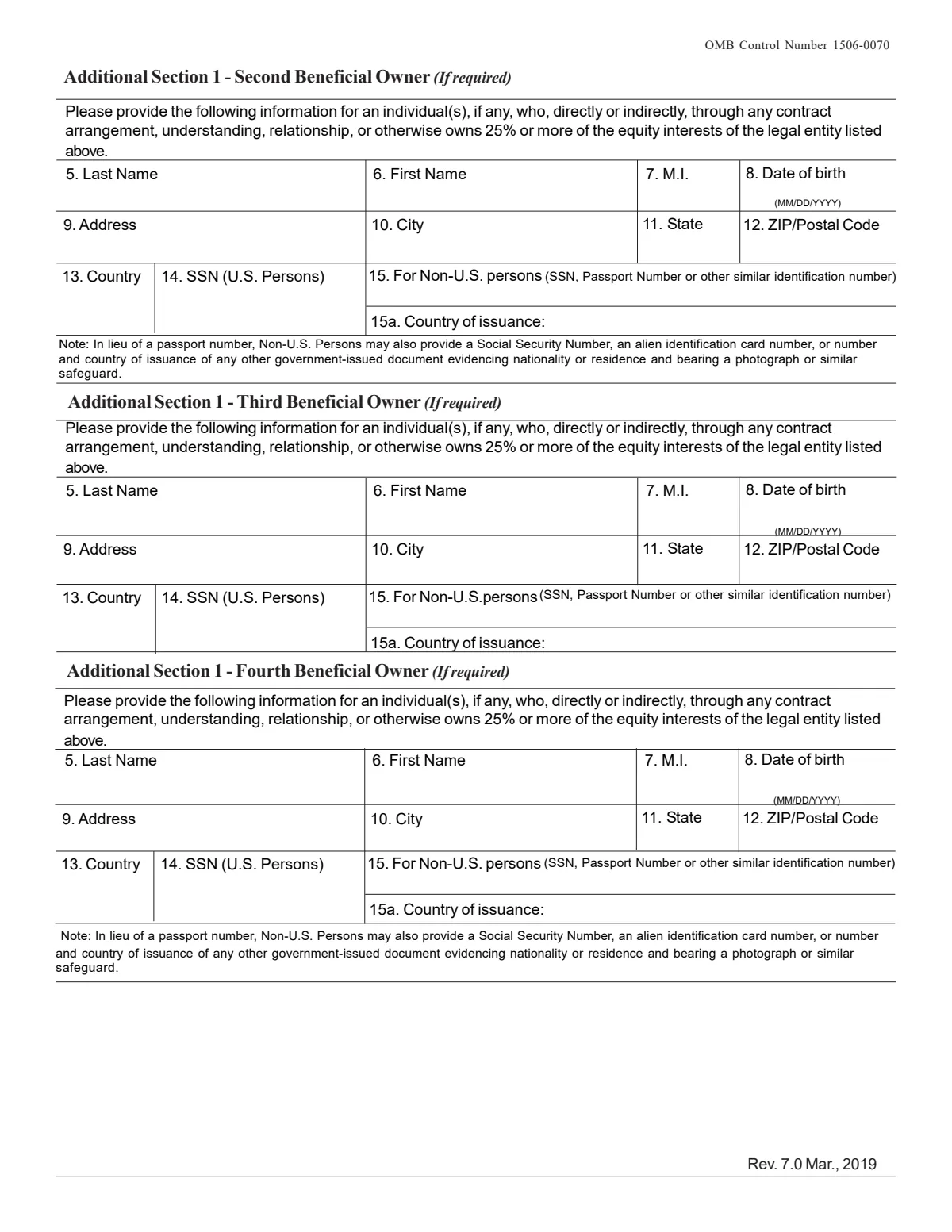
Page 3 repeats Section I's lines 5 to 15a three times, under the headings Additional Section 1, Second, Third and Fourth Beneficial Owner (If required). Use as many blocks as there are 25 percent owners; four is the most there can be. The boxes below group each block's three rows.
| Line | Label | What goes there |
|---|---|---|
| O2-5 | Additional Section 1, Second Beneficial Owner: 5. Last Name, 6. First Name, 7. M.I., 8. Date of birth | Same rules as lines 5 to 8 on page 2. Use this block only if a second individual owns 25 percent or more. |
| O2-9 | 9. Address, 10. City, 11. State, 12. ZIP/Postal Code | Same rules as lines 9 to 12: a residential or business street address. |
| O2-13 | 13. Country, 14. SSN (U.S. Persons), 15. For Non-U.S. persons, 15a. Country of issuance | Same rules as lines 13 to 15a. |
| O3-5 | Additional Section 1, Third Beneficial Owner: 5. Last Name, 6. First Name, 7. M.I., 8. Date of birth | Same rules as lines 5 to 8 on page 2. Use this block only if a third individual owns 25 percent or more. |
| O3-9 | 9. Address, 10. City, 11. State, 12. ZIP/Postal Code | Same rules as lines 9 to 12: a residential or business street address. |
| O3-13 | 13. Country, 14. SSN (U.S. Persons), 15. For Non-U.S. persons, 15a. Country of issuance | Same rules as lines 13 to 15a. The third owner's block prints no note on substitute documents; the note on page 2 still applies. |
| O4-5 | Additional Section 1, Fourth Beneficial Owner: 5. Last Name, 6. First Name, 7. M.I., 8. Date of birth | Same rules as lines 5 to 8 on page 2. Use this block only if a fourth individual owns 25 percent or more. |
| O4-9 | 9. Address, 10. City, 11. State, 12. ZIP/Postal Code | Same rules as lines 9 to 12: a residential or business street address. |
| O4-13 | 13. Country, 14. SSN (U.S. Persons), 15. For Non-U.S. persons, 15a. Country of issuance | Same rules as lines 13 to 15a. |
After it is signed: verify, screen, keep
The form is the identification step. Three duties follow, none of them on the form itself.
31 CFR 1010.230(b)31 CFR 1010.230Code of Federal Regulations, eCFR and (i); CDD FAQs (2016), Question 23; the form's general instructions.
- Verify each person. The institution must “Verify the identity of each beneficial owner identified to the covered financial institution, according to risk-based procedures to the extent reasonable and practicable.” The form warns the customer: “The financial institution may also ask to see a copy of a driver’s license or other identifying document for each beneficial owner listed on this form.” Unlike CIP, the CDD rule allows photocopies; FinCEN's example is accepting a copy of a driver's license for an owner who is not present, “which is not permissible in the CIP rules” (CDD FAQs 2018, Question 4).
- Screen the names. FinCEN's 2016 FAQs say institutions should use the owner information “including for compliance with OFAC-administered sanctions.” (Question 23). A hit goes through OFAC's review steps on our potential match page, and ownership by blocked persons is a separate test under the 50 percent rule, which adds up holdings that the 25 percent test treats one person at a time.
- Keep the record. The record must include “any identifying information obtained by the covered financial institution pursuant to paragraph (b) of this section, including without limitation the certification (if obtained)”, kept “for five years after the date the account is closed”. Verification records are kept “for five years after the record is made.” (31 CFR 1010.230(i))31 CFR 1010.230Code of Federal Regulations, eCFR. FinCEN adds that institutions “are required to retain all beneficial ownership information collected about a legal entity customer” (Question 9), so an updated form does not replace the old one in the file.
When the customer opens another account later, FIN-2026-R001 means no new form is needed, unless the institution knows facts that call the information into question or its ongoing due diligence procedures call for the owners again. In that last case it “may rely on beneficial ownership information previously obtained”, “provided the customer certifies or confirms (verbally or in writing) that such information is up-to-date and accurate.” It “must maintain a record of such certification or confirmation, including for both verbal and written confirmations by the customer.” A new signed form is one way to make that record; a dated note of a verbal confirmation is another.
Mistakes the form invites
- Listing more than four owners, or none in Section II. Page 1 of the PDF has a sentence that reads as if it allows more: “this form requires you to list only those that own 25% or more (up to five) under each of the two prongs of the definition above.” The rule's note settles it: “Under paragraph (d)(1) of this section, depending on the factual circumstances, up to four individuals may need to be identified. Under paragraph (d)(2) of this section, only one individual must be identified.” Four owners at most, one control person always. The rule governs; the sentence on the form also starts mid-sentence, a sign of a drafting slip.
- Naming a company as an owner. Section I takes individuals. Trace ownership through each company to the people, and for a trust at 25 percent, name the trustee.
- Treating the form as verification. It identifies; verification is a separate, risk-based step.
- Sending it to FinCEN. It stays with the institution: “Covered financial institutions should retain the form and not file it with FinCEN.”
- Using it for a sole proprietor. Sole proprietorships and unincorporated associations are not legal entity customers; the individual goes through CIP instead.
- Confusing it with a BOI report. The form is not filed with FinCEN's BOI E-Filing System, and the CTA's reporting rule uses a different owner test. Since the Aug. 14, 2026 final rule only foreign entities registered to do business in a State report BOI; the CDD rule still applies to every legal entity customer, domestic or foreign. See CTA vs CDD.
What the 2026 proposal would change
FinCEN's Nov. 19, 2026 proposed rule (91 FR 74514)91 FR 74514Federal Register, govinfo is a proposal, not law; comments are due Jan. 19, 2027, and FinCEN proposes the rule take effect 90 days after a final rule is published. On the form, it would do three things:
- Move the data list into the rule. The proposal would involve “moving the specific details of the requirement to collect information about beneficial owners from the rule’s Appendix A into the rule itself.” FinCEN says “Most, but not all, of those details would not change.”
- Exclude ITINs for owners. “The proposal also specifies that an Individual Taxpayer Identification Number (ITIN) is not an acceptable substitute for a Social Security number.” That would change what lines 14 and 25 may hold.
- Keep the form optional. A covered institution “may, but is not required, to use the standardized certification form contained in Appendix A to § 1010.230.” The proposal's text also cites the right section.
Until a final rule is published, the current rule, FIN-2026-R001 and Rev. 7.0 apply. Our CDD rule changes in 2026 page tracks the proposal.
How it connects
- The rule behind every line, with the exclusions and exempt accounts: customer due diligence requirements. Who counts as an owner in harder structures: beneficial ownership.
- A worksheet with the same fields plus the institution's own verification and record lines: beneficial ownership certification worksheet.
- Indirect ownership arithmetic: the beneficial owner calculator. The identity rules for the customer itself: customer identification program.
- For a vendor rather than an account customer, the form does not apply; the IRS forms do. tincompliance.com covers the W-9 and W-8BEN-E.
Questions compliance teams ask
Do we have to use FinCEN's certification form?
No. “Financial institutions may choose to comply with the requirements of the Rule by using another method, such as through the institutions’ own forms, or any other means that comply with the substantive requirements of this obligation.” Whatever the format, the person opening the account must certify the information.
The form says 31 CFR 1020.230. Is that the rule?
No. The rule is 31 CFR 1010.23031 CFR 1010.230Code of Federal Regulations, eCFR, and the form is its Appendix A, as FinCEN printed it in the 2016 final rule. Part 1020 has no section 1020.230. The CFR section governs; the citation on the PDF is a printing error.
Can the owners' information come from someone other than the person opening the account?
Under the current rule the information comes from the individual opening the account, who certifies it. FinCEN's Nov. 19, 2026 proposal would let institutions acquire it from a third-party source, subject to the certification. That is a proposal, with comments due Jan. 19, 2027.
Does a customer that opens a second account fill in a new form?
Not necessarily, since FIN-2026-R001 (Feb. 13, 2026). The institution may limit identification to the first account, to facts that call the information into question, and to updates its ongoing due diligence procedures call for. For such an update it may rely on the form on file if the customer confirms, verbally or in writing, that it is up to date and accurate, and it keeps a record of that confirmation.
What goes in Section I when no one owns 25 percent?
Nothing: check the box above line 5 (or write Not Applicable on the Word version) and complete Section II. A control person is always required.
How long do we keep a completed form?
Five years after the account is closed (31 CFR 1010.230(i)(2))31 CFR 1010.230Code of Federal Regulations, eCFR. Keep earlier forms and updates too; FinCEN's FAQs say all beneficial ownership information collected is retained.
Sources
- FinCEN, Certification Regarding Beneficial Owners of Legal Entity Customers, Rev. 7.0 Mar. 2019 (PDF) and Word version (file R6.7, Sept. 14, 2017), from the filing information page
- 31 CFR part 1010, section 1010.230, and 31 CFR part 1020, section 1020.220, as printed by eCFR on Nov. 6, 2026; CDD final rule, 81 FR 29398 (May 11, 2016), with Appendix A
- FinCEN, CDD FAQs (July 19, 2016) and CDD FAQs (Apr. 3, 2018); FIN-2026-R001 (Feb. 13, 2026)
- FinCEN, Customer Due Diligence Requirements for Covered Financial Institutions, proposed rule, 91 FR 7451491 FR 74514Federal Register, govinfo (Nov. 19, 2026)