- What the Bank Secrecy Act is
- Who the BSA binds
- The AML program
- The reports, by who files
- Cash: CTR, Form 8300 and structuring
- Records and the travel rule
- 314(a) and 314(b): requests and sharing
- Filing: the BSA E-Filing System
- Who examines for BSA compliance
- The AML Act of 2020 and what followed
- Questions compliance teams ask
- Sources
31 CFR 1010.31131 CFR 1010.311Code of Federal Regulations, eCFR, 1010.330, 1020.320, 1022.320, 1010.306(a) and 1010.430(d); Form 8300 instructions.
What the Bank Secrecy Act is
The Bank Secrecy Act (BSA) is the body of law in 31 U.S.C. chapter 53, subchapter II, and FinCEN's rules under it in 31 CFR chapter X. Its stated purposes start with records and reports: the subchapter exists to “require certain reports or records that are highly useful in” criminal, tax and regulatory investigations and intelligence work, and to “prevent the laundering of money and the financing of terrorism through the establishment by financial institutions of reasonably designed risk-based programs to combat money laundering and the financing of terrorism” (31 U.S.C. 5311)31 U.S.C. 5311United States Code, Cornell LII.
FinCEN runs it: “Overall authority for enforcement and compliance, including coordination and direction of procedures and activities of all other agencies exercising delegated authority under this chapter, is delegated to the Director, FinCEN.” (31 CFR 1010.810(a))31 CFR 1010.810Code of Federal Regulations, eCFR. For a KYB program, the BSA supplies the customer identification and CDD rules covered on KYC requirements, the reports that follow once a customer is on board, and the records that prove it.
Who the BSA binds
Most BSA duties fall on financial institutions as FinCEN defines them. The definition reaches “Each agent, agency, branch, or office within the United States of any person doing business, whether or not on a regular basis or as an organized business concern, in one or more of the capacities listed below:” banks, broker-dealers, money services businesses, telegraph companies, casinos and card clubs, persons supervised by a bank regulator, futures commission merchants, introducing brokers and mutual funds (31 CFR 1010.100(t))31 CFR 1010.100Code of Federal Regulations, eCFR. Insurance companies, dealers in precious metals, stones or jewels, credit card system operators, loan or finance companies and housing GSEs carry duties under their own parts of chapter X.
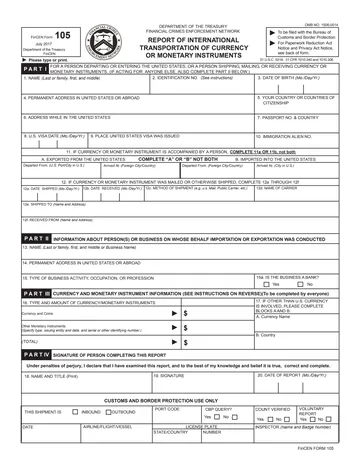
Some duties reach beyond financial institutions. Any trade or business files Form 8300 for large cash payments, and any person who carries more than $10,000 in currency or monetary instruments across the border files a CMIR on FinCEN Form 105. A bank, an MSB and a car dealer therefore all have BSA duties, but very different ones.
The AML program
Each kind of financial institution has its own program rule. FinCEN's 2026 proposal lists them: “The AML program rules are located” at 31 CFR 1020.21031 CFR 1020.210Code of Federal Regulations, eCFR (banks), 1021.210 (casinos), 1022.210 (MSBs), 1023.210 (broker-dealers), 1024.210 (mutual funds), 1025.210 (insurance companies), 1026.210 (futures firms), 1027.210 (dealers in precious metals, stones or jewels), 1028.210 (credit card system operators), 1029.210 (loan or finance companies) and 1030.210 (housing GSEs) (91 FR 18704)91 FR 18704Federal Register, govinfo. For banks the minimum is internal controls, independent testing, a designated compliance individual, training and the CDD element (31 CFR 1020.210(a)(2))31 CFR 1020.210Code of Federal Regulations, eCFR. Institutions that keep correspondent accounts for foreign banks add due diligence on those accounts (31 CFR 1010.610)31 CFR 1010.610Code of Federal Regulations, eCFR and a shell bank ban: a covered financial institution “shall not establish, maintain, administer, or manage a correspondent account in the United States for, or on behalf of, a foreign shell bank.” (31 CFR 1010.630(a)(1)(i))31 CFR 1010.630Code of Federal Regulations, eCFR. Foreign banks certify their status, owners and U.S. agent on the USA PATRIOT Act certification.
The statute frames the program as risk-based, “including ensuring that more attention and resources of financial institutions should be directed toward higher-risk customers and activities” (31 U.S.C. 5318(h))31 U.S.C. 5318United States Code, Cornell LII. A proposed AML/CFT program rule (91 FR 1870491 FR 18704Federal Register, govinfo, Apr. 10, 2026) would rewrite the program rules; it is a proposal, comments closed June 9, 2026. The AML program rules page covers each one.
The reports, by who files
The BSA's reports differ by who files, what triggers them and when they are due. The ones a KYB program meets most often:
| Report | Who files | Trigger | Deadline | Page |
|---|---|---|---|---|
| Currency transaction report (CTR) | Financial institutions other than casinos (31 CFR 1010.311)31 CFR 1010.311Code of Federal Regulations, eCFR | Currency of more than $10,000 | “within 15 days following the day on which the reportable transaction occurred” | CTR |
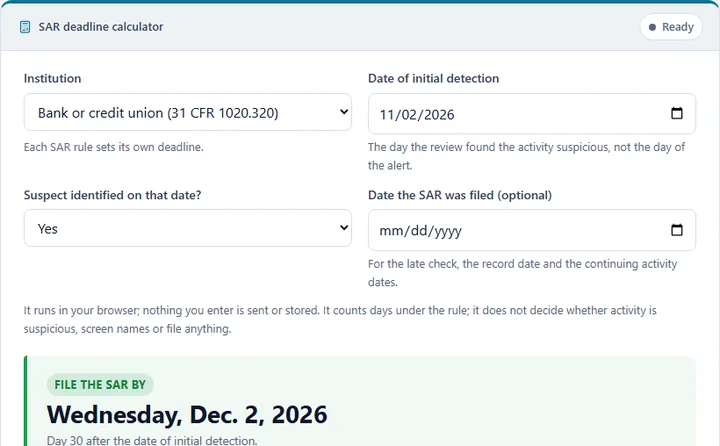
| Suspicious activity report (SAR) | Banks, MSBs and the other institutions with SAR rules | Banks: “involves or aggregates at least $5,000 in funds or other assets”; MSBs: “involves or aggregates funds or other assets of at least $2,000” | “no later than 30 calendar days after the date of initial detection”, 60 at most | SAR |
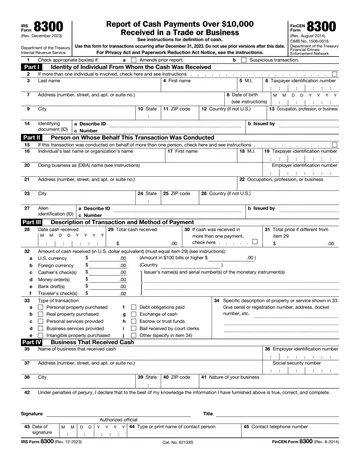
| Form 8300 | Any trade or business | “receives currency in excess of $10,000 in 1 transaction (or 2 or more related transactions)” | “File Form 8300 by the 15th day after the date the cash was received.” | Form 8300 vs CTR |
| CMIR (FinCEN Form 105) | Any person | Currency or monetary instruments “in an aggregate amount exceeding $10,000 at one time” into or out of the United States | “shall be filed at the time of entry into the United States or at the time of departure, mailing or shipping from the United States” (31 CFR 1010.306(b))31 CFR 1010.306Code of Federal Regulations, eCFR | FinCEN Form 105 |
| FBAR (FinCEN Form 114) | U.S. persons with foreign financial accounts | A U.S. person “having a financial interest in, or signature or other authority over, a bank, securities, or other financial account in a foreign country” (31 CFR 1010.350)31 CFR 1010.350Code of Federal Regulations, eCFR | Not covered here | taxproc.com: FBAR penalties |
| MSB registration (FinCEN Form 107) | Money services businesses | “each money services business (whether or not licensed as a money services business by any State) must register with FinCEN” | “within 180 days after the date on which the MSB is established” (FinCEN) | MSB registration |
CTRs, SARs and the exemption designation (FinCEN Form 110) are filed electronically; the form pages Form 8300 line by line and the CTR, SAR and Form 110 pages go field by field. FBAR penalties and procedure belong to the IRS and are covered on taxproc.com.
Cash: CTR, Form 8300 and structuring
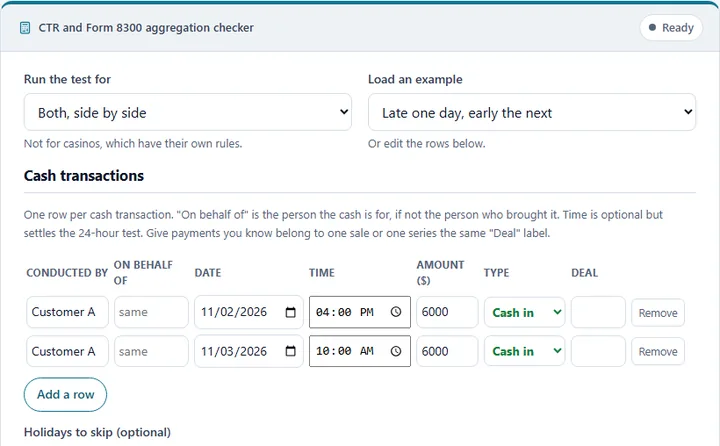
Two parallel cash reports split the economy in two. A financial institution “shall file a report of each deposit, withdrawal, exchange of currency or other payment or transfer, by, through, or to such financial institution which involves a transaction in currency of more than $10,000” (31 CFR 1010.311)31 CFR 1010.311Code of Federal Regulations, eCFR. Any other trade or business that “receives currency in excess of $10,000 in 1 transaction (or 2 or more related transactions)” files Form 8300 (31 CFR 1010.330(a))31 CFR 1010.330Code of Federal Regulations, eCFR, and gives each person named a written statement “on or before January 31 of the year following” (Form 8300 instructions).
31 CFR 1010.31131 CFR 1010.311Code of Federal Regulations, eCFR, 1010.313, 1010.306, 1010.330, 1010.340 and 1010.314.
Splitting a transaction to stay under the line is its own offense: “No person shall for the purpose of evading the transactions in currency reporting requirements of this chapter with respect to such transaction:” structure it or help structure it (31 CFR 1010.314)31 CFR 1010.314Code of Federal Regulations, eCFR. The full comparison is on Form 8300 vs CTR, and the structuring and CTR exemptions pages cover the rest. For businesses that take cash, tincompliance.com's Form 8300 guide walks through the form.
Records and the travel rule
The default retention period is five years: “All records that are required to be retained by this chapter shall be retained for a period of five years.” (31 CFR 1010.430(d))31 CFR 1010.430Code of Federal Regulations, eCFR. CIP and CDD records run five years from account closing or from when the record is made; OFAC's separate rule runs ten years.
Funds transfers carry their own record and travel duties at $3,000. A transmittor's or intermediary institution “shall include in any transmittal order for a transmittal of funds in the amount of $3,000 or more, information as required in this paragraph” (31 CFR 1010.410(f))31 CFR 1010.410Code of Federal Regulations, eCFR. A 2020 proposal to cut the threshold to $250 for cross-border transfers is gone: “The Agencies will not take further action on this NPRM.” (Nov. 9, 2026). See the travel rule page.
314(a) and 314(b): requests and sharing
Under section 314(a), FinCEN sends financial institutions lists of subjects to search for. Institutions search “Any account maintained for a named suspect during the preceding twelve months” and transactions “during the preceding six months” (31 CFR 1010.520(b)(3))31 CFR 1010.520Code of Federal Regulations, eCFR. FinCEN's fact sheet: “Financial institutions have two weeks from the posting date of the request to respond” (Oct. 2026). Requests arrive through FinCEN's 314 portal.
Under section 314(b), institutions may share information with each other under a safe harbor after notice to FinCEN; the notice “shall be effective for the one year period beginning on the date of the notice.” (31 CFR 1010.540(b)(2))31 CFR 1010.540Code of Federal Regulations, eCFR. Register for 314(b) through FinCEN's 314(b) registration form. KYB data feeds both: a 314(a) request is searched against customer and owner records. See the 314(a) and 314(b) page.
Filing: the BSA E-Filing System
BSA reports are electronic. FinCEN's filing page: “As of April 1, 2013, financial institutions must use the new FinCEN reports, which are available only electronically through the BSA E-Filing System.” File CTRs, SARs, exemption designations and MSB registrations in the BSA E-Filing System. Form 8300 can be filed there too, and for many businesses it must be: “Starting January 1, 2024, you must electronically file” Forms 8300 if you are required to file certain other information returns electronically (Form 8300 instructions). FinCEN's filing page also posts FinCEN's certification form, which is never filed: it stays with the institution.
Who examines for BSA compliance
FinCEN delegates examination by type of institution (31 CFR 1010.810(b))31 CFR 1010.810Code of Federal Regulations, eCFR: the federal banking agencies examine the banks they supervise, the SEC examines broker-dealers and investment companies, and the CFTC examines futures firms. The IRS takes the rest: “To the Commissioner of Internal Revenue with respect to all financial institutions, except brokers or dealers in securities, mutual funds, futures commission merchants, introducing brokers in commodities, and commodity trading advisors, not currently examined by Federal bank supervisory agencies for soundness and safety” (31 CFR 1010.810(b)(8))31 CFR 1010.810Code of Federal Regulations, eCFR.
In practice that means MSBs, casinos and card clubs, insurers, dealers in precious metals and “Banking entities limited to Credit Unions that are state-chartered and not federally-insured.” (IRM 4.26.1). The IRS also examines Form 8300 compliance at non-financial businesses. On interpretation, the IRS manual is clear: “FinCEN has the final word on interpretation of its regulations.”
The AML Act of 2020 and what followed
The Anti-Money Laundering Act of 2020 rewrote the BSA's purposes and program factors, and it carried the Corporate Transparency Act. FinCEN's final BOI rule recounts: “On January 1, 2021, Congress enacted into law the CTA as part of the broader Anti-Money Laundering Act of 2020.” FinCEN's AML Act page lists its work under the act, from the “AML/CFT Priorities (June 30, 2021)” to the 2026 program proposal and the BSA modernization items of 2025 and 2026.
The recent items a KYB program should know: the SAR FAQs of Oct. 9, 2025, which say “A financial institution is not required to conduct a separate review” after a SAR to check whether activity continued; the CIP TIN orders of 2025; FIN-2026-R001 on beneficial owners; the CDD proposal of Nov. 19, 2026; and the CTA's narrowing to foreign companies. The dated list is on KYB and AML changes for 2027, and the CTA on its own hub.
Forms, line by line
Tools for this topic
Templates
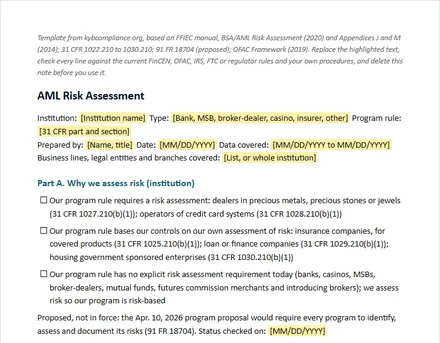
AML risk assessment
A BSA/AML risk assessment worksheet from the FFIEC's 2020 section and its risk matrices, with which institutions a rule requires it and the 2026 proposal labeled.
Questions compliance teams ask
Does the Bank Secrecy Act apply to businesses that are not banks?
Yes, in parts. Money services businesses, casinos, broker-dealers, insurers and other financial institutions have program and reporting duties under 31 CFR chapter X. Any trade or business files Form 8300 for cash over $10,000 (31 CFR 1010.330)31 CFR 1010.330Code of Federal Regulations, eCFR, and any person files a CMIR for more than $10,000 carried across the border (31 CFR 1010.340)31 CFR 1010.340Code of Federal Regulations, eCFR.
Who enforces the BSA?
FinCEN has overall authority (31 CFR 1010.810(a))31 CFR 1010.810Code of Federal Regulations, eCFR. Examination is delegated: the banking agencies for the banks they supervise, the SEC, the CFTC, and the IRS for the institutions no one else examines, including MSBs, casinos and state-chartered credit unions that are not federally insured.
How long do we keep BSA records?
Five years: “All records that are required to be retained by this chapter shall be retained for a period of five years.” (31 CFR 1010.430(d))31 CFR 1010.430Code of Federal Regulations, eCFR. OFAC records are a separate ten-year rule.
Where do we file a CTR or a SAR?
In the BSA E-Filing System. FinCEN accepts these reports only electronically.
What is the travel rule threshold?
$3,000 for funds transfers and transmittals of funds (31 CFR 1010.410)31 CFR 1010.410Code of Federal Regulations, eCFR. The 2020 proposal to lower it to $250 for cross-border transfers was withdrawn on Nov. 9, 2026.
Sources
- 31 U.S.C. 5311 and 31 U.S.C. 5318; 31 CFR part 1010 (1010.100, 1010.306, 1010.311, 1010.314, 1010.330, 1010.340, 1010.410, 1010.430, 1010.520, 1010.540, 1010.810), part 1020 (1020.210, 1020.320) and part 1022 (1022.320, 1022.380), as printed by eCFR on Nov. 6, 2026
- FinCEN, BSA filing information; Anti-Money Laundering Act of 2020 page; 314(a) fact sheet (Oct. 2026); SAR FAQs (Oct. 9, 2025); AML/CFT program proposal, 91 FR 1870491 FR 18704Federal Register, govinfo; travel rule proposal withdrawal (Nov. 9, 2026); BOI final rule, 91 FR 5250891 FR 52508Federal Register, govinfo
- IRS, Instructions for Form 8300 (Rev. Dec. 2023); IRM 4.26.1, Introduction and Program Structure