- The short answer
- Checks by team
- AP and vendor onboarding
- Foreign vendors: Form W-8BEN-E
- TIN Matching: useful, with a limit
- Does the vendor exist?
- Vendor bank changes and email fraud
- Online marketplaces: INFORM and Form 1099-K
- Federal contractors and grant recipients
- OFAC: the check every team owes
- Beneficial owners outside banking
- Questions compliance teams ask
- Sources
26 U.S.C. 3406(a)26 U.S.C. 3406United States Code, Cornell LII; 15 U.S.C. 45f(a)15 U.S.C. 45fUnited States Code, Cornell LII; 26 U.S.C. 6050W(e)26 U.S.C. 6050WUnited States Code, Cornell LII; FAR 9.405-2(b)FAR 9.405-2Federal Acquisition Regulation, acquisition.gov; 2 CFR 180.3002 CFR 180.300Code of Federal Regulations, eCFR and 25.300; 26 CFR 31.3406(j)-1(c); OFAC FAQ 11.
The short answer
No customer identification program and no CDD owner rule applies when a business pays a vendor, admits a seller to a platform or hires a subcontractor. Those rules bind banks, broker-dealers, mutual funds and futures firms, and only for their customers. The CDD rule says so: “Covered financial institutions are required to establish and maintain written procedures that are reasonably designed to identify and verify beneficial owners of legal entity customers” (31 CFR 1010.230(a))31 CFR 1010.230Code of Federal Regulations, eCFR. What reaches an accounts payable team, a marketplace or a federal contractor is a set of narrower rules: the backup withholding rules behind Form W-9, the INFORM Consumers Act, the Form 1099-K rules, the FAR and 2 CFR rules on exclusions and the UEI, and OFAC, which binds everyone: “All U.S. persons must comply with OFAC sanctions” (OFAC FAQ 11).
This hub sorts those rules by team and links the page for each. Every check carries one of three labels: required (a rule requires it of you), required if (only when a condition holds), or good practice, not required (no rule requires it of you; the reason it helps is quoted, with any limit). Banks and other financial institutions start at KYB requirements; money transmitters and payment companies at money transmitter KYB. The step-by-step list for an AP team is the vendor onboarding checklist.
Checks by team
The table sets every check that reaches the three teams this section serves against each of them. It reads the same data as the home page router and the KYB checklist builder, so the three always agree. A dot means no rule in this site's sources requires that check of that team; the team may still run it as good practice.
| Check | AP team | Marketplace | Contractor |
|---|---|---|---|
| Form W-9 (payee TIN) and backup withholding | Required | Required if | · |
| IRS TIN Matching (not for account opening) | Good practice | Good practice | · |
| OFAC sanctions screening | Required | Required | Required |
| OFAC reject and block reports in 10 business days | Required | Required | Required |
| BIS Entity List and the Consolidated Screening List | Required if | Required if | Required if |
| INFORM high-volume seller verification | · | Required | · |
| Form 1099-K for platform payments | · | Required if | · |
| SAM.gov exclusions | · | · | Required if |
| SAM.gov Unique Entity ID | · | · | Required if |
Two things stand out. OFAC is the only check all three teams owe. And the checks people most often call KYB (proving a vendor exists, naming its owners, matching its TIN) are required of none of them, except where INFORM or a federal award says so. That is no reason to skip them; it is a reason to know which ones a rule requires and which ones you run by choice.
AP and vendor onboarding
An accounts payable team's one firm duty at onboarding is a tax duty. A payer must backup withhold when “the payee fails to furnish his TIN to the payor in the manner required” (26 U.S.C. 3406(a)(1)(A))26 U.S.C. 3406United States Code, Cornell LII, and the IRS states the rate: “A payor must deduct, withhold, and deposit with IRS 24% of reportable payments made to that payee until the cause of the backup withholding is remedied.” (Instructions for the Requester of Form W-9, Rev. March 2024). Form W-9 is how the TIN arrives, and “A properly completed and signed Form W-9 can be relied upon to avoid backup withholding to a payee.”
The reporting line moved in 2026. For tax years beginning after 2025, “the minimum threshold amount for reporting certain payments” on certain information returns “and/or perform backup withholding on those payments increased to $2,000”; “Previously, the threshold amount was $600.” (Pub. 1099 (2026)). That $2,000 is the line for 2026 payments; for 2027, Rev. Proc. 2026-35 sets the figure: “For payments made in calendar year 2027, the reporting threshold for payments described in § 6041(a) is $2,100.” (Rev. Proc. 2026-35, sec. 3.52, IRB 2026-48). It names only the section 6041(a) reporting threshold and does not mention backup withholding. The form itself, line by line, is on tincompliance.com's Form W-9 page, and backup withholding in detail on its backup withholding guide. The onboarding view (which lines matter for KYB, and what a W-9 does not prove) is on W-9 and W-8BEN-E at onboarding.
26 U.S.C. 3406(a)(1)(A)26 U.S.C. 3406United States Code, Cornell LII; 26 CFR 31.3406(j)-1(c); OFAC FAQs 11 and 43; FAR 9.405-2(b)FAR 9.405-2Federal Acquisition Regulation, acquisition.gov; FIN-2016-A003 and FIN-2019-A005.
The full list for an AP team, with the status of each check:
| Check | Status | Rule | In the rule's or the agency's words |
|---|---|---|---|
| Form W-9 (payee TIN) and backup withholding | Required | 26 U.S.C. 3406(a)(1)(A)26 U.S.C. 3406United States Code, Cornell LII | “the payee fails to furnish his TIN to the payor in the manner required” |
| IRS TIN Matching (not for account opening) | Good practice, not required | Form W-9 requester instructions; 26 CFR 31.3406(j)-1(c) | “Program participants will generally be able to rely on a verified TIN/name match as reasonable cause under section 6724(a)”. Limit: “A payor may not take into account any such matching details in determining whether to open or close an account with a payee.” |
| OFAC sanctions screening | Required | OFAC FAQ 11 | “All U.S. persons must comply with OFAC sanctions”. Limit: “There is no legal or regulatory requirement to use software or to scan.” |
| OFAC reject and block reports in 10 business days | Required | 31 CFR 501.604(a)(3)31 CFR 501.604Code of Federal Regulations, eCFR | “sales or purchases of goods or services” |
| BIS Entity List and the Consolidated Screening List | Required if: you export, reexport or transfer items subject to the EAR | 15 CFR 744.11(a)15 CFR 744.11Code of Federal Regulations, eCFR | “A license is required, to the extent specified on the Entity List, to export, reexport, or transfer (in-country) any item subject to the EAR” |
Foreign vendors: Form W-8BEN-E
A foreign business does not give you a W-9. Form W-9 tells it: “If you are a nonresident alien or a foreign entity, give the requester the appropriate completed Form W-8 or Form 8233.” For an entity that is usually Form W-8BEN-E, and the timing matters: “Give Form W-8BEN-E to the person requesting it before the payment is made to you, credited to your account, or allocated.” The cost of not getting it: “Failure to provide a Form W-8BEN-E when requested may lead to withholding at a 30% rate or the backup withholding rate in certain cases” (Instructions for Form W-8BEN-E, Rev. October 2021). The form stays with you: “Give this form to the withholding agent or payer. Do not send to the IRS.”
A W-8BEN-E has a shelf life: “Generally, a Form W-8BEN-E will remain valid for purposes of both chapters 3 and 4 for a period starting on the date the form is signed and ending on the last day of the third succeeding calendar year, unless a change in circumstances makes any information on the form incorrect.” Build the renewal date into the vendor file. The form pages are on tincompliance.com's Form W-8BEN-E page; the onboarding points (chapter 3 and 4 status, owners, validity) are on W-9 and W-8BEN-E at onboarding. A foreign vendor's own registry is covered under international KYB.
TIN Matching: useful, with a limit
IRS TIN Matching tells a payer whether a name and TIN combination matches IRS records before it files information returns. The IRS limits who may use it: “TIN Matching is only for payers and their authorized agents that submit information returns.” No rule requires it: “The use of the program is completely voluntary” (Pub. 2108, Rev. 11-2024). The benefit is penalty relief: “Program participants will generally be able to rely on a verified TIN/name match as reasonable cause under section 6724(a)”.
The limit, in the regulation's words: “A payor may not take into account any such matching details in determining whether to open or close an account with a payee.” (26 CFR 31.3406(j)-1(c)). Use a match to file correct 1099s, never as the reason to approve or reject a vendor.
So for an AP team TIN Matching is good practice, not required, and only for information return accuracy. Who may enroll, the result codes and the penalty relief are on IRS TIN Matching in KYB; the step-by-step mechanics are on tincompliance.com's TIN Matching guide.
Does the vendor exist?
No rule requires an AP team to prove that a vendor exists, but a fake vendor is how many payment frauds start. The tax forms help less than people think. Form W-9 asks for the name that “should match the name shown on the charter or other legal document creating the entity”, but nothing on the form proves the charter exists. If a vendor's EIN is in doubt, the IRS route is the vendor's own: “If the TIN is an EIN, the payee must contact the IRS to get his or her employer identification number validated on the IRS Letter 147C.” (Pub. 1281).
A state's business record shows that an entity was formed and whether it is active, but the FFIEC manual warns about what it leaves out: “Few public records will disclose true ownership.” (Business Entities, 2014). What each source proves (the state record, the IRS name and TIN, SAM.gov, OFAC) is laid out on business entity verification, and entity status state by state on goodstandingrules.com.
Vendor bank changes and email fraud
The costliest vendor fraud is not a fake vendor at onboarding but a real vendor impersonated later. FinCEN's first advisory described it: “A criminal impersonates one of Company C's suppliers to e-mail and inform Company C that future invoice payments should be sent to a new account number and location.” (FIN-2016-A003). Its 2019 update found that “Fraudulent vendor and client invoices are generally affiliated with larger BEC transaction amounts than even the CEO fraud scheme” (FIN-2019-A005). Losses reported to the FBI's IC3 for business email compromise ran to “BEC $3,046,598,558 $2,770,151,146 $2,946,830,270” for 2025, 2024 and 2023 (IC3 2025 report).
No rule requires an ordinary business to verify a bank change; FinCEN says its advisory “does not establish new regulatory interpretations, expectations, or requirements.” The FBI's advice is plain: “Use secondary channels and/or two-factor authentication to verify requests for changes in account information.” If money goes out anyway, the FBI says: “Regardless of the amount lost, file a complaint with www.ic3.gov as soon as possible.” The complaint form is at www.ic3.gov. The red flags and the callback control are on business email compromise.
Online marketplaces: INFORM and Form 1099-K
An online marketplace has a KYB duty written into federal law. Under the INFORM Consumers Act a high-volume third party seller is one that, in any continuous 12-month period during the previous 24 months, made “200 or more discrete sales or transactions of new or unused consumer products” and “an aggregate total of $5,000 or more in gross revenues”. The marketplace must collect the seller's bank account, tax ID and contact details “not later than 10 days after qualifying as a high-volume third party seller”, and “verify the information collected under paragraph (1)(A) not later than 10 days after such collection”. It must also “periodically, but not less than annually, notify any high-volume third party seller” to keep the information current, and the seller must certify it (15 U.S.C. 45f(a)15 U.S.C. 45fUnited States Code, Cornell LII).
15 U.S.C. 45f(a)15 U.S.C. 45fUnited States Code, Cornell LII and (b); FTC INFORM guidance (edited January 2025); 91 FR 5844691 FR 58446Federal Register, govinfo.
Sellers “with an aggregate total of $20,000 or more in annual gross revenues on such online marketplace” are disclosed to buyers, and a seller that does not respond can be suspended: the marketplace must “suspend any future sales activity of such seller until such seller provides such information or certification.” The FTC enforces it, and its guidance says: “Violations could result in civil penalties of $53,088 per violation for online marketplaces.” For 2026, the FTC says its “civil penalty amounts will remain unchanged during 2026.” (91 FR 58446)91 FR 58446Federal Register, govinfo. Its first case: “This is the first action to enforce the INFORM Act” (Sept. 5, 2025). Anyone can report a possible violation through the FTC's INFORM report link. The detail is on INFORM Consumers Act.
A marketplace that pays its sellers is usually also a third party settlement organization for Form 1099-K. It “shall be required to report any information under subsection (a) with respect to third party network transactions of any participating payee only if” the amount of the payee's payments for the year “exceeds $20,000, and” “the aggregate number of such transactions exceeds 200.” (26 U.S.C. 6050W(e))26 U.S.C. 6050WUnited States Code, Cornell LII. The IRS: “The One, Big, Beautiful Bill (OBBB) retroactively reinstated the reporting threshold in effect prior to the passage of the American Rescue Plan Act of 2021 (ARPA)” (FS-2025-08). State thresholds differ, and the IRS only warns that “Your state may have a lower reporting threshold for TPSOs”; the amounts are Not listed here. The payee TIN rules apply too: “A payment made by a TPSO is a reportable payment potentially subject to section 3406 backup withholding.” TIN Matching is open for these payees (Pub. 2108 lists Form 1099-K), with the same account limit. See Form 1099-K for platforms, tincompliance.com's Form 1099-K page and its marketplace and gig platform page.
| Check | Status | Rule | In the rule's or the agency's words |
|---|---|---|---|
| INFORM high-volume seller verification | Required | 15 U.S.C. 45f(a)(1)(A)15 U.S.C. 45fUnited States Code, Cornell LII | “not later than 10 days after qualifying as a high-volume third party seller” |
| Form 1099-K for platform payments | Required if: the marketplace is the third party settlement organization that pays sellers | 26 U.S.C. 6050W(e)26 U.S.C. 6050WUnited States Code, Cornell LII | “the aggregate number of such transactions exceeds 200.” |
| Form W-9 (payee TIN) and backup withholding | Required if: the marketplace is the third party settlement organization that pays sellers | Form W-9 (Rev. March 2024), exempt payee code | “Corporations are not exempt from backup withholding for payments made in settlement of payment card or third-party network transactions.” |
| IRS TIN Matching (not for account opening) | Good practice, not required | IRS Form 1099-K FAQs; 26 CFR 31.3406(j)-1(c) | “Verification of payee TINs is done through the Taxpayer Identification Number (TIN) Matching Program.”. Limit: “A payor may not take into account any such matching details in determining whether to open or close an account with a payee.” |
| OFAC sanctions screening | Required | OFAC FAQ 11 | “All U.S. persons must comply with OFAC sanctions”. Limit: “There is no legal or regulatory requirement to use software or to scan.” |
| OFAC reject and block reports in 10 business days | Required | 31 CFR 501.604(a)(3)31 CFR 501.604Code of Federal Regulations, eCFR | “sales or purchases of goods or services” |
| BIS Entity List and the Consolidated Screening List | Required if: you export, reexport or transfer items subject to the EAR | 15 CFR 744.11(a)15 CFR 744.11Code of Federal Regulations, eCFR | “A license is required, to the extent specified on the Entity List, to export, reexport, or transfer (in-country) any item subject to the EAR” |
A marketplace that holds and moves money for sellers should also ask whether it is a money transmitter; the payment processor and agent of the payee carve-outs are on money transmitter KYB. The whole marketplace picture is on KYB for marketplaces.
Federal contractors and grant recipients
Federal money brings its own checks, and they differ for contracts and for grants. A prime contractor under the FAR: “Contractors are prohibited from entering into any subcontract in excess of $45,000, other than a subcontract for a commercially available off-the-shelf item”, with a contractor that has an active exclusion record in SAM, unless there is a compelling reason and notice to the contracting officer (FAR 9.405-2(b)FAR 9.405-2Federal Acquisition Regulation, acquisition.gov, FAC 2026-01, effective Mar. 13, 2026). The clause at FAR 52.209-6FAR 52.209-6Federal Acquisition Regulation, acquisition.gov makes each such subcontractor disclose its status in writing.
A grant recipient checks every lower tier. When you enter a covered transaction, “you must verify that the person with whom you intend to do business is not excluded or disqualified. You do this by:” “Checking SAM.gov Exclusions; or” “Collecting a certification from that person; or” “Adding a clause or condition to the covered transaction with that person.” And: “You may, but are not required to check SAM.gov Exclusions.” (2 CFR 180.300)2 CFR 180.300Code of Federal Regulations, eCFR. Before any subaward, “A recipient may not make a subaward to a subrecipient that has not obtained a UEI and provided it to the recipient.” (2 CFR 25.300)2 CFR 25.300Code of Federal Regulations, eCFR.
A UEI is not a vetting result. A UEI alone needs only the “legal business name and physical address”; a full registration adds “validation of the Taxpayer Identification Number (TIN) with the Internal Revenue Service (IRS)” (FAR 52.204-7)FAR 52.204-7Federal Acquisition Regulation, acquisition.gov, and “You must renew your registration every 365 days to keep it active.” Search and check records at SAM.gov or with SAM.gov's entity status check; the public entity API is capped for users without a role at “10 requests/day”. Outside federal contracts and awards, no rule in the sources requires a SAM.gov check; it is good practice. The pages: federal contractor vetting, SAM.gov UEI and SAM.gov exclusions.
| Check | Status | Rule | In the rule's or the agency's words |
|---|---|---|---|
| SAM.gov exclusions | Required if: for a subcontract over $45,000 (not a COTS item) | FAR 9.405-2(b)FAR 9.405-2Federal Acquisition Regulation, acquisition.gov | “Contractors are prohibited from entering into any subcontract in excess of $45,000” |
| SAM.gov exclusions | Required if: for a covered transaction at the next lower tier (grants and other nonprocurement), when you verify by checking SAM.gov rather than by a certification or a clause | 2 CFR 180.3002 CFR 180.300Code of Federal Regulations, eCFR (grants and other nonprocurement) | “you must verify that the person with whom you intend to do business is not excluded or disqualified”. Limit: “(a) Checking SAM.gov Exclusions; or (b) Collecting a certification from that person; or (c) Adding a clause or condition to the covered transaction with that person.” |
| SAM.gov Unique Entity ID | Required if: you make subawards under a federal financial assistance award (first-tier subrecipients only) | 2 CFR 25.300(a)2 CFR 25.300Code of Federal Regulations, eCFR, 25.105(b) (subawards) | “A recipient may not make a subaward to a subrecipient that has not obtained a UEI and provided it to the recipient.”. Limit: “This part does not apply to subrecipients of subrecipients (second-tier subrecipients) or contractors under Federal awards.” |
| OFAC sanctions screening | Required | OFAC FAQ 11 | “All U.S. persons must comply with OFAC sanctions”. Limit: “There is no legal or regulatory requirement to use software or to scan.” |
| OFAC reject and block reports in 10 business days | Required | 31 CFR 501.604(a)(3)31 CFR 501.604Code of Federal Regulations, eCFR | “sales or purchases of goods or services” |
| BIS Entity List and the Consolidated Screening List | Required if: you export, reexport or transfer items subject to the EAR | 15 CFR 744.11(a)15 CFR 744.11Code of Federal Regulations, eCFR | “A license is required, to the extent specified on the Entity List, to export, reexport, or transfer (in-country) any item subject to the EAR” |
OFAC: the check every team owes
OFAC is the one rule that reaches every vendor, seller and subcontractor relationship. “All U.S. persons must comply with OFAC sanctions” (OFAC FAQ 11). OFAC does not tell you how to screen: “There is no legal or regulatory requirement to use software or to scan.” “There is a requirement, however, not to violate the law by doing business with a target or failing to block property.” (OFAC FAQ 43). Nor will it vouch for a counterparty: “OFAC does not issue non-inclusion certificates”.
The duty does not stop at banks' wires. A U.S. person that rejects a prohibited transaction reports it, and the reporting rule defines the word broadly: “The term transaction for purposes of this section includes wire transfers, trade finance, transactions related to securities, checks, or foreign exchange, and sales or purchases of goods or services.” (31 CFR 501.604(a)(3))31 CFR 501.604Code of Federal Regulations, eCFR; reports are due “within 10 business days of the rejected transaction prohibited by the provisions of this chapter.” (31 CFR 501.604(c))31 CFR 501.604Code of Federal Regulations, eCFR. Search a name in OFAC's Sanctions List Search, and read OFAC sanctions and OFAC potential match before treating a hit as a match. The payables view is on tincompliance.com's vendor sanctions screening guide.
A team that exports has one more list: under the Export Administration Regulations, “A license is required, to the extent specified on the Entity List, to export, reexport, or transfer (in-country) any item subject to the EAR” (15 CFR 744.11(a))15 CFR 744.11Code of Federal Regulations, eCFR. See BIS Entity List.
Beneficial owners outside banking
A vendor team that asks who owns a vendor does so by choice. The reason is sanctions: OFAC “urges persons considering a potential transaction to conduct appropriate due diligence on entities that are party to or involved with the transaction or with which account relationships are maintained in order to determine relevant ownership stakes” (OFAC FAQ 401), because an entity owned 50 percent or more by blocked persons is blocked too (OFAC 50 percent rule). Several sources a vendor team may see say something about owners, each for its own purpose and with its own test:
| Source | What it says about owners | Who it binds |
|---|---|---|
| CDD rule (banks, broker-dealers, mutual funds, futures firms) | Each individual who “owns 25 percent or more of the equity interests of a legal entity customer”, and one control person | Required of covered financial institutions only (31 CFR 1010.230)31 CFR 1010.230Code of Federal Regulations, eCFR |
| Form W-8BEN-E, passive NFFE | Its substantial U.S. owners, each a U.S. person that “Owns, directly or indirectly, more than 10 percent (by vote or value) of the stock of any foreign corporation” | On the form the vendor gives you (Instructions for Form W-8BEN-E) |
| SAM.gov registration | The entity answers “Is your entity owned or controlled by another entity? (yes or no)” | Registrants only (SAM.gov checklist; 2 CFR 25) |
| INFORM | Not owners: the ID of “an individual acting on behalf of such seller” | Marketplaces, for high-volume sellers (15 U.S.C. 45f15 U.S.C. 45fUnited States Code, Cornell LII) |
| OFAC 50 percent rule | Blocked owners of 50 percent or more, in the aggregate; OFAC “urges persons considering a potential transaction to conduct appropriate due diligence on entities that are party to or involved with the transaction or with which account relationships are maintained in order to determine relevant ownership stakes” | Good practice for a vendor team (OFAC FAQ 401) |
| BOI under the CTA | Reported only by companies “Formed under the law of a foreign country” and registered in a State; not open to vendor teams | Not a source for an AP team (31 CFR 1010.380)31 CFR 1010.380Code of Federal Regulations, eCFR |
None of these is the CDD rule, and an AP team that borrows the CDD rule's 25 percent test does so as its own policy. The owner tests side by side are on beneficial ownership, and the CTA's narrowing on the CTA hub.
Templates
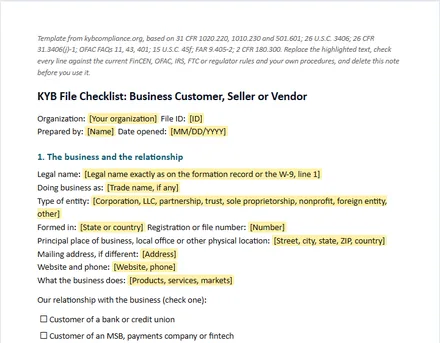
KYB file checklist
One file per business customer, seller, vendor or subrecipient, in fourteen sections, with a table of which sections a rule requires of your type of business.
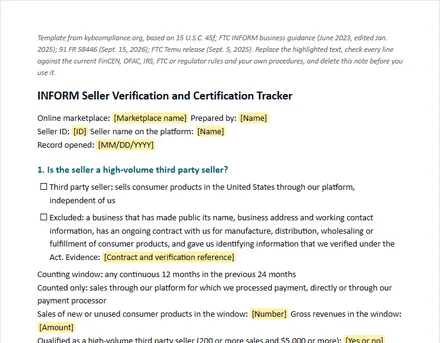
INFORM seller tracker
One record per high-volume third party seller: the day 0 count, the 10-day collect and verify clocks, the $20,000 disclosure tier, the annual certification and the suspension clocks.
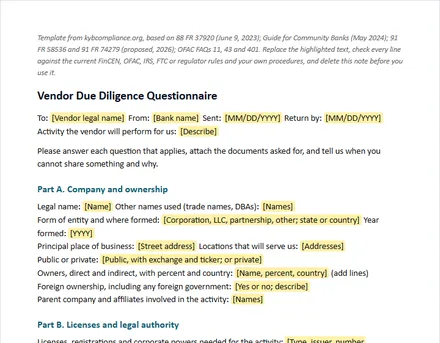
Vendor due diligence questionnaire
Questions to send a vendor, part by part, from the 14 due diligence factors in 88 FR 3792088 FR 37920Federal Register, govinfo and the May 2024 community bank guide; the Sept. 2026 proposal labeled.
Questions compliance teams ask
Do we have to verify our vendors' beneficial owners?
No rule requires an AP team to. The CDD owner rule binds covered financial institutions only (31 CFR 1010.230)31 CFR 1010.230Code of Federal Regulations, eCFR. OFAC urges due diligence on ownership so you do not deal with an entity owned 50 percent or more by blocked persons (OFAC FAQ 401): good practice, not required.
Can we use IRS TIN Matching to approve a new vendor?
No. “A payor may not take into account any such matching details in determining whether to open or close an account with a payee.” (26 CFR 31.3406(j)-1(c)). Use it to file correct information returns and for penalty relief.
Must we screen every vendor against OFAC's lists?
Every U.S. person must comply with OFAC sanctions, so you must not pay a blocked person. OFAC requires no software or scanning; how you make sure is up to you (OFAC FAQs 11 and 43).
Does a marketplace have to verify its sellers?
Its high-volume third party sellers, yes: collect bank, tax ID and contact information within 10 days of a seller qualifying, verify it within 10 more days, and have the seller certify it at least once a year (15 U.S.C. 45f(a)15 U.S.C. 45fUnited States Code, Cornell LII).
When do we have to check SAM.gov for a subcontractor?
Under a FAR contract, before a subcontract over $45,000 that is not for a COTS item (FAR 9.405-2(b))FAR 9.405-2Federal Acquisition Regulation, acquisition.gov. Under a grant, for each covered lower-tier transaction, by a SAM.gov check, a certification or a clause (2 CFR 180.300)2 CFR 180.300Code of Federal Regulations, eCFR. Otherwise it is good practice.
Is a callback on a vendor bank change required?
Not by any rule for an ordinary business. FinCEN and the FBI advise verifying the change through a channel the requester does not control, such as a phone number already on file.
Sources
- 26 U.S.C. 3406; 26 CFR 31.3406(j)-1; 26 U.S.C. 6050W; IRS Form W-9 and requester instructions (Rev. March 2024); Form W-8BEN-E and its instructions (Rev. October 2021); Pub. 1099 (2026); Pub. 1281; Pub. 2108 (Rev. 11-2024); TIN Matching page; FS-2025-08; Instructions for Form 1099-K
- 15 U.S.C. 45f; FTC, INFORM business guidance, Temu release (Sept. 5, 2025) and 2026 civil penalty notice, 91 FR 5844691 FR 58446Federal Register, govinfo
- FAR 9.405-2, 52.209-6, 9.404 and 52.204-7; 2 CFR 180 subpart C; 2 CFR part 25; SAM.gov entity registration page and checklist; GSA, Entity Management API
- OFAC, FAQs: basic information, financial institutions and 50 percent rule; 31 CFR part 501; 15 CFR 744.11; 31 CFR part 1010 (1010.230, 1010.380)
- FinCEN, FIN-2016-A003 and FIN-2019-A005; FBI IC3, PSA I-091124-PSA and 2025 annual report; FFIEC manual, Business Entities (2014)