31 CFR 1022.380(b)(3)31 CFR 1022.380Code of Federal Regulations, eCFR and 1022.320; CSBS MTMA page (Nov. 17, 2026); 3 NYCRR 504.4.
The short answer
A money transmitter answers to two layers of rules. The federal layer is FinCEN's: a money services business (MSB) registers, keeps an AML program that provides for verifying customer identification, files SARs and currency reports and keeps records, and, like every U.S. person, complies with OFAC. The state layer is licensing: most states license money transmission, and many now use the regulators' model law, the Money Transmission Modernization Act (MTMA). The federal registration rule says so itself: it applies “whether or not licensed as a money services business by any State” (31 CFR 1022.380(a)(1))31 CFR 1022.380Code of Federal Regulations, eCFR, and the statute adds: “This section shall not be construed as superseding any requirement of State law relating to money transmitting businesses operating in such State.” (31 U.S.C. 5330)31 U.S.C. 5330United States Code, Cornell LII.
What an MSB does not have is the bank KYB toolkit: no CIP rule and no CDD owner rule. The CDD rule covers banks, broker-dealers, futures firms and mutual funds (31 CFR 1010.230(f) and 1010.605(e)(1))31 CFR 1010.230Code of Federal Regulations, eCFR31 CFR 1010.605Code of Federal Regulations, eCFR. For an MSB, knowing a business customer's owners is good practice, driven by OFAC, and the state licensing laws vet the MSB's own owners instead. This hub covers both layers and links the page for each. A payment company's broader KYB picture is on KYB for MSBs and fintechs.
Who is an MSB
FinCEN's definition reaches “A person wherever located doing business, whether or not on a regular basis or as an organized or licensed business concern, wholly or in substantial part within the United States” in one of seven capacities (31 CFR 1010.100(ff))31 CFR 1010.100Code of Federal Regulations, eCFR. A money transmitter is “A person that provides money transmission services”, meaning “the acceptance of currency, funds, or other value that substitutes for currency from one person and the transmission of currency, funds, or other value that substitutes for currency to another location or person by any means.”
Size does not help a transmitter: “No activity threshold applies to the definition of money transmitter.” For the others it does: “An activity threshold of greater than $1,000 per person per day in one or more transactions applies to the definitions of: currency dealer or exchanger; check casher; issuer of traveler's checks, money orders or stored value; and seller or redeemer of travelers' checks, money orders or stored value.” (FinCEN). Prepaid access has its own definitions and rules: providers, sellers and the excluded arrangements are on our prepaid access page. A fintech or marketplace that collects money for sellers looks at two carve-outs: a person that “Acts as a payment processor to facilitate the purchase of, or payment of a bill for, a good or service through a clearance and settlement system by agreement with the creditor or seller”, and one that “Accepts and transmits funds only integral to the sale of goods or the provision of services, other than money transmission services, by the person who is accepting and transmitting the funds.” FinCEN adds that “Whether a person is a money transmitter as described in this section is a matter of facts and circumstances.” FinCEN's Am I an MSB? page walks through each type.
31 CFR 1010.10031 CFR 1010.100Code of Federal Regulations, eCFR(ff) and 1022.380(a)(3); FinCEN MSB registration page.
The state model law has its own carve-out for collecting on a seller's behalf: the MTMA exempts “A person appointed as an agent of a payee to collect and process a payment from a payor to the payee for goods or services, other than money transmission itself, provided to the payor by the payee”, where the payment “is treated as received by the payee upon receipt by the agent so that the payor's obligation is extinguished” (MTMA, the model). Whether a given state enacted that exemption is a question for its statute.
What an MSB must check
The table reads the same data as the home page router and the KYB checklist builder, so they agree. Each line says whether a rule requires it of an MSB, requires it only if a condition holds, or is good practice, with the rule's own words.
| Check | Status | Rule | In the rule's or the agency's words |
|---|---|---|---|
| MSB registration with FinCEN | Required | 31 CFR 1022.380(a)31 CFR 1022.380Code of Federal Regulations, eCFR | “each money services business (whether or not licensed as a money services business by any State) must register with FinCEN”. Limit: “A person that is a money services business solely because that person serves as an agent of another money services business, see § 1010.100(ff) of this chapter, is not required to register under this section” |
| Customer identity checks in the AML program | Required | 31 CFR 1022.210(d)(1)(i)(A)31 CFR 1022.210Code of Federal Regulations, eCFR | “Verifying customer identification” |
| Ownership due diligence (beneficial owners) | Good practice, not required | OFAC FAQ 401 (the CDD rule covers banks, broker-dealers, FCMs, introducing brokers and mutual funds: 31 CFR 1010.230(f)31 CFR 1010.230Code of Federal Regulations, eCFR, 1010.605(e)(1)) | “urges persons considering a potential transaction to conduct appropriate due diligence on entities that are party to or involved with the transaction or with which account relationships are maintained in order to determine relevant ownership stakes” |
| OFAC sanctions screening | Required | OFAC FAQ 11 | “All U.S. persons must comply with OFAC sanctions”. Limit: “There is no legal or regulatory requirement to use software or to scan.” |
| OFAC reject and block reports in 10 business days | Required | 31 CFR 501.604(a)(1)31 CFR 501.604Code of Federal Regulations, eCFR | “Any U.S. person (or person subject to U.S. jurisdiction in the case of part 515 of this chapter), including a financial institution, that rejects a transaction that is not blocked under the provisions of this chapter” |
| Currency transaction report (CTR) | Required | 31 CFR 1010.31131 CFR 1010.311Code of Federal Regulations, eCFR | “Each financial institution other than a casino shall file a report of each deposit, withdrawal, exchange of currency or other payment or transfer, by, through, or to such financial institution which involves a transaction in currency of more than $10,000” |
| Suspicious activity report (SAR) | Required if: the MSB is a dealer in foreign exchange, an issuer or seller of traveler's checks or money orders, a provider or seller of prepaid access, a money transmitter or the U.S. Postal Service (not a business that is only a check casher) | 31 CFR 1022.320(a)(1)31 CFR 1022.320Code of Federal Regulations, eCFR | “Every money services business described in § 1010.100(ff)(1), (3), (4), (5), (6), and (7) of this chapter, shall file with the Treasury Department, to the extent and in the manner required by this section, a report of any suspicious transaction” |
| State money transmitter licensing (MTMA) | Required if: where a state licenses money transmission | CSBS, Nov. 17, 2026 | “thirty-one states have enacted the law in full or in part.” |
| NY DFS Part 504 monitoring and filtering | Required if: licensed by New York as a money transmitter or check casher | 3 NYCRR 504.2 | “all check cashers and money transmitters licensed pursuant to the Banking Law” |
| BIS Entity List and the Consolidated Screening List | Required if: you export, reexport or transfer items subject to the EAR | 15 CFR 744.11(a)15 CFR 744.11Code of Federal Regulations, eCFR | “A license is required, to the extent specified on the Entity List, to export, reexport, or transfer (in-country) any item subject to the EAR” |
OFAC binds an MSB as it binds every U.S. person: “All U.S. persons must comply with OFAC sanctions” (OFAC FAQ 11). OFAC does not mandate how: “There is no legal or regulatory requirement to use software or to scan.” (OFAC FAQ 43). New York does, for its licensees (Part 504, below).
FinCEN registration
Registration is the MSB's most basic federal duty: “Any person who owns or controls a money transmitting business shall register the business (whether or not the business is licensed as a money transmitting business in any State) with the Secretary of the Treasury” (31 U.S.C. 5330)31 U.S.C. 5330United States Code, Cornell LII. FinCEN: “The form, Registration of Money Services Business, FinCEN Form 107, must be completed and signed by the owner or controlling person and filed within 180 days after the date on which the MSB is established.” File through FinCEN Form 107 in the BSA E-Filing System. “Registration must be renewed every two years. Re-registration is required in limited circumstances.”
31 CFR 1022.380(b)31 CFR 1022.380Code of Federal Regulations, eCFR and (b)(4); FinCEN MSB registration page; RMSB filing instructions (July 2014); MSB Registrant Search Q&A.
The circumstances are three: a change in ownership or control that requires re-registration under state law; “a transfer of more than 10 percent of the voting power or equity interests”; or when the MSB “experiences a more than 50-per cent increase in the number of its agents”. “The registration form must be filed not later than 180 days after such change in ownership, transfer of voting power or equity interests, or increase in agents.” (31 CFR 1022.380(b)(4))31 CFR 1022.380Code of Federal Regulations, eCFR. Agents of another MSB are excused: such a person “is not required to register under this section” unless it also does MSB business on its own behalf (31 CFR 1022.380(a)(3))31 CFR 1022.380Code of Federal Regulations, eCFR.
The penalty is printed two ways. The rule text and FinCEN's page both say $5,000; FinCEN's inflation adjustment raised it, and the adjusted amount governs penalties assessed now:
| Source | Amount | Which governs |
|---|---|---|
| 31 CFR 1022.380(e)31 CFR 1022.380Code of Federal Regulations, eCFR | “Any person who fails to comply with any requirement of 31 U.S.C. 533031 U.S.C. 5330United States Code, Cornell LII or this section shall be liable for a civil penalty of $5,000 for each violation.” | The amount set by the rule text |
| FinCEN's MSB registration page | “may be liable for a civil penalty of up to $5,000 for each violation” | Repeats the unadjusted amount |
| 31 CFR 1010.82131 CFR 1010.821Code of Federal Regulations, eCFR; 90 FR 562990 FR 5629Federal Register, govinfo | “civil penalty for failure to register as money transmitting business. 5,000 10,556” (old amount, then new), for “penalties assessed on or after January 17, 2025” | Governs: the inflation-adjusted amount for penalties assessed now |
“Each day a violation of 31 U.S.C. 533031 U.S.C. 5330United States Code, Cornell LII or this section continues constitutes a separate violation.” And on the criminal side: “It is unlawful to do business without complying with the registration requirements. A criminal fine and/or imprisonment for up to 5 years may be imposed.”
To check a counterparty, use FinCEN's MSB Registrant Search. It lags filings and drops lapsed registrants: “FinCEN will update the MSB Registrant Search Web page weekly. MSBs will be added to the Web page within approximately two weeks of electronically filing their Registration of Money Services Businesses (RMSB)”, and “Entities must renew their registration every two years, and, once a year, FinCEN will delete from the MSB Registrant Search Web page any entities that did not renew their MSB registration by their renewal deadline.” FinCEN will not confirm a registration by phone: “FinCEN will not provide registration confirmation via the Regulatory Helpline or the E-Filing Help Desk.” The details are on MSB registration, and the form field by field on the planned FinCEN Form 107 page.
The AML program and customer identification
Every MSB “shall develop, implement, and maintain an effective anti-money laundering program”, one “reasonably designed to prevent the money services business from being used to facilitate money laundering and the financing of terrorist activities.” It is sized to the business: “The program shall be commensurate with the risks posed by the location and size of, and the nature and volume of the financial services provided by, the money services business.” (31 CFR 1022.210(a) and (b))31 CFR 1022.210Code of Federal Regulations, eCFR. “The program shall be in writing”, and it must name a person to assure day to day compliance, train staff and “Provide for independent review to monitor and maintain an adequate program.” (31 CFR 1022.210(c) and (d))31 CFR 1022.210Code of Federal Regulations, eCFR.
This is where an MSB's customer identification duty lives. The program's policies must provide for, to the extent they apply, “Verifying customer identification, including as set forth in paragraph (d)(1)(iv) of this section”, filing reports, keeping records and responding to law enforcement (31 CFR 1022.210(d)(1)(i))31 CFR 1022.210Code of Federal Regulations, eCFR. For prepaid access the rule is specific: a provider or seller “must establish procedures to verify the identity of a person who obtains prepaid access under a prepaid program and obtain identifying information concerning such a person, including name, date of birth, address, and identification number.” For a business customer the rule sets no list of entity documents the way the bank CIP rule does; the program decides, by risk.
The reports that follow: a SAR when a transaction “involves or aggregates funds or other assets of at least $2,000”, filed “no later than 30 calendar days after the date of the initial detection” (31 CFR 1022.320)31 CFR 1022.320Code of Federal Regulations, eCFR, CTRs for currency of more than $10,000, and the $3,000 funds transfer records. All are filed in the BSA E-Filing System. See suspicious activity report and AML program rules.
Cash sent abroad also carries a federal tax. “There is hereby imposed on any remittance transfer a tax equal to 1 percent of the amount of such transfer.” It reaches only transfers the sender funds with “cash, a money order, a cashier’s check, or any other similar physical instrument”, and the provider “shall collect the amount of the tax imposed under subsection (a) with respect to such transfer from the sender” (26 U.S.C. 447526 U.S.C. 4475United States Code, Cornell LII, for transfers made after Dec. 31, 2025). How providers deposit and report it is on excisetax.org's remittance transfer tax page.
Agents and authorized delegates
An MSB answers for its agents. Federally, “A money services business must prepare and maintain a list of its agents.” The list “must be revised each January 1, for the immediately preceding 12 month period”, “is not filed with the registration form”, and goes to FinCEN or law enforcement on request (31 CFR 1022.380(d))31 CFR 1022.380Code of Federal Regulations, eCFR. For each agent it carries “The name of the agent, including any trade names or doing-business-as names”, the address, phone and services, the months in which the agent's gross transactions “exceeded $100,000”, and “The name and address of any depository institution at which the agent maintains a transaction account”.
An agent and its principal may split the program work, but not the responsibility: they “may by agreement allocate between them responsibility for development of policies, procedures, and internal controls”, yet “Each money services business shall remain solely responsible for implementation of the requirements set forth in this section” (31 CFR 1022.210(d)(1)(iii))31 CFR 1022.210Code of Federal Regulations, eCFR.
The model state law calls agents authorized delegates, and it puts a KYB duty on the licensee: before appointing one, “conduct a reasonable risk-based background investigation sufficient for the licensee to determine whether the authorized delegate has complied and will likely comply with applicable state and federal law.” And “An authorized delegate may not use a subdelegate to conduct money transmission on behalf of a licensee.” (MTMA, the model; each state's enactment governs).
State licensing and the MTMA
The MTMA is the state regulators' model, written to set “a single set of nationwide standards, including net worth (capital), surety bond, and permissible investments (liquidity) requirements, to modernize the supervision and regulation of money transmitters.” Its core rule: “A person may not engage in the business of money transmission or advertise, solicit, or hold itself out as providing money transmission unless the person is licensed under this [Act]”. A model law is not law anywhere until a state enacts it, and each state's statute governs.
How many states? CSBS: “To date, thirty-one states have enacted the law in full or in part.” (CSBS's MTMA page, Nov. 17, 2026). Its own list of enactments (August 2026, with its Nov. 1, 2026 report) names 35 states with some MTMA-related enactment, counting partial provisions and exemptions, and CSBS does not say which 31 it counts. This site publishes 31 with CSBS's date; for any one state, check its statute.
CSBS also says “Money transmitters licensed in at least one state that has already adopted the MTMA collectively account for 99% of reported money transmission activity.” The most recent dates on its lists:
CSBS MTMA legislation list (August 2026) and 2026 State Legislative Highlights (Nov. 1, 2026). Each state's statute governs.
| State | CSBS's entry |
|---|---|
| Louisiana | “Louisiana (H.B. 1230) Enacts the full MTMA effective July 1, 2026.” |
| Virginia | “Virginia (H.B. 1942) Full MTMA introduction. Effective July 1, 2026” |
| Oklahoma | “Oklahoma (H.B. 3521) Enacts the full MTMA effective November 1, 2026.” |
| Alaska | “Alaska (S.B. 86) Enacts the full MTMA with virtual currency title effective July 1, 2027” |
| Delaware | “Delaware (S.B. 18) Enacts the full MTMA with virtual currency title effective the earlier of July 6, 2027, or publication of final regulations.” |
CSBS says the model standardizes “The licensing process, including standardized determinations of who is in control of a licensee and the vetting process.” For KYB, the MTMA matters in two ways. First, it vets the licensee's owners, not its customers: a person controls a licensee with “the power to vote, directly or indirectly, at least 25 percent of the outstanding voting shares or voting interests of a licensee or person in control of a licensee;” and “A person is presumed to exercise a controlling influence when the person holds the power to vote, directly or indirectly, at least 10 percent of the outstanding voting shares or voting interests” of a licensee or a person in control of one. A key individual is “any individual ultimately responsible for establishing or directing policies and procedures of the licensee, such as an executive officer, manager, director, or trustee”, and “Any person, or group of persons acting in concert, seeking to acquire control of a licensee shall obtain the written approval of the [Commissioner] prior to acquiring control.”
Second, it leaves customer KYC to federal law: “A licensee and an authorized delegate shall file all reports required by federal currency reporting, record keeping, and suspicious activity reporting requirements as set forth in the Bank Secrecy Act”, and “The timely filing of a complete and accurate report required under this [Section 7.05] with the appropriate federal agency is deemed compliant with the requirements of this [Section 7.05].” The state-by-state list in CSBS's words is on Money Transmission Modernization Act.
New York: DFS Part 504
New York adds a monitoring and filtering rule for the institutions it licenses. Part 504 covers “all Bank Regulated Institutions and all Nonbank Regulated Institutions”, the nonbank ones being “all check cashers and money transmitters licensed pursuant to the Banking Law.” (3 NYCRR 504.2). Each must keep a transaction monitoring program and a filtering program; the filtering program “may be manual or automated” but must be “reasonably designed for the purpose of interdicting transactions that are prohibited by OFAC” (3 NYCRR 504.3). So for a New York licensee, OFAC screening is not just good practice: it is a program the state examines.
Each year the board or senior officers certify: “each Regulated Institution shall adopt and submit to the Superintendent a Board Resolution or Senior Officer(s) Compliance Finding in the form set forth in Attachment A by April 15th of each year.” DFS: “Regulated institutions must submit the required certification covering the prior calendar year by April 15 of each year via the DFS Portal.” Submit it through the DFS Portal. The support is kept “for a period of five years” (3 NYCRR 504.4). Its effective date: “This Part shall be effective January 1, 2017.” See NY DFS Part 504.
State owner laws: New York and the rest
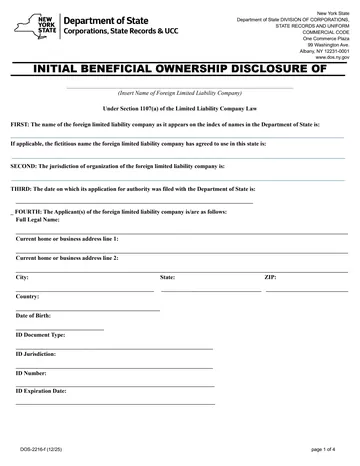
Only New York has a state beneficial owner filing law, and it is narrow. The Department of State: “Limited liability companies that were formed under the law of a foreign country and which are authorized to do business in New York are subject to the new beneficial ownership information disclosure requirements.” The rest are out: “Domestic limited liability companies and foreign limited liabilities formed in another state or U.S. territory, including companies formed in Puerto Rico, and authorized to do business in New York State, are exempt from reporting requirements.” The filings are confidential. A bill to widen the law, S8432, was “vetoed memo.164” on Dec. 19, 2025 (NY Senate). Elsewhere, the bills stalled. California's SB 1201 ended “From Assembly without further action” (Nov. 30, 2024). Maryland's SB 954 (2024) got no further than a Senate hearing; its last status reads “In the Senate - Hearing 3/06 at 1:00 p.m.” And Massachusetts H.501 “Accompanied a study order, see H5178” (Mar. 5, 2026). So there is no state owner register a KYB team can search. See NY LLC Transparency Act and state beneficial ownership laws; the form is on the planned NY DOS-2216-f page.
When a bank onboards an MSB
Banks that take MSB customers run their own CIP and CDD on them, and the FFIEC manual sets a floor on top: “Confirm FinCEN registration, if required. (Note: registration must be renewed every two years.)” “Confirm compliance with state or local licensing requirements, if applicable.” “Confirm agent status, if applicable.” (Non-Bank Financial Institutions, 2014). The reason: “Registration with FinCEN, if required, and compliance with any state-based licensing requirements represent the most basic of compliance obligations for MSBs.”
The manual also limits the bank's role: “The BSA does not require, and neither FinCEN nor the federal banking agencies expect, banks to serve as the de facto regulator of any type of NBFI industry or individual NBFI customer, including MSBs.” And “Unless indicated by the risk assessment of the MSB, banks are not expected to routinely review an MSB's BSA/AML program.” If a customer is unregistered or unlicensed, “a bank should file a SAR if it becomes aware that a customer is operating in violation of the registration or state licensing requirement”, but “There is no requirement in the BSA regulations for a bank to close an account that is the subject of a SAR.” The same manual notes that “Processors generally are not subject to BSA/AML regulatory requirements.” (Third-Party Payment Processors, 2014), which is why a bank looks at a processor's merchants instead. The bank side is on KYB for banks.
Forms, line by line
Questions compliance teams ask
Does an MSB have to collect beneficial owners of its business customers?
Not under the CDD rule, which covers banks, broker-dealers, futures firms and mutual funds (31 CFR 1010.230(f), 1010.605(e)(1))31 CFR 1010.230Code of Federal Regulations, eCFR31 CFR 1010.605Code of Federal Regulations, eCFR. An MSB's program must provide for verifying customer identification (31 CFR 1022.210(d)(1)(i)(A))31 CFR 1022.210Code of Federal Regulations, eCFR; owner checks are good practice, driven by OFAC's 50 percent rule.
How long does a new MSB have to register with FinCEN?
180 days after it is established, on FinCEN Form 107 in the BSA E-Filing System, then a renewal every two calendar years, filed by Dec. 31 of the year before the renewal period (31 CFR 1022.380(b)(3))31 CFR 1022.380Code of Federal Regulations, eCFR.
Do agents of a money transmitter register with FinCEN?
Not if they are MSBs only because they act as agents of another MSB; the principal keeps them on its agent list, revised each Jan. 1 (31 CFR 1022.380(a)(3) and (d))31 CFR 1022.380Code of Federal Regulations, eCFR. An agent that also offers MSB services on its own account registers.
How many states have enacted the MTMA?
CSBS: “To date, thirty-one states have enacted the law in full or in part.” (Nov. 17, 2026). Its own legislation list names 35 states with some MTMA-related enactment, and CSBS does not say which 31 it counts. For any one state, its statute governs.
What is the penalty for not registering an MSB?
The rule text says $5,000 for each violation, each day a separate violation (31 CFR 1022.380(e))31 CFR 1022.380Code of Federal Regulations, eCFR; the inflation-adjusted amount is $10,556 for penalties assessed on or after Jan. 17, 2025 (31 CFR 1010.821)31 CFR 1010.821Code of Federal Regulations, eCFR. Operating without registering can also be a crime.
When is the NY DFS Part 504 certification due?
By April 15 each year, covering the prior calendar year, filed through the DFS Portal; the support is kept for five years (3 NYCRR 504.4).
Sources
- 31 U.S.C. 5330; 26 U.S.C. 4475; 31 CFR part 1010 (1010.100(ff), 1010.230, 1010.821) and part 1022 (1022.210, 1022.320, 1022.380), as printed by eCFR on Nov. 6, 2026; FinCEN, 2025 penalty adjustment, 90 FR 562990 FR 5629Federal Register, govinfo
- FinCEN, MSB registration page, MSB Registrant Search Q&A, Am I an MSB?, RMSB (Form 107) filing instructions (July 2014) and filing information
- FFIEC BSA/AML manual, Non-Bank Financial Institutions and Third-Party Payment Processors (2014)
- CSBS, MTMA page (Nov. 17, 2026), MTMA legislation list (August 2026), 2026 State Legislative Highlights (Nov. 1, 2026), the model act and its FAQs
- New York, 3 NYCRR 504.2, 504.3, 504.4 and 504.6; DFS, Transaction Monitoring Certification page; Department of State, beneficial owner disclosure FAQs; NY Senate, S8432
- California SB 1201; Maryland SB 954 (2024); Massachusetts H.501; OFAC, FAQ 11 and FAQ 43