- What KYC means in the rules
- Who must do what, by institution
- Identify and verify: the CIP rules
- Business customers: the CDD owner rule
- The AML program and ongoing due diligence
- Higher risk and enhanced due diligence
- Sanctions: OFAC for every customer
- How long to keep KYC records
- What changed in 2025 and 2026
- Questions compliance teams ask
- Sources
FinCEN, CDD final rule, 81 FR 2939881 FR 29398Federal Register, govinfo (May 11, 2016); 31 CFR 1020.22031 CFR 1020.220Code of Federal Regulations, eCFR, 1010.230 and 1020.210.
What KYC means in the rules
Know your customer (KYC) is how the industry describes a financial institution's customer checks; the rules use other names. FinCEN's own outline comes from the CDD final rule, where FinCEN said that “FinCEN believes that there are four core elements of customer due diligence (CDD)”: “(1) Customer identification and verification, (2) beneficial ownership identification and verification, (3) understanding the nature and purpose of customer relationships to develop a customer risk profile, and (4) ongoing monitoring for reporting suspicious transactions and, on a risk-basis, maintaining and updating customer information.” (81 FR 2939881 FR 29398Federal Register, govinfo, May 11, 2016). Those four elements are what most people mean by KYC: identify the customer, identify the owners of a business customer, understand the relationship, and keep watching it. The terms on this page are defined, each from its rule, in our KYB and AML glossary.
Not every business has a KYC program, and not every financial institution has the same one. The IRS manual for BSA examiners puts it plainly: “Not all financial institutions are required to have a Know Your Customer (KYC) program.” (IRM 4.26.6). Which duties apply depends on the kind of institution, and the table below sorts them. This page is for the compliance teams that run these checks. If you are verifying your own identity for an app or an account, ask that app or company what it needs and why.
Who must do what, by institution
Three sets of rules make up KYC in US law. The CIP rules identify each customer. The CDD rule adds the beneficial owners of a business customer, and it binds only “covered financial institutions are federally regulated banks and federally insured credit unions, mutual funds, brokers or dealers in securities, futures commission merchants, and introducing brokers in commodities.” (CDD FAQs, A.5). The AML program rules, one per kind of institution, hold the rest, including the risk profile and monitoring. On top of all three sits OFAC, which binds every U.S. person.
31 CFR 1010.605(e)(1)31 CFR 1010.605Code of Federal Regulations, eCFR; the program rules listed in 91 FR 1870491 FR 18704Federal Register, govinfo; OFAC FAQ 11; 31 CFR 1010.430(d)31 CFR 1010.430Code of Federal Regulations, eCFR and 501.601.
| Institution | CIP rule | CDD owner rule | AML program rule |
|---|---|---|---|
| Banks, savings associations, credit unions | 31 CFR 1020.22031 CFR 1020.220Code of Federal Regulations, eCFR | Yes (31 CFR 1010.230)31 CFR 1010.230Code of Federal Regulations, eCFR | 31 CFR 1020.21031 CFR 1020.210Code of Federal Regulations, eCFR |
| Broker-dealers in securities | 31 CFR 1023.22031 CFR 1023.220Code of Federal Regulations, eCFR | Yes | 31 CFR 1023.21031 CFR 1023.210Code of Federal Regulations, eCFR |
| Mutual funds | 31 CFR 1024.22031 CFR 1024.220Code of Federal Regulations, eCFR | Yes | 31 CFR 1024.21031 CFR 1024.210Code of Federal Regulations, eCFR |
| Futures commission merchants and introducing brokers | 31 CFR 1026.22031 CFR 1026.220Code of Federal Regulations, eCFR | Yes | 31 CFR 1026.21031 CFR 1026.210Code of Federal Regulations, eCFR |
| Money services businesses | No CIP rule; the program must provide for “Verifying customer identification” | No: not a covered financial institution | 31 CFR 1022.21031 CFR 1022.210Code of Federal Regulations, eCFR |
| Casinos, insurance companies, dealers in precious metals, stones or jewels, card system operators, loan or finance companies, housing GSEs | Not listed | No: not covered financial institutions | 31 CFR 1021.21031 CFR 1021.210Code of Federal Regulations, eCFR, 1025.210, 1027.210, 1028.210, 1029.210, 1030.210 |
The program rules are listed in FinCEN's April 2026 proposal: “The AML program rules are located” in parts 1020 through 1030 of 31 CFR chapter X (91 FR 18704)91 FR 18704Federal Register, govinfo. "Not listed" means this site's sources give no CIP rule for that institution. Non-bank KYC, outside financial institutions entirely (marketplaces, AP teams, contractors), is on the KYB requirements hub.
Identify and verify: the CIP rules
A CIP is a written program for identifying each customer before opening an account. The bank rule sets the standard every CIP rule shares: “The procedures must enable the bank to form a reasonable belief that it knows the true identity of each customer.” (31 CFR 1020.220(a)(2))31 CFR 1020.220Code of Federal Regulations, eCFR. Before opening the account, the bank must obtain at least a name, a date of birth for an individual, an address and an identification number. For a person, the address is “a residential or business street address”; for a business, “a principal place of business, local office, or other physical location”. The number for a U.S. person is “a taxpayer identification number” (31 CFR 1020.220(a)(2)(i))31 CFR 1020.220Code of Federal Regulations, eCFR.
Verification can use documents or other methods, and the CIP must cover two more steps: checking whether the customer appears on a designated government list, and telling customers why the information is collected. The list step is empty for now; the FFIEC manual says “As of the publication date of this Manual, no designated government lists for CIP purposes exist.”, and OFAC screening is a separate duty (FFIEC manual, CIP, 2021). The CIP must also include “procedures for providing bank customers with adequate notice that the bank is requesting information to verify their identities.” (31 CFR 1020.220(a)(5))31 CFR 1020.220Code of Federal Regulations, eCFR.
Broker-dealers (31 CFR 1023.220)31 CFR 1023.220Code of Federal Regulations, eCFR, mutual funds (31 CFR 1024.220)31 CFR 1024.220Code of Federal Regulations, eCFR and futures firms (31 CFR 1026.220)31 CFR 1026.220Code of Federal Regulations, eCFR have parallel rules. The rule-by-rule detail, the 2025 TIN orders and the mobile driver's license FAQs are on the CIP page; business customers in particular are on the CIP for business customers page, and the documents a business may give, mapped to the rule that asks for each, on business verification documents.
Business customers: the CDD owner rule
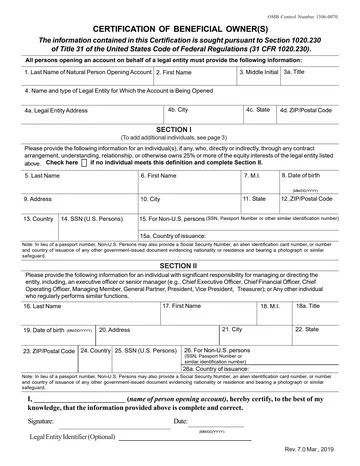
When the customer is a business, KYC reaches the people behind it. Covered financial institutions must identify and verify the beneficial owners of each legal entity customer: each individual who “owns 25 percent or more of the equity interests of a legal entity customer”, and “A single individual with significant responsibility to control, manage, or direct a legal entity customer” (31 CFR 1010.230(d))31 CFR 1010.230Code of Federal Regulations, eCFR. The customer certifies them, often on FinCEN's certification form (Appendix A, optional), and the institution verifies their identities with the CIP elements.
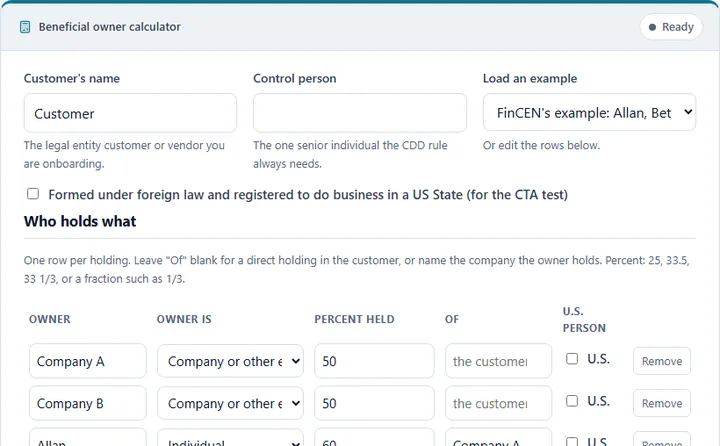
Since Feb. 13, 2026, covered institutions may identify and verify owners at the first account, not at every new account, under FIN-2026-R001. The full rule, its 16 excluded customer classes and the certification are on the CDD rule page, and the agency lookups that help show a customer is an excluded financial institution or listed company on verify a financial institution; the two prongs and indirect ownership on beneficial ownership (the industry term is explained on UBO meaning); and the 2026 changes on CDD rule changes 2026. The beneficial owner calculator runs FinCEN's indirect ownership method on any chain.
The AML program and ongoing due diligence
The program rule is where KYC continues after the account opens. For banks, the program must include, at a minimum, “A system of internal controls to assure ongoing compliance”, “Independent testing for compliance to be conducted by bank personnel or by an outside party”, a designated compliance individual, training, and the CDD element: “Understanding the nature and purpose of customer relationships for the purpose of developing a customer risk profile” and “Conducting ongoing monitoring to identify and report suspicious transactions and, on a risk basis, to maintain and update customer information.” (31 CFR 1020.210(a)(2))31 CFR 1020.210Code of Federal Regulations, eCFR.
The statute behind the program rules now speaks of risk directly: programs are to be “risk-based, including ensuring that more attention and resources of financial institutions should be directed toward higher-risk customers and activities” (31 U.S.C. 5318(h))31 U.S.C. 5318United States Code, Cornell LII. The risk profile need not be elaborate: “The profile may, but need not, include a system of risk ratings or categories of customers.” (CDD FAQs, F.1). Updating is driven by events, not a calendar: “There is no categorical requirement that financial institutions update customer information on a continuous or periodic schedule.” (CDD FAQs, F.6).
FinCEN proposed a new AML/CFT program rule on Apr. 10, 2026 (91 FR 18704)91 FR 18704Federal Register, govinfo. It is a proposal; comments closed June 9, 2026, and FinCEN proposed that a final rule take effect 12 months after it is issued. The program rules by institution are on the AML program rules page, and update triggers on the ongoing due diligence page.
Higher risk and enhanced due diligence
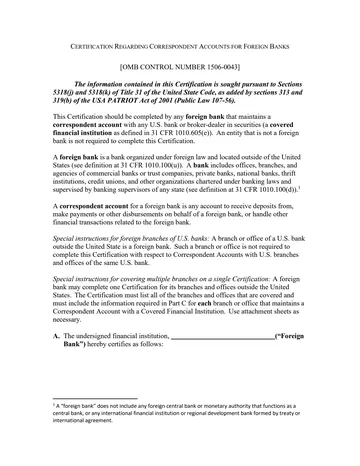
"Enhanced due diligence" is required by rule in two places only. For correspondent accounts for foreign financial institutions, a covered institution's program must include “appropriate, specific, risk-based, and, where necessary, enhanced policies, procedures, and controls” (31 CFR 1010.610(a))31 CFR 1010.610Code of Federal Regulations, eCFR, with enhanced steps for certain foreign banks in 1010.610(b). For private banking accounts of non-U.S. persons, it must “Ascertain the identity of all nominal and beneficial owners of a private banking account” and, for senior foreign political figures, apply “enhanced scrutiny of such account that is reasonably designed to detect and report transactions that may involve the proceeds of foreign corruption.” (31 CFR 1010.620)31 CFR 1010.620Code of Federal Regulations, eCFR.
Outside those two rules, extra diligence is risk-based, and no customer type is high risk by definition. The FFIEC manual: “Examiners are reminded that no specific customer type automatically presents a higher risk of ML/TF or other illicit financial activity.” (FFIEC manual, customers, 2021). On politically exposed persons: “The CDD rule does not require a bank to screen for or otherwise determine whether a customer or beneficial owner of a legal entity customer may be considered a PEP.” (FFIEC manual, PEPs, 2021). FinCEN agrees: “covered financial institutions are not required or expected to automatically categorize as ‘high risk’ products or customer types listed in government publications” (CDD FAQs, F.5). The EDD page goes further, correspondent account due diligence covers 1010.610 in full, and the politically exposed persons page covers PEPs.
Sanctions: OFAC for every customer
OFAC screening is part of KYC for every U.S. business, financial institution or not: “All U.S. persons must comply with OFAC sanctions” (OFAC FAQ 11). For banks, OFAC adds an ownership expectation: “OFAC expects banks to conduct due diligence on their own direct customers (including, for example, their ownership structure) to confirm that those customers are not persons whose property and interests in property are blocked.” (OFAC FAQ 116). FinCEN expects the owner data to be used the same way: institutions should use beneficial ownership information “including for compliance with OFAC-administered sanctions.” (CDD FAQs, G.1).
No software is required: “There is no legal or regulatory requirement to use software or to scan.” (OFAC FAQ 43). Search a name in OFAC's Sanctions List Search, and see the OFAC hub for screening, the 50 percent rule, blocking, rejecting and reports.
How long to keep KYC records
| Record | How long | Rule |
|---|---|---|
| CIP identifying information | “for five years after the date the account is closed” | 31 CFR 1020.220(a)(3)31 CFR 1020.220Code of Federal Regulations, eCFR(ii) |
| CIP verification records | “for five years after the record is made” | 31 CFR 1020.220(a)(3)31 CFR 1020.220Code of Federal Regulations, eCFR(ii) |
| CDD owner identification, including the certification | “for five years after the date the account is closed” | 31 CFR 1010.230(i)(2)31 CFR 1010.230Code of Federal Regulations, eCFR |
| Other BSA records | “shall be retained for a period of five years.” | 31 CFR 1010.430(d)31 CFR 1010.430Code of Federal Regulations, eCFR |
| OFAC transaction records | “available for examination for at least 10 years after the date of such transaction” | 31 CFR 501.60131 CFR 501.601Code of Federal Regulations, eCFR, since Mar. 12, 2025 |
The CTR, SAR and other reports that KYC feeds are on the Bank Secrecy Act hub.
What changed in 2025 and 2026
- Owners once, not at every account: FIN-2026-R001, Feb. 13, 2026, in force and optional.
- CDD revision proposed: 91 FR 7451491 FR 74514Federal Register, govinfo, Nov. 19, 2026, a proposal. “Comments must be received by January 19, 2027.”
- TINs from a third party: the CIP TIN order “permits a bank to use an alternative collection method to obtain TIN information from a third-party rather than from the customer” (June 27, 2025).
- Mobile driver's licenses: “an unexpired, government-issued VDC, such as an mDL, would qualify as a” government-issued identification under the CIP rule (FinCEN and the bank agencies, Sept. 2026).
- SARs: the Oct. 9, 2025 FAQs ended the separate continuing activity review.
The dated list is on KYB and AML changes for 2027.
Forms, line by line
Tools for this topic
Templates
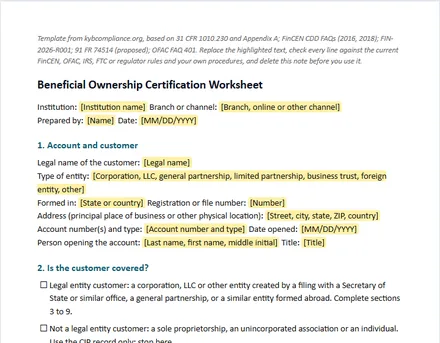
Certification worksheet
One file per legal entity customer: coverage, the 25 percent owners and control person, the certification, FIN-2026-R001 confirmations, verification, screening and retention dates.
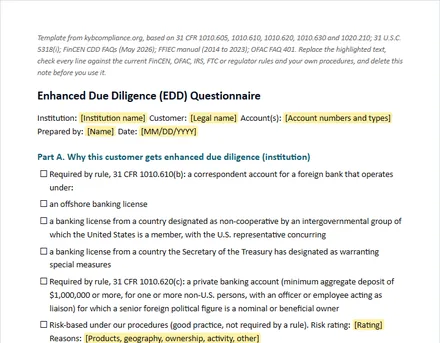
EDD questionnaire
Questions for a high-risk customer, part by part, each marked required by 31 CFR 1010.610(b)31 CFR 1010.610Code of Federal Regulations, eCFR or 1010.620(c), required due diligence, or good practice.
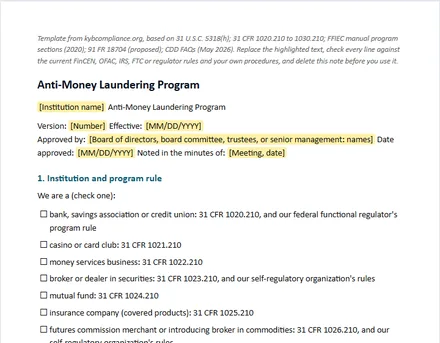
AML program policy
A written AML program outline from each program rule and the FFIEC's 2020 program sections: controls, officer, training, testing, CDD and the provisions each part adds.
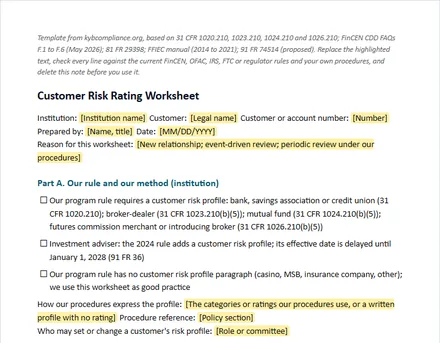
Customer risk rating worksheet
A customer risk profile worksheet built from the factors in the FFIEC manual and FinCEN's CDD FAQs, each part marked required or good practice, with no scoring method.
Questions compliance teams ask
What are the KYC requirements for a bank?
A customer identification program (31 CFR 1020.220)31 CFR 1020.220Code of Federal Regulations, eCFR, the CDD owner rule for legal entity customers (31 CFR 1010.230)31 CFR 1010.230Code of Federal Regulations, eCFR, an AML program with a customer risk profile and ongoing monitoring (31 CFR 1020.210)31 CFR 1020.210Code of Federal Regulations, eCFR, and OFAC compliance. Records are kept five years under the BSA rules and ten years under OFAC's.
Does a money services business need a CIP?
There is no CIP rule for MSBs in 31 CFR part 102231 CFR part 1022Code of Federal Regulations, eCFR. The MSB's AML program must provide for “Verifying customer identification” (31 CFR 1022.210(d))31 CFR 1022.210Code of Federal Regulations, eCFR, and the CDD owner rule does not apply to MSBs.
Is enhanced due diligence required by law?
Only in two rules: correspondent accounts for foreign financial institutions (31 CFR 1010.610)31 CFR 1010.610Code of Federal Regulations, eCFR and private banking accounts for non-U.S. persons (31 CFR 1010.620)31 CFR 1010.620Code of Federal Regulations, eCFR. Elsewhere it is risk-based, and FinCEN says institutions are not required to treat listed customer types as high risk automatically (CDD FAQs, F.5).
Must we screen customers for PEPs?
“The CDD rule does not require a bank to screen for or otherwise determine whether a customer or beneficial owner of a legal entity customer may be considered a PEP.” Private banking accounts for non-U.S. persons are the exception: there the bank must ask whether an owner is a senior foreign political figure (31 CFR 1010.620)31 CFR 1010.620Code of Federal Regulations, eCFR.
Is KYC the same as KYB?
KYC is the customer check; KYB is the same check when the customer is a business, plus its owners. See KYB vs KYC.
Do we have to use screening software for OFAC?
“There is no legal or regulatory requirement to use software or to scan.” (OFAC FAQ 43). What is required is not dealing with a blocked person and blocking property when the rules require it.
Sources
- 31 CFR part 1010 (1010.230, 1010.430, 1010.605), 1010.610, 1010.620; part 1020 (1020.210, 1020.220); part 1022; part 1023; part 1024; part 1026, as printed by eCFR on Nov. 6, 2026; 31 U.S.C. 5318
- FinCEN, CDD final rule, 81 FR 2939881 FR 29398Federal Register, govinfo (May 11, 2016); CDD Rule FAQs (May 6, 2026); FIN-2026-R001; proposed CDD rule, 91 FR 7451491 FR 74514Federal Register, govinfo; AML/CFT program proposal, 91 FR 1870491 FR 18704Federal Register, govinfo; CIP TIN order; mDL and VDC FAQs
- FFIEC BSA/AML Examination Manual: Customer Identification Program (2021), Risks: customers (2021), Politically Exposed Persons (2021)
- IRS, IRM 4.26.6; OFAC FAQs 11, 43 and 116; 31 CFR 501.601