- At a glance
- Revision, e-filing and where it goes
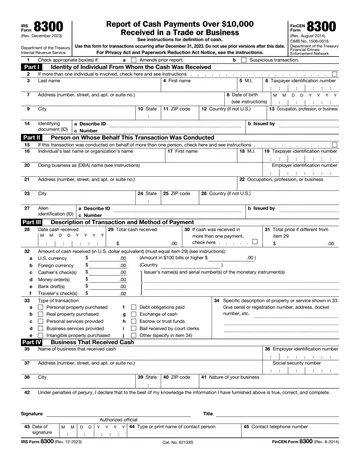
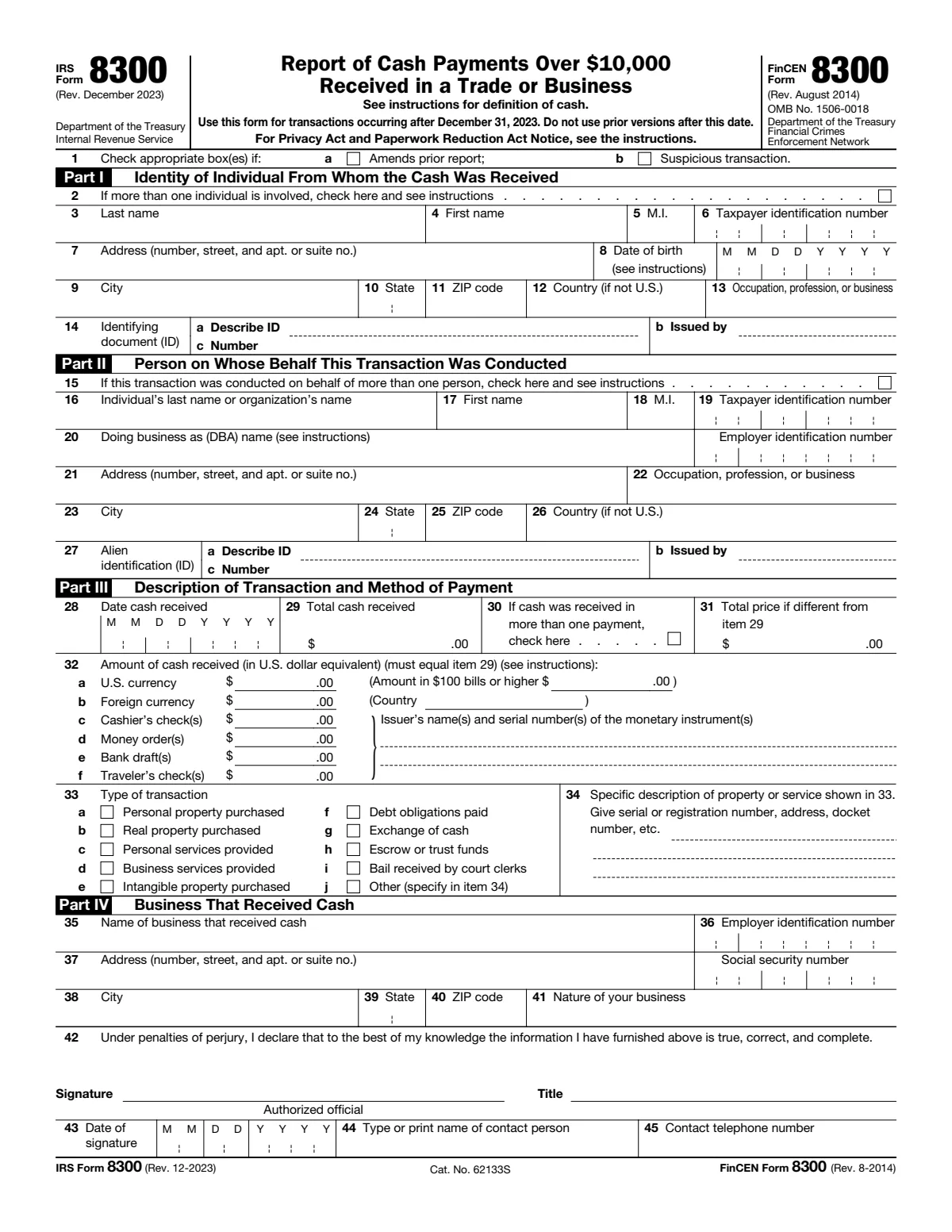
- The form, with hotspots
- Item 1: amended or suspicious
- Part I: the individual who paid
- Part II: the person it was paid for
- Part III: the transaction and the cash
- Part IV: your business and signature
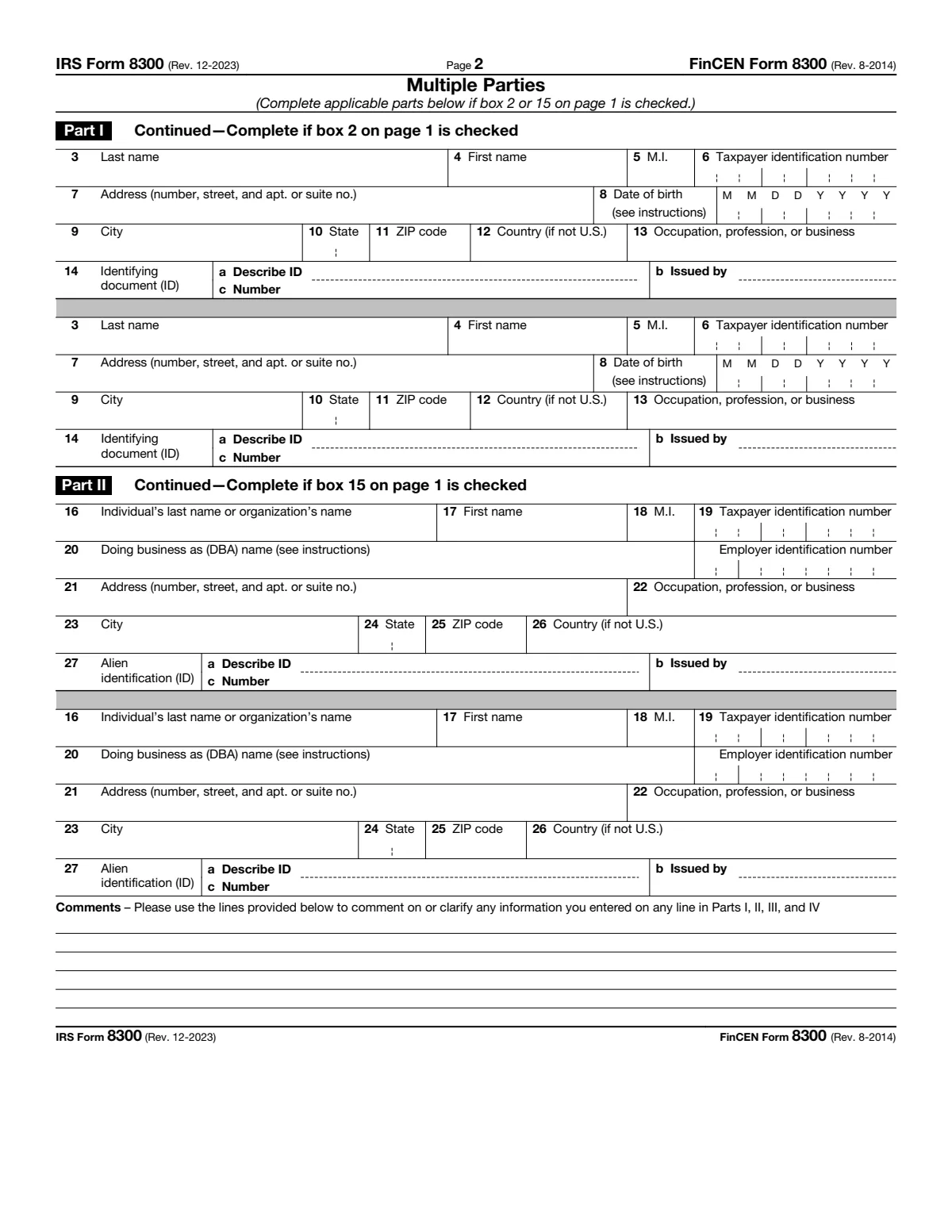
- Page 2: more parties and Comments
- What counts as cash
- Multiple payments, statements and records
- Rules that trip filers up
- How it connects
- Questions compliance teams ask
- Sources
- Who files
- A trade or business receiving over $10,000 in cash
- Due
- 15 days after the cash is received
- Filed with
- IRS and FinCEN (BSA E-Filing, or paper to the IRS)
- Form revision
- IRS Rev. 12-2023 / FinCEN Rev. 8-2014
- Pages
- 2
At a glance
Form 8300, Report of Cash Payments Over $10,000 Received in a Trade or Business, is one form filed under two laws: section 6050I of the Internal Revenue Code and 31 U.S.C. 533131 U.S.C. 5331United States Code, Cornell LII, the Bank Secrecy Act's rule for businesses. FinCEN's rule says the information “shall be reported on the same form as prescribed by the Secretary.” (31 CFR 1010.330(a)(1)(ii))31 CFR 1010.330Code of Federal Regulations, eCFR. Banks report their cash on CTRs instead, and so do casinos for gaming cash; this form is for other trades and businesses.
- Who files. “Each person engaged in a trade or business who, in the course of that trade or business, receives more than $10,000 in cash in one transaction or in two or more related transactions, must file Form 8300.”
- When. “File Form 8300 by the 15th day after the date the cash was received.” “If that date falls on a Saturday, Sunday, or legal holiday, file the form on the next business day.”
- How. Electronically through FinCEN's BSA E-Filing System when the business must e-file its other information returns; otherwise on paper to the IRS in Detroit, as the instructions give the address.
- Then. A written statement to each person named, by Jan. 31 of the next year, and a copy of the report kept five years.
- Form. Form 8300 (PDF) with its instructions (Rev. December 2023); the IRS About Form 8300 page lists “None at this time.” under recent developments as of Nov. 22, 2026.
Instructions for Form 8300 (Rev. December 2023); 31 CFR 1010.330(b)31 CFR 1010.330Code of Federal Regulations, eCFR and (e)(3).
Revision, e-filing and where it goes
The form carries two revision dates because two agencies issue it: “IRS Form 8300 (Rev. 12-2023)” and “FinCEN Form 8300 (Rev. 8-2014)”, under “OMB No. 1506-0018”. The top of page 1 says “Use this form for transactions occurring after December 31, 2023. Do not use prior versions after this date.”
E-filing. “Starting January 1, 2024, you must electronically file Forms 8300, Report of Cash Payments Over $10,000 Received in a Trade or Business, if you are required to file certain other information returns electronically”. The trigger is the business's other information returns: “You are required to file certain other information returns electronically if you are required to file, in aggregate, at least 10 information returns of one or more type, other than Form 8300, during the calendar year.” Five W-2s and five 1099-INTs make ten, so every Form 8300 that year is e-filed; Form 8300s themselves do not count toward the ten. A business under the threshold “may file Form 8300 in paper form without requesting a waiver”, and paper goes to “Internal Revenue Service, Detroit Federal Building, P.O. Box 32621, Detroit, Ml 48232.” A hardship waiver comes through Form 8508, and a waiver cannot be requested for Form 8300 alone; filers with a religious objection are exempt automatically and write RELIGIOUS EXEMPTION at the top of page 1.
Late returns are filed the same way as timely ones and marked: the word LATE in Comments when e-filed, or at the top of page 1 on paper. “If you are required to file electronically and fail to do so, the form is considered late.”
Tap a box once for its note, again to jump to the line. Zoom in to read the small print.
Item 1: amended or suspicious
The instructions' first rule: “You must complete all parts. However, you may skip Part II if the individual named in Part I is conducting the transaction on their own behalf.” Item 1 sits above Part I and is used only for corrections and for flagging suspicion.
| Line | Label | What goes there |
|---|---|---|
| 1a | Check appropriate box(es) if: a Amends prior report | “If you are amending a report, check box 1a, Amends prior report.” Complete every Part again (Parts I to IV) with the amended information, and “Do not attach a copy of the original report.” |
| 1b | b Suspicious transaction | “To voluntarily report a suspicious transaction (see Suspicious transaction above), check box 1b, Suspicious transaction.” “Describe in the Comments section what was suspicious about the transaction.” A suspicious transaction is one “in which it appears that a person is attempting to cause Form 8300 not to be filed, or to file a false or incomplete form, or in which the transaction(s) otherwise appears suspicious for any reason.” The customer's year-end statement must never say so (see below). |
Part I: the individual who paid
Part I identifies the person who handed over the cash, after checking an ID. The rule behind item 14: a business “must verify the identity of the person from whom the reportable currency is received.” (31 CFR 1010.330(e)(2))31 CFR 1010.330Code of Federal Regulations, eCFR.
| Line | Label | What goes there |
|---|---|---|
| 2 | If more than one individual is involved, check here and see instructions | “If two or more individuals conducted the transaction you are reporting, check the box and complete Part I on page 1 for any one of the individuals.” The others go in Part I on page 2. “If more than three individuals are involved, paper filers should complete and attach a copy of Part I for each additional individual and electronic filers may add additional Part I entries (up to 99).” |
| 3 | Last name | Part I is always an individual: the person who physically delivered the cash, even when the buyer is a company (the company goes in Part II). |
| 4 | First name | First name. |
| 5 | M.I. | Middle initial. |
| 6 | Taxpayer identification number | “Enter the TIN of the individual named.” “The TIN for an individual (including a sole proprietorship) is the individual’s SSN.” If you requested the TIN but cannot get it within 15 days after the transaction, “file the report and use the Comments section on page 2 of the form to explain why the TIN is not included.” Nonresident aliens and foreign organizations without U.S. income, offices or filing duties need not give one. |
| 7 | Address (number, street, and apt. or suite no.) | The individual's address. It must be verified against an ID document (item 14). |
| 8 | Date of birth (see instructions) | “Enter eight numerals for the date of birth of the individual named.” The example: July 6, 1960 is 07/06/1960. |
| 9 | City | City. |
| 10 | State | State. |
| 11 | ZIP code | ZIP code. |
| 12 | Country (if not U.S.) | Leave blank for a U.S. address. |
| 13 | Occupation, profession, or business | “Do not use general or nondescriptive terms such as ‘businessperson’ or ‘self-employed.’” A retired or unemployed person gets the former occupation, such as “‘retired attorney’ or ‘unemployed roofer.’” “For electronic filers, this item is limited to 25 characters.” |
| 14 | Identifying document (ID): a Describe ID, b Issued by, c Number | “You must verify the name and address of the named individual(s).” The document is one “normally accepted as a means of identification when cashing checks (for example, a driver’s license, passport, alien registration card, or other official document).” The example: a Utah driver's license is “‘driver’s license’ in item 14a, ‘Utah’ in item 14b”, and the license number in 14c. “You must complete all three items (a, b, and c) in this item to make sure that Form 8300 will be processed correctly.” The rule is 31 CFR 1010.330(e)(2)31 CFR 1010.330Code of Federal Regulations, eCFR, which requires a passport, alien identification card or similar document for an alien. |
Part II: the person it was paid for
Part II names the person or company on whose behalf the cash was paid. For a business customer, this is the KYB part of the form: the company's legal name, its EIN and any trade name. The IRS reference guide adds that the business “must also obtain the TIN of a person or person(s)” when the transaction is conducted for someone else.
| Line | Label | What goes there |
|---|---|---|
| 15 | If this transaction was conducted on behalf of more than one person, check here and see instructions | Check the box and “complete Part II for any one of the persons.” The instructions count parent and child or siblings as more than one person. Part II may be skipped altogether “if the individual named in Part I is conducting the transaction on their own behalf.” |
| 16 | Individual’s last name or organization’s name | “If the person is an organization, put its name as shown on required tax filings in item 16 and its EIN in item 19.” For a business customer this is where the company goes; the employee or agent who brought the cash is in Part I. A report that omits the principal when the business knows an agent is acting is incomplete (31 CFR 1010.330(e)(2))31 CFR 1010.330Code of Federal Regulations, eCFR. |
| 17 | First name | Blank for an organization. |
| 18 | M.I. | Blank for an organization. |
| 19 | Taxpayer identification number; Employer identification number | “If the individual is a sole proprietor and has an EIN, you must enter both the SSN and EIN in item 19.” For TIN rules and EIN checks, tincompliance.com covers TINs and W-9s. |
| 20 | Doing business as (DBA) name (see instructions) | “If a sole proprietor or organization named in items 16 through 18 is doing business under a name other than that entered in item 16 (for example, a ‘trade’ or ‘doing business as (DBA)’ name), enter it here.” |
| 21 | Address (number, street, and apt. or suite no.) | Address of the person in item 16. |
| 22 | Occupation, profession, or business | Describe it as specifically as item 13 (the instructions give the rule there). |
| 23 | City | City. |
| 24 | State | State. |
| 25 | ZIP code | ZIP code. |
| 26 | Country (if not U.S.) | Leave blank for a U.S. address. |
| 27 | Alien identification (ID): a Describe ID, b Issued by, c Number | “If the person is not required to furnish a TIN, complete this item.” Item 27a is the type of document (for example, a passport), 27b the issuing country and 27c the number. As with item 14, all three are required. |
Part III: the transaction and the cash
Part III records when, how much, in what form and for what. The total in item 29 and the breakdown in item 32 must agree.
Instructions for Form 8300 (Rev. December 2023), Definitions; 31 CFR 1010.330(c)31 CFR 1010.330Code of Federal Regulations, eCFR.
| Line | Label | What goes there |
|---|---|---|
| 28 | Date cash received | “If you received the cash in more than one payment, enter the date you received the payment that caused the combined amount to exceed $10,000.” This date starts the 15-day filing clock. |
| 29 | Total cash received | “Enter the total cash received as of the date that cash amount exceeded $10,000 within a 12-month period.” After a report, further related payments are reported again each time they add more than $10,000 within a new 12-month period. |
| 30 | If cash was received in more than one payment, check here | Check it when the amount in item 29 came in more than one payment, such as installments or payments on related transactions. “Check this box if the amount shown in item 29 was received in more than one payment” |
| 31 | Total price if different from item 29 | “Enter the total price of the property, services, amount of cash exchanged, etc.” For example, the full price of a car bought partly with cash. |
| 32 | Amount of cash received (in U.S. dollar equivalent) (must equal item 29) (see instructions) | “Enter the dollar amount of each form of cash received.” “The sum of the amounts must equal item 29.” |
| 32a | U.S. currency (Amount in $100 bills or higher) | U.S. currency, with the amount in $100 bills or larger on the same line. |
| 32b | Foreign currency (Country) | “Show foreign currency amounts in U.S. dollar equivalent at a fair market rate of exchange available to the public.” |
| 32c | Cashier’s check(s) | A cashier's check, money order, bank draft or traveler's check counts as cash only when its face amount is $10,000 or less and it is received in a designated reporting transaction, or when the business knows it is used to avoid reporting (definition of cash, below). |
| 32d | Money order(s) | Same test as 32c. |
| 32e | Bank draft(s) | Same test as 32c. |
| 32f | Traveler’s check(s) | Same test as 32c. |
| 32-issuer | Issuer’s name(s) and serial number(s) of the monetary instrument(s) | “Names of all issuers and all serial numbers involved must be provided.” “If necessary, provide this information in the Comments section on page 2 of the form.” |
| 33 | Type of transaction: a Personal property purchased to j Other (specify in item 34) | “Select up to three types of transactions and if more are required, select ‘other’ and add details in the Comments section.” If none fits, check j and describe it, “(for example, ‘car lease,’ ‘boat lease,’ ‘house lease,’ or ‘aircraft rental’).” “This box is only for use by court clerks.” (box i); bail bondsmen check d, Business services provided. |
| 34 | Specific description of property or service shown in 33. Give serial or registration number, address, docket number, etc. | For example, a vehicle's serial or registration number, a property address, or a court docket number for bail. This is item 34, not the Comments section (see the reference guide slip below). |
Part IV: your business and signature
Part IV is the filer. The signer must be authorized by the business, and the contact person in items 44 and 45 is who the IRS or FinCEN will call.
| Line | Label | What goes there |
|---|---|---|
| 35 | Name of business that received cash | Your business. A member of a consolidated group gives “information specific to that member corporation must be provided in Part IV, items 35 through 41, rather than information about the common parent.” The parent's name and EIN go in Comments. |
| 36 | Employer identification number; Social security number | “If you are a sole proprietorship, you must enter your SSN. If your business also has an EIN, you must provide the EIN as well. All other business entities must enter an EIN.” |
| 37 | Address (number, street, and apt. or suite no.) | The business's address. |
| 38 | City | City. |
| 39 | State | State. |
| 40 | ZIP code | ZIP code. |
| 41 | Nature of your business | “Clearly describe the nature of your business, for example, ‘attorney’ or ‘jewelry dealer.’ Do not use general or nondescriptive terms such as ‘business’ or ‘store.’” |
| 42 | Under penalties of perjury, I declare that to the best of my knowledge the information I have furnished above is true, correct, and complete. Signature, Title | “This form must be signed by an individual who has been authorized to do so for the business that received the cash.” |
| 43 | Date of signature | The signing date. |
| 44 | Type or print name of contact person | A contact for questions. The same contact's name and telephone number go on the customer's year-end statement. |
| 45 | Contact telephone number | Telephone number for item 44. |
Page 2: more parties and Comments
Page 2 is used only “(Complete applicable parts below if box 2 or 15 on page 1 is checked.)” It holds two more individuals for Part I and two more persons for Part II; e-filers may add entries up to 99 of each. The Comments lines at the bottom are used on almost every report that needs an explanation.
| Line | Label | What goes there |
|---|---|---|
| I2-3 | Part I continued, second individual: 3 Last name, 4 First name, 5 M.I., 6 Taxpayer identification number, 7 Address, 8 Date of birth | Same rules as items 3 to 8 on page 1. |
| I2-9 | 9 City, 10 State, 11 ZIP code, 12 Country (if not U.S.), 13 Occupation, profession, or business | Same rules as items 9 to 13. |
| I2-14 | 14 Identifying document (ID) | Same rules as item 14: all three parts. |
| I3-3 | Part I continued, third individual: 3 Last name, 4 First name, 5 M.I., 6 Taxpayer identification number, 7 Address, 8 Date of birth | Same rules as items 3 to 8 on page 1. |
| I3-9 | 9 City, 10 State, 11 ZIP code, 12 Country (if not U.S.), 13 Occupation, profession, or business | Same rules as items 9 to 13. |
| I3-14 | 14 Identifying document (ID) | Same rules as item 14: all three parts. |
| II2-16 | Part II continued, second person: 16 to 19 name and TIN, 20 DBA name and Employer identification number | Same rules as items 16 to 20 on page 1. |
| II2-21 | 21 Address, 22 Occupation, profession, or business, 23 City, 24 State, 25 ZIP code, 26 Country (if not U.S.) | Same rules as items 21 to 26. |
| II2-27 | 27 Alien identification (ID) | Same rules as item 27. |
| II3-16 | Part II continued, third person: 16 to 19 name and TIN, 20 DBA name and Employer identification number | Same rules as items 16 to 20 on page 1. |
| II3-21 | 21 Address, 22 Occupation, profession, or business, 23 City, 24 State, 25 ZIP code, 26 Country (if not U.S.) | Same rules as items 21 to 26. |
| II3-27 | 27 Alien identification (ID) | Same rules as item 27. |
| Comments | Comments: Please use the lines provided below to comment on or clarify any information you entered on any line in Parts I, II, III, and IV | The place for what the lines cannot hold. The instructions send several entries here: why a TIN is missing; what was suspicious about a 1b report; the word “‘LATE’” on a late electronic filing; “‘RELATED PARTY TRANSACTION’” when the filer is related to a party; a consolidated group's parent name and EIN; overflow issuer names and serial numbers. “Comments section is limited to 720 characters.” |
What counts as cash
Cash is wider than bills and coins, and narrower than every payment. The instructions define it as “U.S. and foreign coin and currency received in any transaction”, or a cashier's check, money order, bank draft or traveler's check “having a face amount of $10,000 or less that is received in a designated reporting transaction”, or one the recipient knows is being used to avoid reporting. A designated reporting transaction is “A retail sale (or the receipt of funds by a broker or other intermediary in connection with a retail sale) of a consumer durable, a collectible, or a travel or entertainment activity.” And: “Cash does not include a check drawn on the payer’s own account, such as a personal check, regardless of the amount.”
FinCEN's rule gives the same test with worked examples (31 CFR 1010.330(c))31 CFR 1010.330Code of Federal Regulations, eCFR. In one, a coin dealer takes $6,200 in currency and a $7,000 cashier's check for gold coins; the sale is a designated reporting transaction, so the check counts and the dealer reports. In another, a boat dealer takes a single $16,500 cashier's check; it does not count, because its face amount is over $10,000. A cashier's check that is the proceeds of a bank loan, or a payment on certain installment or down payment plans, is also not cash (Publication 1544 has the detail).
Some receipts are outside the form: cash received “By a financial institution required to file FinCEN Currency Transaction Report (FinCEN Report 112)”, a casino's gaming cash, a transaction entirely outside the United States, and one “that is not in the course of a person’s trade or business.” Casinos still file Form 8300 for restaurants, shops and other nongaming business. The bank side is on our currency transaction report page, and the two reports are compared on Form 8300 vs CTR.
Multiple payments, statements and records
Related and multiple payments. “Any transactions conducted between a payer (or its agent) and the recipient in a 24-hour period are related transactions.” Longer gaps still count when the business knows or has reason to know the payments are connected. For installments, the rule is: “you must report the multiple payments any time you receive a total amount of cash that exceeds $10,000 within any 12-month period.” “Submit the report within 15 days of the date you receive the payment that causes the total amount of cash to exceed $10,000.” FinCEN's example: $11,000 on January 10 is reported by January 25; later payments of $4,000, $6,000 and $12,000 total $22,000 and are reported by May 30, within 15 days of the May 15 payment (31 CFR 1010.330(b)(4))31 CFR 1010.330Code of Federal Regulations, eCFR.
The customer statement. “You must give a written or electronic statement to each person named on a required Form 8300 on or before January 31 of the year following the calendar year in which the cash is received.” It shows the business's contact name, phone and address, the aggregate reportable cash, and that the information was furnished to the IRS. Two limits: no statement goes out for a voluntary suspicious filing, and a required statement “must not indicate if the filer noted the transaction was suspicious.” tincompliance.com has a ready Form 8300 annual customer statement template.
Records. “Persons must keep a copy of each Form 8300 for 5 years from the date filed.” An e-filing confirmation is not enough: “A confirmation that the Form 8300 has been filed is not a substitute for the form.” FinCEN's rule says the same: a copy of each report “for five years from the date of filing” (31 CFR 1010.330(e)(3))31 CFR 1010.330Code of Federal Regulations, eCFR.
Rules that trip filers up
- Splitting a payment to stay under $10,000. “A single transaction may not be broken into multiple transactions to avoid reporting.” Structuring, or helping a customer do it, carries its own penalties and can be criminal. See structuring.
- Vague occupations. "Self-employed", "business" and "store" are refused terms in items 13, 22 and 41.
- Partial ID entries. Items 14 and 27 need all three parts, without formatting or special characters in the number.
- Putting the refused-TIN note in item 34. The IRS reference guide tells e-filers that when a customer refuses a TIN, the business will “If business files Forms 8300 electronically, business will leave item 6 blank and notate in the Comments Section (item 34)”. On the form, item 34 is the “Specific description of property or service shown in 33.”, and Comments is a separate section on page 2. The instructions govern: they say to “use the Comments section on page 2 of the form to explain why the TIN is not included.” Write the note in Comments.
- Sending a copy of the form as the statement. Not prohibited, but not advisable, because it shows the filer's EIN or SSN; and never for a report marked suspicious.
- Treating a late paper filing as on time. A business that must e-file and files on paper has filed late.
- Penalties. “A minimum penalty of $25,000 may be imposed if the failure is due to an intentional or willful disregard of the cash reporting requirements.” Criminal cases can bring “imprisonment of up to 5 years or fines of up to $250,000 for individuals and $500,000 for corporations or both.” tincompliance.com's Form 8300 penalty calculator works through the civil amounts.
How it connects
- The business owner's guide, with industries, examples and IRS exam practice, is on tincompliance.com: Form 8300 for businesses that take cash. This page stays with the form itself.
- Cash reporting by banks and the comparison: currency transaction report and Form 8300 vs CTR. Suspicious activity reports for institutions that file them: suspicious activity report.
- The Bank Secrecy Act's reports in one place: Bank Secrecy Act. Another form page: the CDD certification form.
Questions compliance teams ask
Is Form 8300 filed with the IRS or with FinCEN?
Both, on one form. Section 6050I requires the report to the IRS and 31 U.S.C. 533131 U.S.C. 5331United States Code, Cornell LII to FinCEN, and FinCEN's rule says the information is reported on the same form. E-filers file through FinCEN's BSA E-Filing System; paper filers mail it to the IRS in Detroit.
Does a cashier's check count as cash?
Only if its face amount is $10,000 or less and it was received in a designated reporting transaction (a retail sale of a consumer durable, a collectible, or travel or entertainment), or if you know it is being used to avoid reporting. A cashier's check over $10,000, and any personal check, is not cash for Form 8300.
The customer will not give a TIN. Do we still file?
Yes. File by the deadline and explain in the Comments section why the TIN is missing. Document your requests; the instructions warn of penalties for an incorrect or missing TIN, and reasonable cause can apply.
Must we e-file?
Yes, if the business must file at least 10 other information returns (W-2s, 1099s and others, not counting Forms 8300) in the calendar year. Below that, paper is allowed without a waiver, and e-filing is still encouraged.
Do we tell the customer we filed?
Yes, for a required report: a written or electronic statement by Jan. 31 of the following year, showing your contact, the total reportable cash and that the information went to the IRS. Never for a voluntary suspicious filing, and the statement must not say a report was marked suspicious.
Can we file a Form 8300 for $8,000?
Yes, voluntarily, if the transaction is suspicious: check box 1b and explain in Comments. No customer statement is sent for a voluntary filing.
Sources
- IRS and FinCEN, Form 8300 (Rev. December 2023) and Instructions for Form 8300 (Rev. December 2023); IRS, About Form 8300 and IRS Form 8300 reference guide
- 31 CFR part 1010, section 1010.330, as printed by eCFR on Nov. 6, 2026
- FinCEN, filing information page, and the BSA E-Filing System