- The short answer
- Every check by reader
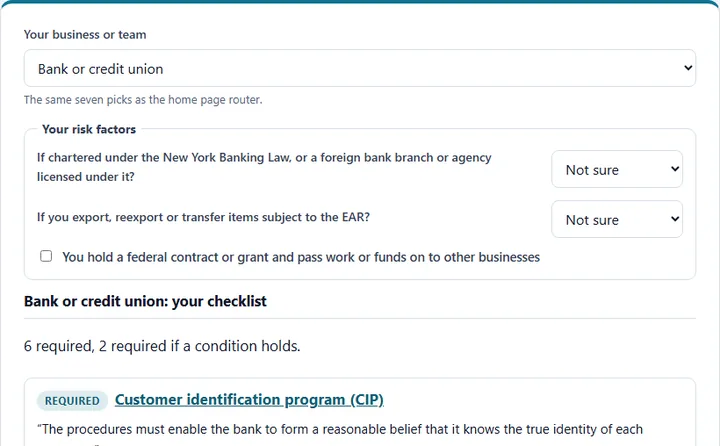
- Banks and credit unions
- MSBs, payment companies and fintechs
- Broker-dealers, mutual funds and futures firms
- Online marketplaces
- AP and vendor onboarding teams
- Federal contractors and grant recipients
- Businesses that take cash
- What binds every U.S. business: OFAC
- Good practice, not required
- What KYB cannot rely on: BOI
- What is changing
- Questions compliance teams ask
- Sources
Counted from the checks by reader on this page; each check is quoted from its rule on the KYB checklist and the home page router.
The short answer
Know your business (KYB) is not a defined term in US law. The checks a KYB program runs come from separate rules, and each one binds a defined group of businesses. A bank checks a business customer because the customer identification program (CIP) rule and the customer due diligence (CDD) rule require it. An online marketplace checks a high-volume seller because the INFORM Consumers Act requires it. An accounts payable team asks a vendor for a W-9 because the backup withholding rules require it. Every U.S. business screens for sanctions because OFAC's rules bind every U.S. person: “All U.S. persons must comply with OFAC sanctions” (OFAC FAQ 11).
So the useful question is never "what does KYB require?" but "which rule reaches us, and what does it say?" This page answers that for seven kinds of business or team, the same seven the home page's checks by business type uses. Each check carries one of three labels: required (a rule requires it of you), required if (only when a condition holds), or good practice, not required (no rule requires it of you, but it helps, with the reason and any limit quoted). What KYB means in practice, layer by layer, is on what is KYB, and the person-versus-business comparison is on KYB vs KYC.
31 CFR 1010.605(e)(1)31 CFR 1010.605Code of Federal Regulations, eCFR, 1020.220, 1022.210, 1022.380; OFAC FAQ 11; 15 U.S.C. 45f15 U.S.C. 45fUnited States Code, Cornell LII; FAR 9.405-2(b)FAR 9.405-2Federal Acquisition Regulation, acquisition.gov; 31 CFR 1010.33031 CFR 1010.330Code of Federal Regulations, eCFR.
Every check by reader
The table sets every check this site tracks against the seven readers. A dot means no rule in this site's sources requires that check of that reader. Read across a row to see who a check binds, or down a column to see your own list. The rows are the same data the home page router and the KYB checklist builder run, so the three always agree; the KYB checklist prints each check with the words of its rule.
Two patterns stand out. OFAC is the only rule that requires something of all seven readers: screening, and reports of blocked property and rejected transactions within 10 business days. The BIS Entity List can reach any of them, but only a reader that exports. And the owner rules split cleanly: covered financial institutions must collect beneficial owners under the CDD rule, while everyone else collects owners, if at all, as sanctions due diligence that OFAC urges but no rule requires.
Banks and credit unions
A bank's KYB duties are the fullest, because the BSA rules were written for banks first. The CIP rule sets the standard for identifying the business itself: “The procedures must enable the bank to form a reasonable belief that it knows the true identity of each customer.” (31 CFR 1020.220(a)(2))31 CFR 1020.220Code of Federal Regulations, eCFR. The CDD rule adds the people behind it: banks and the other covered institutions “are required to establish and maintain written procedures that are reasonably designed to identify and verify beneficial owners of legal entity customers” (31 CFR 1010.230(a))31 CFR 1010.230Code of Federal Regulations, eCFR. Since Feb. 13, 2026 they may do that once, at the first account, rather than at every new account (FIN-2026-R001).
OFAC expects more of banks than of other businesses on ownership: “OFAC expects banks to conduct due diligence on their own direct customers (including, for example, their ownership structure) to confirm that those customers are not persons whose property and interests in property are blocked.” (OFAC FAQ 116). And once the account is open, the bank reports cash over $10,000 on a CTR and suspicious activity on a SAR. The checks, read from this site's data:
- Customer identification program (CIP): Required. Rule: 31 CFR 1020.22031 CFR 1020.220Code of Federal Regulations, eCFR.
- CDD rule: beneficial owners of legal entity customers: Required. Rule: 31 CFR 1010.230(a)31 CFR 1010.230Code of Federal Regulations, eCFR.
- OFAC sanctions screening: Required. Rule: OFAC FAQ 116.
- OFAC reject and block reports in 10 business days: Required. Rule: 31 CFR 501.604(a)(1)31 CFR 501.604Code of Federal Regulations, eCFR.
- Currency transaction report (CTR): Required. Rule: 31 CFR 1010.31131 CFR 1010.311Code of Federal Regulations, eCFR.
- Suspicious activity report (SAR): Required. Rule: 31 CFR 1020.32031 CFR 1020.320Code of Federal Regulations, eCFR.
- NY DFS Part 504 monitoring and filtering: Required if: chartered under the New York Banking Law, or a foreign bank branch or agency licensed under it. Rule: 3 NYCRR 504.2(b).
- BIS Entity List and the Consolidated Screening List: Required if: you export, reexport or transfer items subject to the EAR. Rule: 15 CFR 744.11(a)15 CFR 744.11Code of Federal Regulations, eCFR.
Detail: the CIP rules, the CDD rule, beneficial ownership, CTRs, SARs and the KYB for banks and credit unions guide; for particular customers, cannabis businesses, third-party payment processors, casinos and politically exposed persons; for financial institutions as customers, verify a financial institution and correspondent account due diligence; and the business verification documents each rule asks for.
MSBs, payment companies and fintechs
A money services business has no CIP rule and is not a covered financial institution under the CDD rule (31 CFR 1010.605(e)(1))31 CFR 1010.605Code of Federal Regulations, eCFR. Its KYB duties come from three other places. First, registration: “each money services business (whether or not licensed as a money services business by any State) must register with FinCEN” (31 CFR 1022.380(a))31 CFR 1022.380Code of Federal Regulations, eCFR. A bank or partner onboarding an MSB can check that registration in FinCEN's MSB Registrant Search. Second, the MSB's own AML program must provide for “Verifying customer identification” (31 CFR 1022.210(d))31 CFR 1022.210Code of Federal Regulations, eCFR. Third, OFAC, as for every U.S. person.
Owners are the gap. No rule requires an MSB to collect a business customer's beneficial owners, but OFAC “urges persons considering a potential transaction to conduct appropriate due diligence on entities that are party to or involved with the transaction or with which account relationships are maintained in order to determine relevant ownership stakes” (OFAC FAQ 401). That makes owner collection good practice for an MSB, not a CDD requirement. State licensing adds its own layer where a state licenses money transmission.
- MSB registration with FinCEN: Required. Rule: 31 CFR 1022.380(a)31 CFR 1022.380Code of Federal Regulations, eCFR.
- Customer identity checks in the AML program: Required. Rule: 31 CFR 1022.210(d)(1)(i)(A)31 CFR 1022.210Code of Federal Regulations, eCFR.
- Ownership due diligence (beneficial owners): Good practice, not required. Rule: OFAC FAQ 401 (the CDD rule covers banks, broker-dealers, FCMs, introducing brokers and mutual funds: 31 CFR 1010.230(f)31 CFR 1010.230Code of Federal Regulations, eCFR, 1010.605(e)(1)).
- OFAC sanctions screening: Required. Rule: OFAC FAQ 11.
- OFAC reject and block reports in 10 business days: Required. Rule: 31 CFR 501.604(a)(1)31 CFR 501.604Code of Federal Regulations, eCFR.
- Currency transaction report (CTR): Required. Rule: 31 CFR 1010.31131 CFR 1010.311Code of Federal Regulations, eCFR.
- Suspicious activity report (SAR): Required if: the MSB is a dealer in foreign exchange, an issuer or seller of traveler's checks or money orders, a provider or seller of prepaid access, a money transmitter or the U.S. Postal Service (not a business that is only a check casher). Rule: 31 CFR 1022.320(a)(1)31 CFR 1022.320Code of Federal Regulations, eCFR.
- State money transmitter licensing (MTMA): Required if: where a state licenses money transmission. Rule: CSBS, Nov. 17, 2026.
- NY DFS Part 504 monitoring and filtering: Required if: licensed by New York as a money transmitter or check casher. Rule: 3 NYCRR 504.2.
- BIS Entity List and the Consolidated Screening List: Required if: you export, reexport or transfer items subject to the EAR. Rule: 15 CFR 744.11(a)15 CFR 744.11Code of Federal Regulations, eCFR.
Detail: the KYB for MSBs and fintechs, MSB registration, MSB Registrant Search, prepaid access, crypto KYC, the MTMA and NY DFS Part 504 pages.
Broker-dealers, mutual funds and futures firms
These firms carry the bank set under their own parts of 31 CFR chapter X. The broker-dealer CIP rule uses the bank's words: “The procedures must enable the broker-dealer to form a reasonable belief that it knows the true identity of each customer.” (31 CFR 1023.220)31 CFR 1023.220Code of Federal Regulations, eCFR. Mutual funds (31 CFR 1024.220)31 CFR 1024.220Code of Federal Regulations, eCFR and futures commission merchants and introducing brokers (31 CFR 1026.220)31 CFR 1026.220Code of Federal Regulations, eCFR have parallel CIP rules, and all of them are covered financial institutions under the CDD rule (31 CFR 1010.605(e)(1))31 CFR 1010.605Code of Federal Regulations, eCFR.
- Customer identification program (CIP): Required. Rule: 31 CFR 1023.22031 CFR 1023.220Code of Federal Regulations, eCFR (broker-dealers; 1024.220 and 1026.220 for funds and FCMs).
- CDD rule: beneficial owners of legal entity customers: Required. Rule: 31 CFR 1010.230(a)31 CFR 1010.230Code of Federal Regulations, eCFR.
- OFAC sanctions screening: Required. Rule: OFAC FAQ 11.
- OFAC reject and block reports in 10 business days: Required. Rule: 31 CFR 501.604(a)(1)31 CFR 501.604Code of Federal Regulations, eCFR.
- Currency transaction report (CTR): Required. Rule: 31 CFR 1010.31131 CFR 1010.311Code of Federal Regulations, eCFR.
- Suspicious activity report (SAR): Required. Rule: 31 CFR 1023.32031 CFR 1023.320Code of Federal Regulations, eCFR.
- BIS Entity List and the Consolidated Screening List: Required if: you export, reexport or transfer items subject to the EAR. Rule: 15 CFR 744.11(a)15 CFR 744.11Code of Federal Regulations, eCFR.
Detail: the KYB for broker-dealers and funds guide, and the CDD rule for pooled vehicles and other customers on the control prong only. Insurance companies have their own, narrower program rule: see insurance company AML. Investment advisers have a FinCEN AML rule that is not yet in force: see the investment adviser AML rule.
Online marketplaces
An online marketplace's KYB rule is the INFORM Consumers Act. It requires the marketplace to collect bank, contact and tax identification information from each high-volume third party seller “not later than 10 days after qualifying as a high-volume third party seller on the platform”, and to verify it (15 U.S.C. 45f(a)15 U.S.C. 45fUnited States Code, Cornell LII). A marketplace that pays its sellers as a third party settlement organization also files Form 1099-K when a seller's payments pass both thresholds; the count test is that “the aggregate number of such transactions exceeds 200.” (26 U.S.C. 6050W(e))26 U.S.C. 6050WUnited States Code, Cornell LII.
The IRS points platforms to its TIN Matching Program for payee TINs: “Verification of payee TINs is done through the Taxpayer Identification Number (TIN) Matching Program.” That helps the information return. It does not decide the onboarding: “A payor may not take into account any such matching details in determining whether to open or close an account with a payee.” (26 CFR 31.3406(j)-1(c)). OFAC applies too, including reports of rejected transactions, which cover “sales or purchases of goods or services” (31 CFR 501.604(a)(3))31 CFR 501.604Code of Federal Regulations, eCFR.
- INFORM high-volume seller verification: Required. Rule: 15 U.S.C. 45f(a)(1)(A)15 U.S.C. 45fUnited States Code, Cornell LII.
- Form 1099-K for platform payments: Required if: the marketplace is the third party settlement organization that pays sellers. Rule: 26 U.S.C. 6050W(e)26 U.S.C. 6050WUnited States Code, Cornell LII.
- Form W-9 (payee TIN) and backup withholding: Required if: the marketplace is the third party settlement organization that pays sellers. Rule: Form W-9 (Rev. March 2024), exempt payee code.
- IRS TIN Matching (not for account opening): Good practice, not required. Rule: IRS Form 1099-K FAQs; 26 CFR 31.3406(j)-1(c).
- OFAC sanctions screening: Required. Rule: OFAC FAQ 11.
- OFAC reject and block reports in 10 business days: Required. Rule: 31 CFR 501.604(a)(3)31 CFR 501.604Code of Federal Regulations, eCFR.
- BIS Entity List and the Consolidated Screening List: Required if: you export, reexport or transfer items subject to the EAR. Rule: 15 CFR 744.11(a)15 CFR 744.11Code of Federal Regulations, eCFR.
Detail: the KYB for marketplaces, INFORM and Form 1099-K for platforms pages, and TIN Matching in KYB.
AP and vendor onboarding teams
An AP team's core KYB rule is a tax rule. A payer that files information returns gets the vendor's taxpayer identification number on Form W-9, and backup withholding applies when “the payee fails to furnish his TIN to the payor in the manner required” (26 U.S.C. 3406(a)(1)(A))26 U.S.C. 3406United States Code, Cornell LII. How to collect and read a W-9 is on tincompliance.com's W-9 guide, and the IRS's TIN Matching steps on its TIN Matching guide.
TIN Matching is good practice for an AP team, for one purpose: getting the name and TIN right on the information return. The regulation forbids using it for the vendor decision itself: “A payor may not take into account any such matching details in determining whether to open or close an account with a payee.” (26 CFR 31.3406(j)-1(c)). OFAC binds the AP team as a U.S. person, and a payment rejected for sanctions reasons is reported to OFAC within 10 business days in the OFAC Reporting System. Exporters also check the BIS Entity List: “A license is required, to the extent specified on the Entity List, to export, reexport, or transfer (in-country) any item subject to the EAR” when a listed entity is a party (15 CFR 744.11(a))15 CFR 744.11Code of Federal Regulations, eCFR.
- Form W-9 (payee TIN) and backup withholding: Required. Rule: 26 U.S.C. 3406(a)(1)(A)26 U.S.C. 3406United States Code, Cornell LII.
- IRS TIN Matching (not for account opening): Good practice, not required. Rule: Form W-9 requester instructions; 26 CFR 31.3406(j)-1(c).
- OFAC sanctions screening: Required. Rule: OFAC FAQ 11.
- OFAC reject and block reports in 10 business days: Required. Rule: 31 CFR 501.604(a)(3)31 CFR 501.604Code of Federal Regulations, eCFR.
- BIS Entity List and the Consolidated Screening List: Required if: you export, reexport or transfer items subject to the EAR. Rule: 15 CFR 744.11(a)15 CFR 744.11Code of Federal Regulations, eCFR.
Detail: the vendor onboarding checklist, business entity verification, the BIS Entity List, and tincompliance.com's vendor sanctions screening guide for the payment side.
Federal contractors and grant recipients
Federal money brings SAM.gov into KYB. Under the FAR, “Contractors are prohibited from entering into any subcontract in excess of $45,000”, other than for a commercially available off-the-shelf item, with a contractor that is debarred, suspended or proposed for debarment, unless there is a compelling reason (FAR 9.405-2(b))FAR 9.405-2Federal Acquisition Regulation, acquisition.gov. Grant recipients and other nonprocurement participants “must verify that the person with whom you intend to do business is not excluded or disqualified”, by checking SAM.gov Exclusions, collecting a certification, or adding a clause (2 CFR 180.300)2 CFR 180.300Code of Federal Regulations, eCFR. Subawards need a UEI: “A recipient may not make a subaward to a subrecipient that has not obtained a UEI and provided it to the recipient.” (2 CFR 25.300(a))2 CFR 25.300Code of Federal Regulations, eCFR. Exclusion records and UEIs are searched on SAM.gov.
- SAM.gov exclusions: Required if: for a subcontract over $45,000 (not a COTS item). Rule: FAR 9.405-2(b)FAR 9.405-2Federal Acquisition Regulation, acquisition.gov.
- SAM.gov exclusions: Required if: for a covered transaction at the next lower tier (grants and other nonprocurement), when you verify by checking SAM.gov rather than by a certification or a clause. Rule: 2 CFR 180.3002 CFR 180.300Code of Federal Regulations, eCFR (grants and other nonprocurement).
- SAM.gov Unique Entity ID: Required if: you make subawards under a federal financial assistance award (first-tier subrecipients only). Rule: 2 CFR 25.300(a)2 CFR 25.300Code of Federal Regulations, eCFR, 25.105(b) (subawards).
- OFAC sanctions screening: Required. Rule: OFAC FAQ 11.
- OFAC reject and block reports in 10 business days: Required. Rule: 31 CFR 501.604(a)(3)31 CFR 501.604Code of Federal Regulations, eCFR.
- BIS Entity List and the Consolidated Screening List: Required if: you export, reexport or transfer items subject to the EAR. Rule: 15 CFR 744.11(a)15 CFR 744.11Code of Federal Regulations, eCFR.
Detail: the federal contractor vetting, SAM.gov exclusions and SAM.gov UEI pages.
Businesses that take cash
A dealer, retailer or service business that takes a large cash payment has a reporting duty, not an onboarding one. A person who, in the course of a trade or business, “receives currency in excess of $10,000 in 1 transaction (or 2 or more related transactions)” files Form 8300 (31 CFR 1010.330(a))31 CFR 1010.330Code of Federal Regulations, eCFR. The form asks for the payer's identity, so the business identifies the customer at that moment. Where and how to file, including the e-file rule, is on our Form 8300 pages below. “File Form 8300 by the 15th day after the date the cash was received.” (Form 8300 instructions).
- Form 8300 for cash over $10,000: Required. Rule: 31 CFR 1010.330(a)31 CFR 1010.330Code of Federal Regulations, eCFR.
- OFAC sanctions screening: Required. Rule: OFAC FAQ 11.
- OFAC reject and block reports in 10 business days: Required. Rule: 31 CFR 501.604(a)(3)31 CFR 501.604Code of Federal Regulations, eCFR.
- BIS Entity List and the Consolidated Screening List: Required if: you export, reexport or transfer items subject to the EAR. Rule: 15 CFR 744.11(a)15 CFR 744.11Code of Federal Regulations, eCFR.
Detail: Form 8300 vs CTR, the Form 8300 line by line page and tincompliance.com's Form 8300 guide for businesses that take cash.
What binds every U.S. business: OFAC
OFAC is the one KYB rule with no list of covered businesses, because it binds persons, not industries. The FAQ in full: “All U.S. persons must comply with OFAC sanctions, including all U.S. citizens and permanent residents regardless of where they are located, all individuals and entities within the United States, and all U.S. incorporated entities and their foreign branches.” (OFAC FAQ 11).
What OFAC requires is the result, not a method. “There is no legal or regulatory requirement to use software or to scan.” “There is a requirement, however, not to violate the law by doing business with a target or failing to block property.” (OFAC FAQ 43). Every person that engages in a transaction subject to OFAC's rules keeps records “available for examination for at least 10 years after the date of such transaction” (31 CFR 501.60131 CFR 501.601Code of Federal Regulations, eCFR, since Mar. 12, 2025). Search a name in OFAC's Sanctions List Search; what to do with a hit is on our OFAC hub and potential match page.
Good practice, not required
Some checks appear in KYB programs because they help, not because a rule requires them of the reader. In this site's data, these are marked good practice for at least one reader: IRS TIN Matching (not for account opening), Ownership due diligence (beneficial owners). Three more come up often:
- Media searches. Even for covered institutions, FinCEN says the CDD rule “does not categorically require” “the performance of media searches or particular screenings” (CDD FAQs, F.4, May 6, 2026).
- Good standing. No federal KYB rule requires a Secretary of State status check. Where to check one, state by state, is on goodstandingrules.com.
- Risk categories. FinCEN: “covered financial institutions are not required or expected to automatically categorize as ‘high risk’ products or customer types listed in government publications” (CDD FAQs, F.5).
Mark these as choices in written procedures, so an examiner or auditor reads a decision rather than a gap. The KYB checklist prints the reason each one helps.
What KYB cannot rely on: BOI
The Corporate Transparency Act's beneficial ownership database is not a KYB source for most US businesses. FinCEN's BOI page: “U.S. companies are exempt from the Beneficial Ownership Information (BOI) reporting requirements and therefore, are no longer required to file BOI reports.” Only entities “Formed under the law of a foreign country” and registered to do business in a State still report (31 CFR 1010.380(c)(1)(ii))31 CFR 1010.380Code of Federal Regulations, eCFR, and bank access to the database has not been shown to have opened: FinCEN's FAQs still describe that phase as “expected to begin in the spring of 2025”. The CDD rule is unaffected; FinCEN says the two regimes “serve different purposes and arise under different legal authorities.” See the Corporate Transparency Act hub.
What is changing
The main pending change is to the CDD rule itself. FinCEN published a proposed rule on Nov. 19, 2026 (91 FR 74514)91 FR 74514Federal Register, govinfo. It is a proposal: “Comments must be received by January 19, 2027.” As proposed, an institution “may obtain any information described in paragraph (b)(1)(ii) of this section by acquiring it from a third-party source.” Until a final rule is published, the current rule and FIN-2026-R001 apply. Every dated change, with what is due in 2027, is on KYB and AML changes for 2027.
Tools and templates for this topic
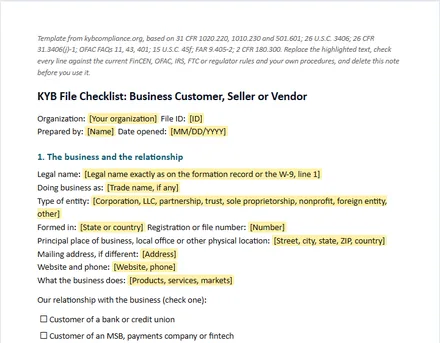
KYB file checklist
One file per business customer, seller, vendor or subrecipient, in fourteen sections, with a table of which sections a rule requires of your type of business.
Questions compliance teams ask
Is there a federal KYB law?
No law uses that name. The checks come from specific rules for specific businesses: the CIP and CDD rules for banks, broker-dealers, mutual funds and futures firms; MSB registration and the MSB program rule; INFORM for marketplaces; backup withholding for payers; the FAR and 2 CFR 180 for federal money; Form 8300 for cash; and OFAC for every U.S. person.
We are a fintech, not a bank. Does the CDD rule apply to us?
Not as such. The CDD rule binds covered financial institutions: banks, broker-dealers, mutual funds, and futures commission merchants and introducing brokers (31 CFR 1010.605(e)(1))31 CFR 1010.605Code of Federal Regulations, eCFR. A fintech that is an MSB verifies customer identity under its own program rule (31 CFR 1022.210(d))31 CFR 1022.210Code of Federal Regulations, eCFR. A fintech that offers accounts through a partner bank works within the bank's CIP and CDD program.
Which KYB check applies to every business?
Only OFAC. “All U.S. persons must comply with OFAC sanctions” (OFAC FAQ 11). How you screen is up to you: “There is no legal or regulatory requirement to use software or to scan.” (OFAC FAQ 43).
Can an AP team use IRS TIN Matching to approve a vendor?
Not for the approval. TIN Matching is for getting the name and TIN right on information returns, and “A payor may not take into account any such matching details in determining whether to open or close an account with a payee.” (26 CFR 31.3406(j)-1(c)).
Do we need a vendor's beneficial owners?
No rule requires an AP team, a marketplace or an MSB to collect them. OFAC urges due diligence on ownership (FAQ 401), because an entity owned 50 percent or more by blocked persons is blocked even when it is not listed. That makes owner collection good practice, not a requirement, outside covered financial institutions.
Sources
- 31 CFR part 1010 (1010.230, 1010.330, 1010.380, 1010.605), part 1020 (1020.220), part 1022 (1022.210, 1022.380) and part 1023 (1023.220), as printed by eCFR on Nov. 6, 2026
- OFAC FAQs: basic information (11), financial institutions (43, 116), 50 percent rule (401); 31 CFR part 501 (501.601, 501.604)
- FinCEN, CDD Rule consolidated FAQs (May 6, 2026); FIN-2026-R001 (Feb. 13, 2026); proposed CDD rule, 91 FR 7451491 FR 74514Federal Register, govinfo (Nov. 19, 2026); BOI page and BOI FAQs; BOI final rule, 91 FR 5250891 FR 52508Federal Register, govinfo
- 15 U.S.C. 45f; 26 U.S.C. 6050W; 26 U.S.C. 3406; 26 CFR 31.3406(j)-1; IRS, Form 1099-K FAQs for third party filers; Instructions for Form 8300
- FAR 9.405-2; 2 CFR 180.300; 2 CFR 25.300; 15 CFR 744.11