- Who must comply
- What sanctions do: blocking and prohibitions
- The lists and the 50 percent rule
- Screening: what is required and what is not
- Clearing a potential match
- Block, reject or process
- Reports in 10 business days
- Records for 10 years
- Penalties and enforcement
- A compliance program
- Other US screening lists
- Questions compliance teams ask
- Sources
OFAC 50 percent guidance (Aug. 13, 2014); 31 CFR 501.60331 CFR 501.603Code of Federal Regulations, eCFR, 501.604 and 501.601; 89 FR 7483289 FR 74832Federal Register, govinfo.
Who must comply
OFAC, the Treasury Department's Office of Foreign Assets Control, administers US economic sanctions, and its rules bind people rather than industries. “All U.S. persons must comply with OFAC sanctions, including all U.S. citizens and permanent residents regardless of where they are located, all individuals and entities within the United States, and all U.S. incorporated entities and their foreign branches.” “In the case of certain programs, foreign subsidiaries owned or controlled by U.S. persons also must comply.” (OFAC FAQ 11).
That makes OFAC the one KYB check that applies to a bank, a fintech, a marketplace, an AP team, a federal contractor and a car dealer alike. Non-U.S. persons are reached too: they “are prohibited from causing or conspiring to cause U.S. persons to violate U.S. sanctions” (OFAC FAQ 3). OFAC is not a bank regulator; “its basic requirement is that financial institutions not violate the laws that it administers.” (OFAC FAQ 25).
What sanctions do: blocking and prohibitions
Most sanctions work by blocking. “Blocking immediately imposes an across-the-board prohibition against transfers or dealings of any kind with regard to the property.” “Title to the blocked property remains with the blocked person, but the exercise of powers and privileges normally associated with ownership is prohibited without authorization from OFAC.” (OFAC FAQ 9). Other programs prohibit dealings with a country or region, or restrict particular activities without blocking.
There is no small-transaction safe harbor: “There is no minimum or maximum amount subject to the regulations.” (OFAC FAQ 44). And OFAC will not certify that a customer is clean: “OFAC does not issue non-inclusion certificates” (OFAC FAQ 469).
The lists and the 50 percent rule
The Specially Designated Nationals (SDN) List is the core list. “Their assets are blocked and U.S. persons are generally prohibited from dealing with them.” (OFAC FAQ 18). It changes often: “The SDN list is frequently updated. There is no predetermined timetable” (OFAC FAQ 20). OFAC's other lists restrict less than full blocking; for two of them, “U.S. persons are not required to block the property of individuals and entities on these FSE and SSI lists (unless the targets are also on the SDN list), but other prohibitions and investment restrictions apply.” (OFAC FAQ 56). See the SDN list.
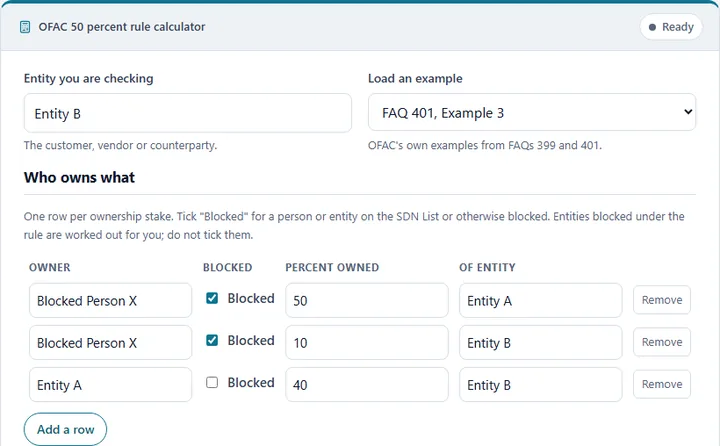
The list is not the whole answer, which is why ownership matters in KYB. Under OFAC's 2014 guidance, “any entity owned in the aggregate, directly or indirectly, 50 percent or more by one or more blocked persons is itself considered to be a blocked person.” The test is ownership only: “OFAC's 50 Percent Rule speaks only to ownership and not to control.” (OFAC FAQ 398). And holdings add up across programs: “the ownership interests of persons blocked under different OFAC sanctions programs are aggregated.” (OFAC FAQ 399). See the 50 percent rule and the 50 percent rule calculator.
Screening: what is required and what is not
OFAC requires an outcome, not a tool. “There is no legal or regulatory requirement to use software or to scan.” “There is a requirement, however, not to violate the law by doing business with a target or failing to block property.” “The important thing is not to conclude transactions before the analysis is completed.” (OFAC FAQ 43). How often to screen is your call: “The frequency of running an OFAC scan must be guided by your organization's internal policies and procedures.” (OFAC FAQ 28).
OFAC's free tool is the Sanctions List Search. Know its limits: “Only the name field of Sanctions List Search invokes fuzzy logic when the tool is run.” (OFAC FAQ 246); on a match score threshold, “OFAC cannot make such a recommendation because each search has its own unique set of facts” (FAQ 250); it is not for bulk use, since “It should not be utilized by automated systems that are configured to continually run searches through the tool.” (FAQ 287). See OFAC search.
For business customers, screen the owners as well as the name. For banks it is an expectation: “OFAC expects banks to conduct due diligence on their own direct customers (including, for example, their ownership structure) to confirm that those customers are not persons whose property and interests in property are blocked.” (OFAC FAQ 116). For everyone else OFAC “urges persons considering a potential transaction to conduct appropriate due diligence on entities that are party to or involved with the transaction or with which account relationships are maintained in order to determine relevant ownership stakes” (OFAC FAQ 401). AP teams screening vendors will find the payment side on tincompliance.com's vendor sanctions screening guide.
Clearing a potential match
OFAC's FAQ 5 sets out six steps for an alert. The core of the review is step 3: “To verify or disqualify a potential match, compare all of the details in the OFAC listing with the information available to you about the data in your transaction or activity”. Then “Step 5: Determine whether you are required to block the property, or whether you are required to reject the transaction or stop certain activity.” And last: “Step 6: Report valid matches to OFAC and maintain required records.”
OFAC FAQ 5 (updated Sept. 9, 2026); 31 CFR 501.60331 CFR 501.603Code of Federal Regulations, eCFR, 501.604 and 501.601.
OFAC will not do the review for you: “OFAC does not confirm potential matches or false positives to our sanctions lists”. Keep the file: “Organizations should keep complete, accurate records detailing the steps taken to investigate the potential match and the information relied upon” (OFAC FAQ 5). The potential match page goes step by step, and the OFAC screening log is a ready file for the record.
Block, reject or process
A valid match ends in one of three ways. Blocked property is frozen in place: funds “must be placed into a segregated, interest-bearing account on a U.S. financial institution's books, from which only OFAC-authorized debits may be made.” (OFAC FAQ 32). A prohibited transaction with no blocked person's interest is rejected: “Rejected transactions must not be processed forward to the beneficiary.” (OFAC FAQ 36). Anything else is processed, with the record kept.
OFAC FAQs 5, 32 and 36; 31 CFR 501.60331 CFR 501.603Code of Federal Regulations, eCFR and 501.604; OFAC FAQ 91.
The blocked and rejected transactions page covers each case, and tincompliance.com's guide to blocked or rejected payments covers the AP side.
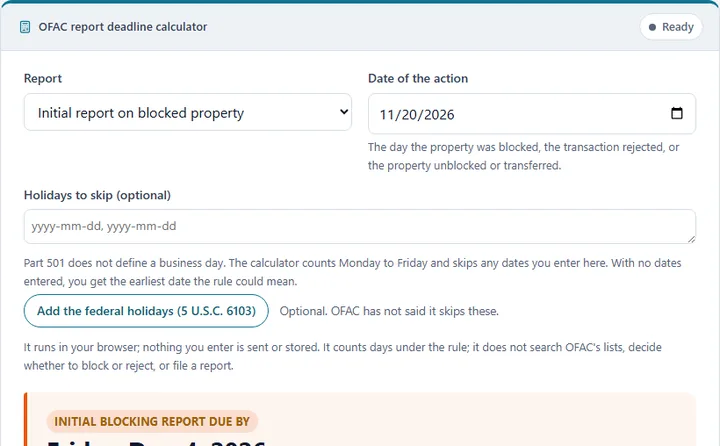
Reports in 10 business days
Blocking and rejecting both trigger reports, and the reject duty is not limited to banks. Any U.S. person that rejects a prohibited transaction reports it, and a transaction includes “sales or purchases of goods or services” (31 CFR 501.604(a)(3))31 CFR 501.604Code of Federal Regulations, eCFR. OFAC said so when it amended the rule: “OFAC confirms that this reporting requirement applies to all U.S. persons”, not only financial institutions (89 FR 40372)89 FR 40372Federal Register, govinfo.
| Report | Deadline | Rule |
|---|---|---|
| Blocked property, initial report | “within 10 business days from the date that property becomes blocked” | 31 CFR 501.603(b)(1)31 CFR 501.603Code of Federal Regulations, eCFR |
| Annual Report of Blocked Property | “A report on all blocked property held as of June 30 of the current year shall be filed annually by September 30.” | 31 CFR 501.603(b)(2)31 CFR 501.603Code of Federal Regulations, eCFR |
| Unblocked or transferred property | “within 10 business days from the date blocked property is unblocked or transferred” | 31 CFR 501.603(b)(3)31 CFR 501.603Code of Federal Regulations, eCFR |
| Rejected transaction | “within 10 business days of the rejected transaction” | 31 CFR 501.604(c)31 CFR 501.604Code of Federal Regulations, eCFR |
File reports in the OFAC Reporting System, required for these reports since “beginning on August 8, 2024.” Access starts by email: “To register for access to ORS, email OFACReport@treasury.gov with the following information”. For 2026, “The ARBP is a comprehensive report listing all blocked property held as of June 30, 2026, that must be filed by September 30, 2026.”
Records for 10 years
OFAC's recordkeeping rule reaches everyone who transacts under its rules: “every person engaging in any transaction subject to the provisions of this chapter shall keep a full and accurate record of each such transaction engaged in”, and the record must be “available for examination for at least 10 years after the date of such transaction” (31 CFR 501.601)31 CFR 501.601Code of Federal Regulations, eCFR. The period doubled from five years when “This interim final rule is effective March 12, 2025.” It follows the 2024 statute, which “extends from five years to 10 years the statute of limitations for civil and criminal violations of the International Emergency Economic Powers Act (IEEPA) or the Trading with the Enemy Act (TWEA).” See OFAC recordkeeping.
Penalties and enforcement
OFAC moved its penalty provisions into a new 31 CFR part 50531 CFR part 505Code of Federal Regulations, eCFR: “This rule is effective September 25, 2026.”, and “No substantive changes to these penalty provisions are being made with this rule.” The civil maximum under IEEPA, the statute behind most programs, is “the greater of $377,700 or an amount that is twice the amount of the transaction”, the amount set by OFAC's adjustment that “This rule is effective January 15, 2025.” (90 FR 3687)90 FR 3687Federal Register, govinfo. How OFAC weighs a case is in its Enforcement Guidelines (31 CFR part 50131 CFR part 501Code of Federal Regulations, eCFR, appendix A); the OFAC penalties page covers the matrix.
The 2026 cases carry KYB lessons. In an Oct. 13, 2026 settlement with a bank, an analyst dismissed an alert on a newly designated individual “which identified the individual as the beneficial owner of a business”, and the blocked business's account stayed open for months. OFAC repeated a point that applies to every program that buys screening: “Each organization remains responsible for its own compliance regardless of whether it relies upon third-party providers.”
A compliance program
No OFAC rule requires a formal program for most businesses: “OFAC regulations do not require a formal SCP”. OFAC's 2019 Framework describes what it credits, in five parts: “(1) management commitment; (2) risk assessment; (3) internal controls; (4) testing and auditing; and (5) training.” For onboarding it suggests a sanctions risk rating built from KYC and CDD information and “independent research conducted by the organization at the initiation of the customer relationship.”
One class of business may get a mandatory program. FinCEN and OFAC proposed that “Each permitted payment stablecoin issuer (PPSI) is required to maintain an effective sanctions compliance program (SCP).” (91 FR 1858291 FR 18582Federal Register, govinfo, Apr. 10, 2026). It is a proposal, with comments closed June 9, 2026. See the OFAC compliance program page.
Other US screening lists
OFAC's lists are not the only government lists, and they work differently. The BIS Entity List is an export license list, not a blocking list: “A license is required, to the extent specified on the Entity List, to export, reexport, or transfer (in-country) any item subject to the EAR” when a listed entity is a party (15 CFR 744.11(a))15 CFR 744.11Code of Federal Regulations, eCFR. OFAC explains why the lists stay apart: “The unique goals of the OFAC and BIS programs preclude the creation of a combined OFAC and BIS list.” (OFAC FAQ 56). BIS's 50 percent Affiliates rule is stayed: “This final rule extends the suspension through January 10, 2027.”
The Consolidated Screening List combines export and sanctions lists “and may be used as an aid to industry in conducting electronic screens”; search it with the Consolidated Screening List Search Engine. It is an aid, not the record: “the user must check the official publication of restricted parties in the Federal Register.” Federal contractors also check exclusions on SAM.gov, and FinCEN's special measures restrict dealings with named foreign institutions. See the BIS Entity List and the SAM.gov exclusions and special measures pages. Lists from the UN, the EU, the UK and other governments are in our sanctions lists worldwide directory, each linked to its publisher.
Forms, line by line
Tools for this topic
Templates
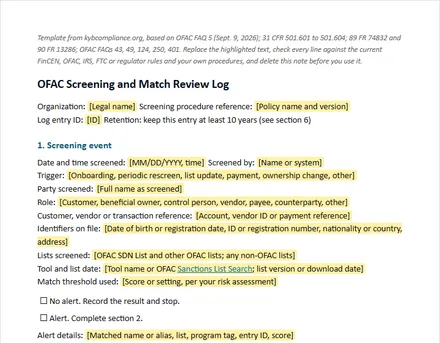
OFAC screening log
One entry per screening alert: OFAC's six match review steps, the block, reject or process decision, the 10-business-day report and the 10-year retention date.
Questions compliance teams ask
Does OFAC apply to a business that is not a bank?
Yes. “All U.S. persons must comply with OFAC sanctions” (OFAC FAQ 11). A marketplace, an AP team or a dealer is bound the same way, and reports rejected transactions, including sales or purchases of goods or services (31 CFR 501.604(a)(3))31 CFR 501.604Code of Federal Regulations, eCFR.
Are we required to use screening software?
“There is no legal or regulatory requirement to use software or to scan.” (OFAC FAQ 43). The requirement is not to deal with a target or fail to block property, and not to finish a transaction before the analysis is done.
A company is not on the SDN List. Can we deal with it?
Not if blocked persons own 50 percent or more of it in the aggregate: such an entity “is itself considered to be a blocked person.” Check the owners as well as the name.
How fast must we report a block or a reject?
Within 10 business days, in the OFAC Reporting System (31 CFR 501.603(b)(1) and 501.604(c))31 CFR 501.603Code of Federal Regulations, eCFR31 CFR 501.604Code of Federal Regulations, eCFR. Blocked property held on June 30 also goes on the Annual Report of Blocked Property by Sept. 30.
Will OFAC confirm a match for us?
No. “OFAC does not confirm potential matches or false positives to our sanctions lists”. Work the alert through FAQ 5's six steps and keep the record.
How long do we keep screening records?
Ten years since Mar. 12, 2025 (31 CFR 501.601)31 CFR 501.601Code of Federal Regulations, eCFR, for every person engaging in a transaction subject to OFAC's rules.
Sources
- OFAC FAQs: basic information (3, 9, 11, 469), financial institutions (43, 44, 116), starting a compliance program (25, 28), SDN list (18, 20, 56), searching the lists (246, 250, 287), 50 percent rule (398, 399, 401), assessing name matches (5), blocking and rejecting (32, 36)
- OFAC, revised guidance on entities owned by blocked persons (Aug. 13, 2014); A Framework for OFAC Compliance Commitments (2019); 2026 ARBP guidance; statute of limitations guidance (July 22, 2024); enforcement release (Oct. 13, 2026); OFAC Reporting System page
- 31 CFR part 501 (501.601, 501.603, 501.604) as printed by eCFR; 89 FR 40372 (May 10, 2024); 89 FR 74832 (Sept. 13, 2024); 90 FR 3687 (Jan. 15, 2025); part 505, 91 FR 60821 (Sept. 25, 2026); 91 FR 18582 (proposed)
- BIS, 15 CFR 744.11 and 91 FR 70789; trade.gov, Consolidated Screening List; FAR 9.404