- At a glance
- Who collects it, and from whom
- Required or optional
- The certification, with hotspots
- Part A and the instructions
- Parts B and C: accounts covered and physical presence
- Part D: nested shell banks
- Part E: ownership
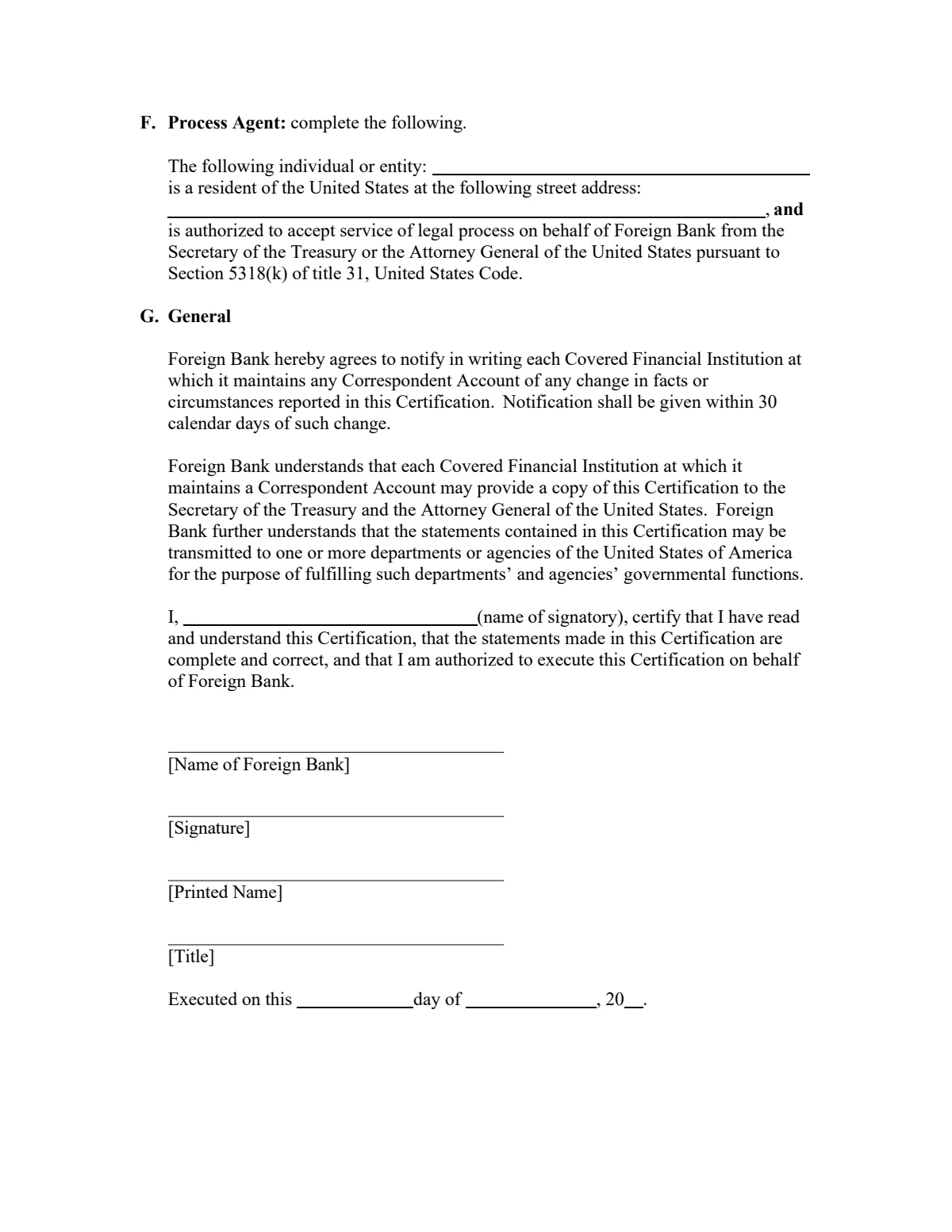
- Part F: the process agent
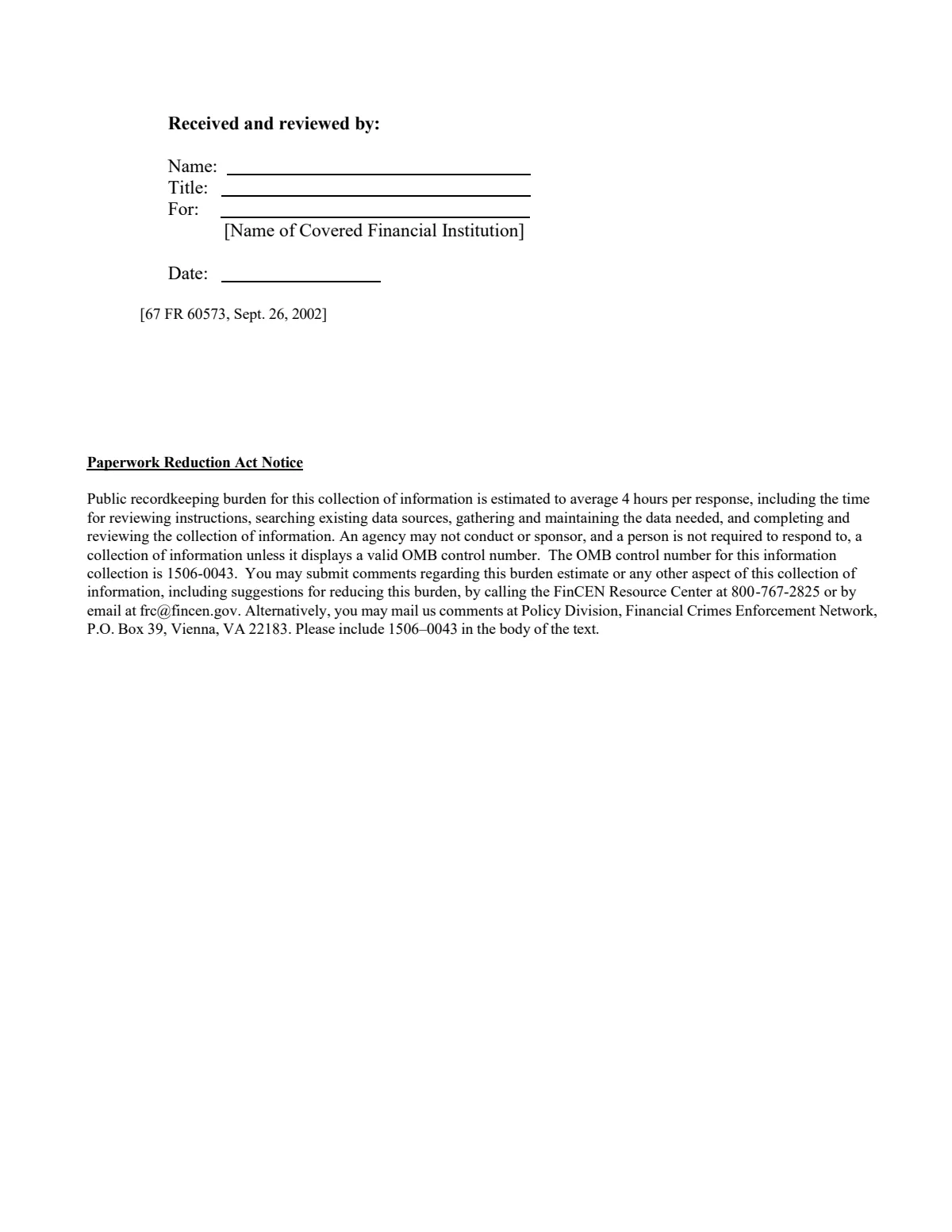
- Part G: changes, signature and receipt
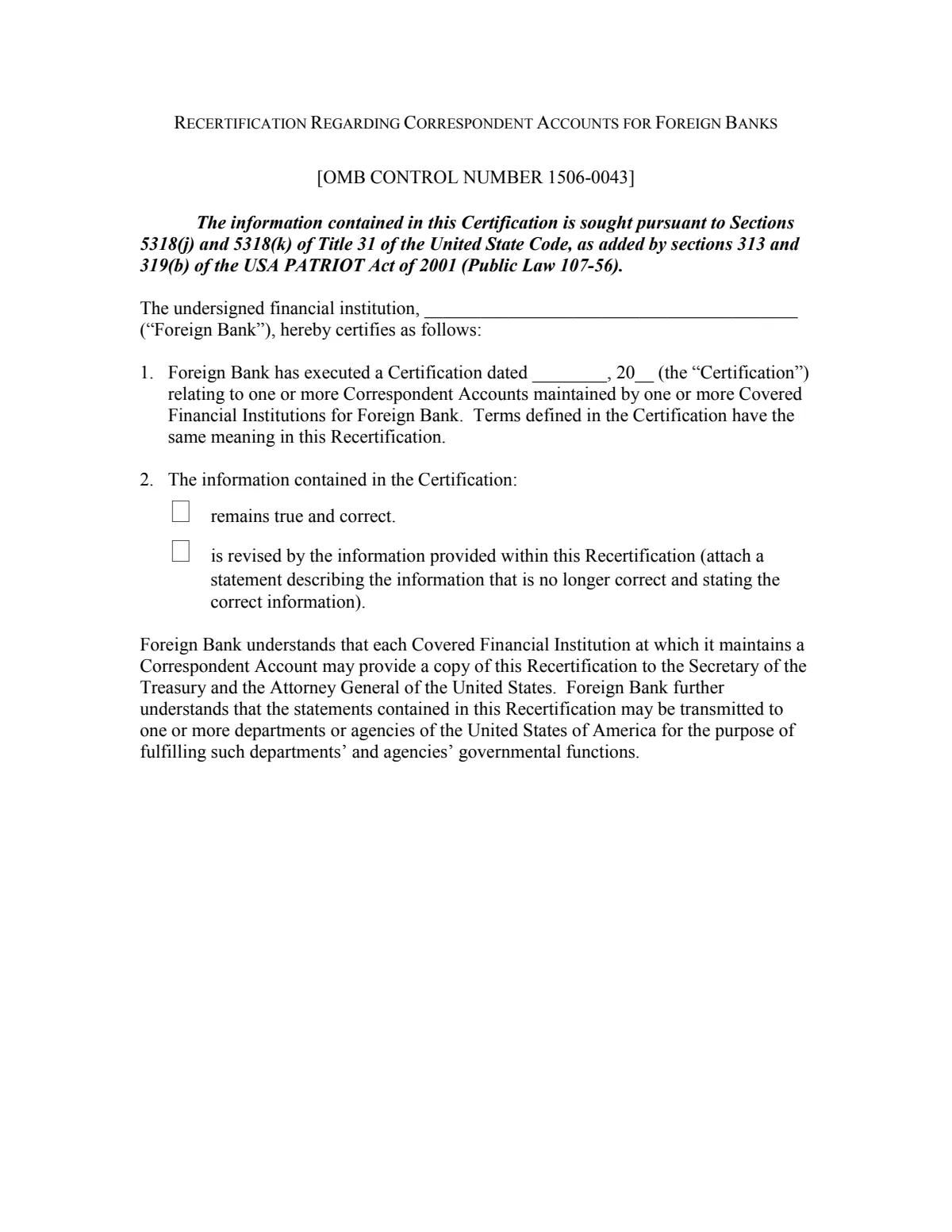
- The recertification, line by line
- Deadlines: 30 days, three years, 90 days
- Reviewing what you receive
- Where the rule, the statute and FinCEN's pages differ
- Mistakes to avoid
- How it connects
- Questions compliance teams ask
- Sources
- Who completes
- The foreign bank that holds a U.S. correspondent account
- Due
- Within 30 calendar days after the account opens; recertify at least every 3 years
- Filed with
- Kept by the U.S. bank or broker-dealer, not filed
- Form revision
- None printed; OMB 1506-0043 (67 FR 6057367 FR 60573Federal Register, govinfo, Sept. 26, 2002)
- Pages
- Certification 5 PDF pages; recertification 2
31 CFR 1010.605(j)31 CFR 1010.605Code of Federal Regulations, eCFR and 1010.630(b), (d) and (e); FIN-2006-G003.
At a glance
The Certification Regarding Correspondent Accounts for Foreign Banks is FinCEN's form for the two promises a foreign bank makes to the U.S. banks and broker-dealers that hold its correspondent accounts: that it is not a shell bank, and who owns it and accepts legal process for it in the United States. People search for it as the USA PATRIOT Act certification because it carries out sections 313 and 319(b) of that Act. The form says so in its header: “The information contained in this Certification is sought pursuant to Sections 5318(j) and 5318(k) of Title 31 of the United State Code” (the form's own spelling).
- Who completes it. The foreign bank. “An entity that is not a foreign bank is not required to complete this Certification.”
- Who collects it. The U.S. institution that keeps the correspondent account: an insured bank, commercial bank or trust company, private banker, credit union, savings association, U.S. branch or agency of a foreign bank, section 25A corporation or registered broker-dealer (below).
- When. Within 30 calendar days after the account is established, then a recertification at least once every three years (31 CFR 1010.630(b) and (d)(2)).
- Filed with. Nobody. The U.S. institution keeps it, and may give copies to Treasury and the Attorney General.
- The forms. Both PDFs are on FinCEN's Chapter X page: the certification (PDF) and the recertification (PDF). Neither has a revision date; both carry OMB control number 1506-0043 and the citation “67 FR 6057367 FR 60573Federal Register, govinfo, Sept. 26, 2002”.
Who collects it, and from whom
Covered financial institutions. For this rule the list is narrower than for the correspondent due diligence rule. Under 31 CFR 1010.605(e)(2) it is an insured bank, a commercial bank or trust company, a private banker, an agency or branch of a foreign bank in the United States, a credit union, a savings association, a corporation acting under section 25A of the Federal Reserve Act, and a registered broker-dealer. Futures commission merchants, introducing brokers and mutual funds are covered for 1010.610 and 1010.620 but not for this rule. FinCEN's summary of section 313 puts it in one line: “Banks and broker-dealers are prohibited from having correspondent accounts for any foreign bank that does not have a physical presence in any country.”
Foreign banks. A foreign bank is “A bank organized under foreign law, or an agency, branch or office located outside the United States of a bank.” (31 CFR 1010.100(u))31 CFR 1010.100Code of Federal Regulations, eCFR. A U.S. bank's branch abroad is one, and the form's footnote 1 leaves out central banks and treaty-formed development banks. A foreign money transmitter or dealer in foreign exchange is a foreign financial institution, not a foreign bank (31 CFR 1010.605(f)): it does not complete this form, though the due diligence program of 31 CFR 1010.61031 CFR 1010.610Code of Federal Regulations, eCFR still covers its account.
Stablecoin issuers (proposal). FinCEN's Apr. 10, 2026 proposed rule for permitted payment stablecoin issuers (91 FR 1858291 FR 18582Federal Register, govinfo, comments closed June 9, 2026) would apply most of the correspondent rules to them, but says “FinCEN is not proposing to apply to PPSIs Sec. 1010.630, which prohibits correspondent accounts for foreign shell banks”. It is a proposal, not law, and until a final rule nothing changes for anyone.
Required or optional
Three things are required of the U.S. institution, and one is not.
- Required: no shell bank accounts. “A covered financial institution shall not establish, maintain, administer, or manage a correspondent account in the United States for, or on behalf of, a foreign shell bank.” (31 CFR 1010.630(a)(1)). Congress judged shell banks risky enough that “an absolute ban on correspondent accounts with such entities is justified.” (FFIEC manual, 2023)
- Required: records of owners and the agent. Records in the United States of the owners of each foreign bank whose shares are not publicly traded, and of the U.S. agent for service of legal process (1010.630(a)(2)).
- Required: the information, on time. If the institution “has not obtained a certification (or recertification), or has not otherwise obtained documentation of the information required by such certification (or recertification)” within 30 calendar days and every three years after, it must close the accounts (1010.630(d)(2)).
- Optional: FinCEN's form. The certification is the safe harbor: the institution “will be deemed to be in compliance with the requirements of paragraph (a) of this section with respect to a foreign bank if the covered financial institution obtains, at least once every three years, a certification or recertification from the foreign bank.” The FFIEC: “While banks are not required to use these forms, the forms are designed to provide a means of complying with the requirements.” FinCEN's 2006 guidance also allows the “other format that certifies compliance” with the rule.
So the form itself is good practice, not required; getting the information it carries, on time, is required. The form is still the simplest route, because the rule ties the safe harbor to it: the rule defines certification as “the certification and recertification forms regarding correspondent accounts for foreign banks located on FinCEN's Internet Web site” (31 CFR 1010.605(b)).
Tap a box once for its note, again to jump to the line. Zoom in to read the small print.
Part A and the instructions
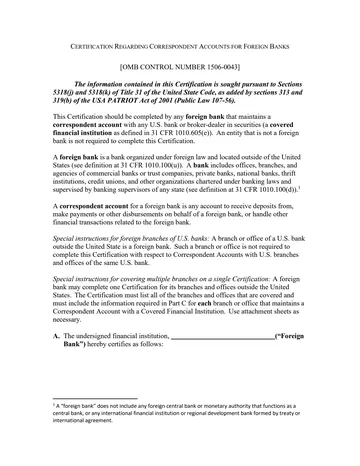
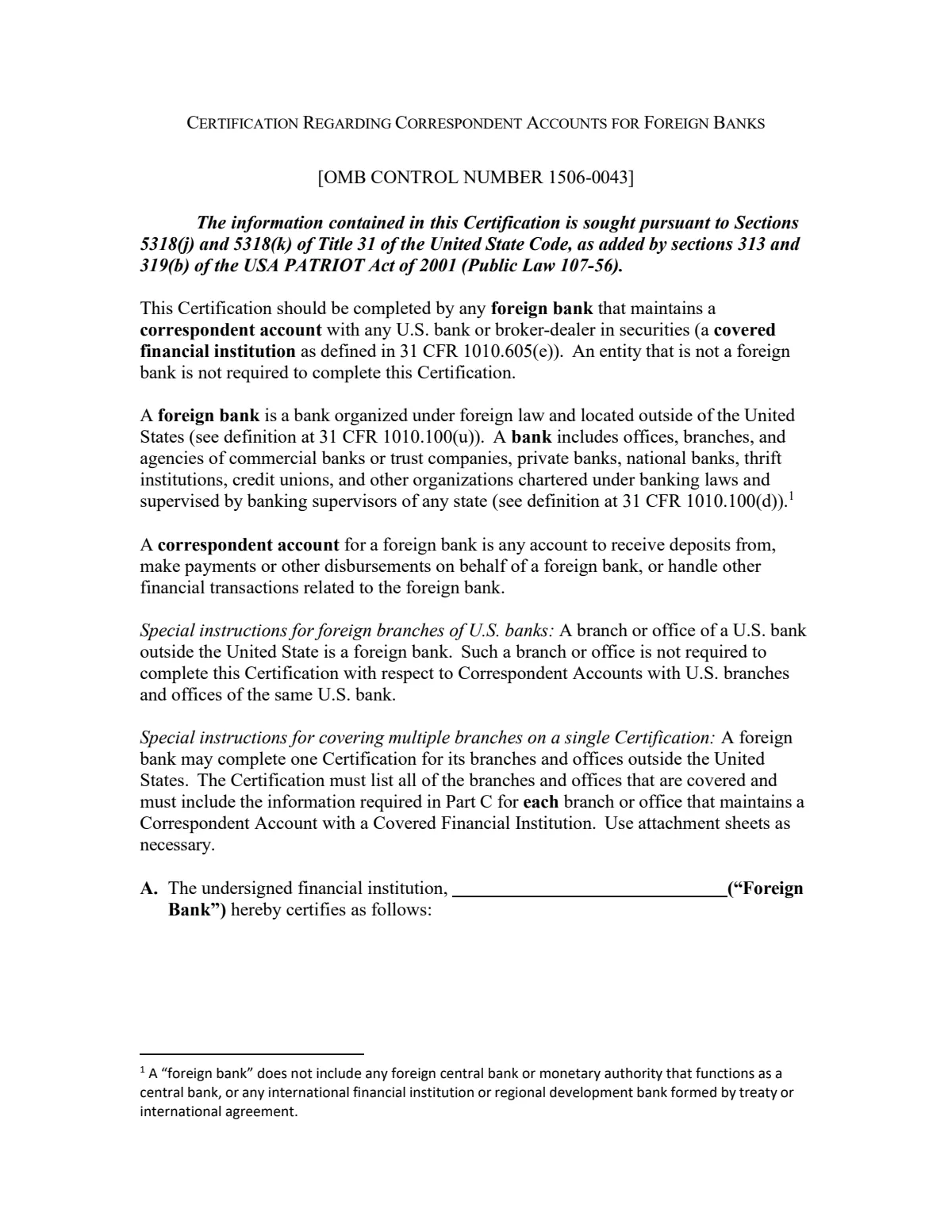
Page 1 is mostly instructions: who completes the form, the definitions, and two special cases (foreign branches of U.S. banks, and one form for several branches). Part A is the only blank: the foreign bank's name.
| Line | Label | What goes there |
|---|---|---|
| Intro | This Certification should be completed by any foreign bank that maintains a correspondent account with any U.S. bank or broker-dealer in securities ... | The form's own scope line: “This Certification should be completed by any foreign bank that maintains a correspondent account with any U.S. bank or broker-dealer in securities”. And the other side: “An entity that is not a foreign bank is not required to complete this Certification.” A foreign money transmitter or other foreign financial institution that is not a bank is outside this form, though its account falls under the correspondent due diligence rule (31 CFR 1010.610)31 CFR 1010.610Code of Federal Regulations, eCFR. |
| Defs | A foreign bank is a bank organized under foreign law and located outside of the United States ... A correspondent account for a foreign bank is any account ... | The form defines a correspondent account as “any account to receive deposits from, make payments or other disbursements on behalf of a foreign bank, or handle other financial transactions related to the foreign bank.” The rule's definition is the same in substance (31 CFR 1010.605(c)(1)(ii)), and “account” is read broadly for banks: “any formal banking or business relationship established by a bank to provide regular services, dealings, and other financial transactions”. |
| Branches | Special instructions for foreign branches of U.S. banks ... | “Such a branch or office is not required to complete this Certification with respect to Correspondent Accounts with U.S. branches and offices of the same U.S. bank.” For accounts at other U.S. institutions, the branch completes the form like any other foreign bank. |
| Multi | Special instructions for covering multiple branches on a single Certification ... | “A foreign bank may complete one Certification for its branches and offices outside the United States.” The form then “must include the information required in Part C for each branch or office that maintains a Correspondent Account with a Covered Financial Institution.” The form says to use attachment sheets as necessary. |
| A | A. The undersigned financial institution, ____ ("Foreign Bank") hereby certifies as follows: | The certifying institution's name. Every later statement on the form is made by “(‘Foreign Bank’) hereby certifies as follows:” Match it to the name on your account records and on Part G's name line. |
| fn1 | 1 A "foreign bank" does not include any foreign central bank or monetary authority ... | A foreign bank “does not include any foreign central bank or monetary authority that functions as a central bank, or any international financial institution or regional development bank formed by treaty or international agreement.” |
Parts B and C: accounts covered and physical presence
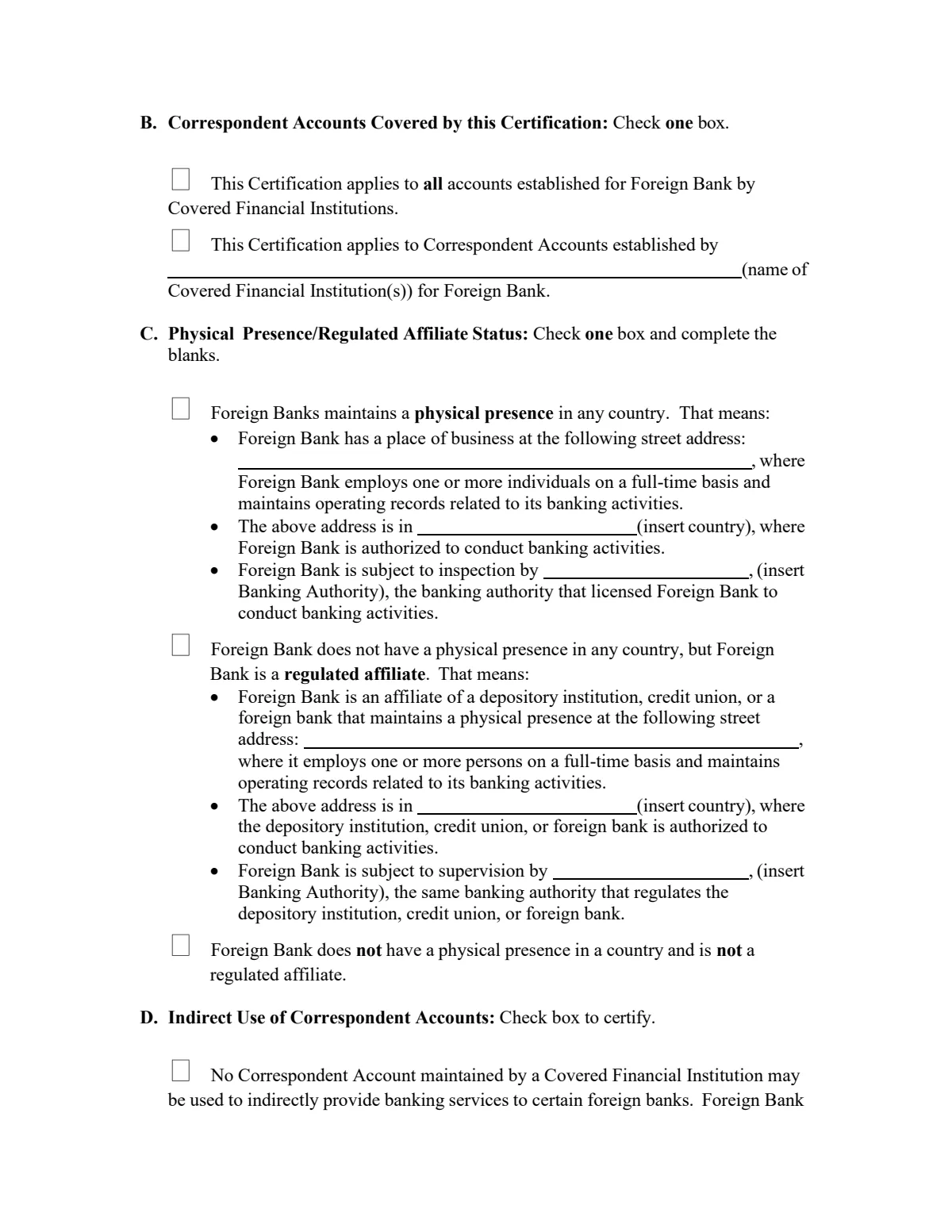
Part B says which U.S. institutions may rely on the form. Part C is the core of the shell bank test, and exactly one of its three boxes is checked. A shell bank is not banned because it is small or offshore. It is banned because it has no fixed place of business where it employs people, keeps its records and can be inspected by the supervisor that licensed it.
31 CFR 1010.605(g)31 CFR 1010.605Code of Federal Regulations, eCFR, (l) and (n); 31 CFR 1010.630(a)(1)31 CFR 1010.630Code of Federal Regulations, eCFR.
| Line | Label | What goes there |
|---|---|---|
| B-1 | This Certification applies to all accounts established for Foreign Bank by Covered Financial Institutions. | Part B says “Check one box.” The first box makes it a global certification. FinCEN: “A separate certification need not be completed for each covered financial institution; a single certification can be relied on by each covered financial institution that is referenced on the form.” (FIN-2006-G003, footnote 8). |
| B-2 | This Certification applies to Correspondent Accounts established by ____ (name of Covered Financial Institution(s)) for Foreign Bank. | Name each covered institution. If yours is not named and the first box is not checked, the certification does not cover your account: ask for one that does. |
| C-1 | Foreign Banks maintains a physical presence in any country. That means: Foreign Bank has a place of business at the following street address: ____, where Foreign Bank employs one or more individuals on a full-time basis and maintains operating records related to its banking activities. | Part C is the shell bank test, so “Check one box and complete the blanks.” The address is a place “where Foreign Bank employs one or more individuals on a full-time basis and maintains operating records related to its banking activities.” The rule adds that it must be at “a fixed address (other than solely an electronic address or a post-office box)” (31 CFR 1010.605(l)). |
| C-1-country | The above address is in ____ (insert country), where Foreign Bank is authorized to conduct banking activities. | The country must be one where the bank holds banking authority. An address in a country where it is not licensed does not meet the definition. |
| C-1-authority | Foreign Bank is subject to inspection by ____, (insert Banking Authority), the banking authority that licensed Foreign Bank to conduct banking activities. | Name “the banking authority that licensed Foreign Bank to conduct banking activities.” A place of business that its licensing authority cannot inspect is not a physical presence under the rule. |
| C-2 | Foreign Bank does not have a physical presence in any country, but Foreign Bank is a regulated affiliate. That means: Foreign Bank is an affiliate of a depository institution, credit union, or a foreign bank that maintains a physical presence at the following street address: ____ | The regulated affiliate exception (31 CFR 1010.630(a)(1)): “Nothing in paragraph (a)(1) of this section prohibits a covered financial institution from providing a correspondent account or banking services to a regulated affiliate.” Control here means “Ownership, control, or power to vote 50 percent or more of any class of voting securities or other voting interests of another company”, or control of the board (31 CFR 1010.605(n))31 CFR 1010.605Code of Federal Regulations, eCFR. |
| C-2-country | The above address is in ____ (insert country), where the depository institution, credit union, or foreign bank is authorized to conduct banking activities. | The affiliate's country, not the shell bank's place of organization. |
| C-2-authority | Foreign Bank is subject to supervision by ____, (insert Banking Authority), the same banking authority that regulates the depository institution, credit union, or foreign bank. | The exception needs both: the affiliate link and supervision by “the same banking authority that regulates the depository institution, credit union, or foreign bank.” |
| C-3 | Foreign Bank does not have a physical presence in a country and is not a regulated affiliate. | This box describes the bank the rule bans: “Foreign shell bank means a foreign bank without a physical presence in any country.” A certification with this box checked is not a way to keep the account; see the rule in 31 CFR 1010.630(a)(1). |
Part D: nested shell banks
A foreign bank with a real presence could still let a shell bank reach the U.S. system through its own account. Part D is the foreign bank's certification that it does not. The U.S. institution's duty is to take reasonable steps; the certification is one of them. For the wider due diligence on nested accounts, see enhanced due diligence.
| Line | Label | What goes there |
|---|---|---|
| D | D. Indirect Use of Correspondent Accounts: Check box to certify. No Correspondent Account maintained by a Covered Financial Institution may be used to indirectly provide banking services to certain foreign banks. | This is the nested account check. The rule requires the U.S. institution to “take reasonable steps to ensure that any correspondent account established, maintained, administered, or managed by that covered financial institution in the United States for a foreign bank is not being used by that foreign bank to indirectly provide banking services to a foreign shell bank.” (31 CFR 1010.630(a)(1)(ii))31 CFR 1010.630Code of Federal Regulations, eCFR. The FFIEC gives the example: “such as with nested correspondent accounts.” |
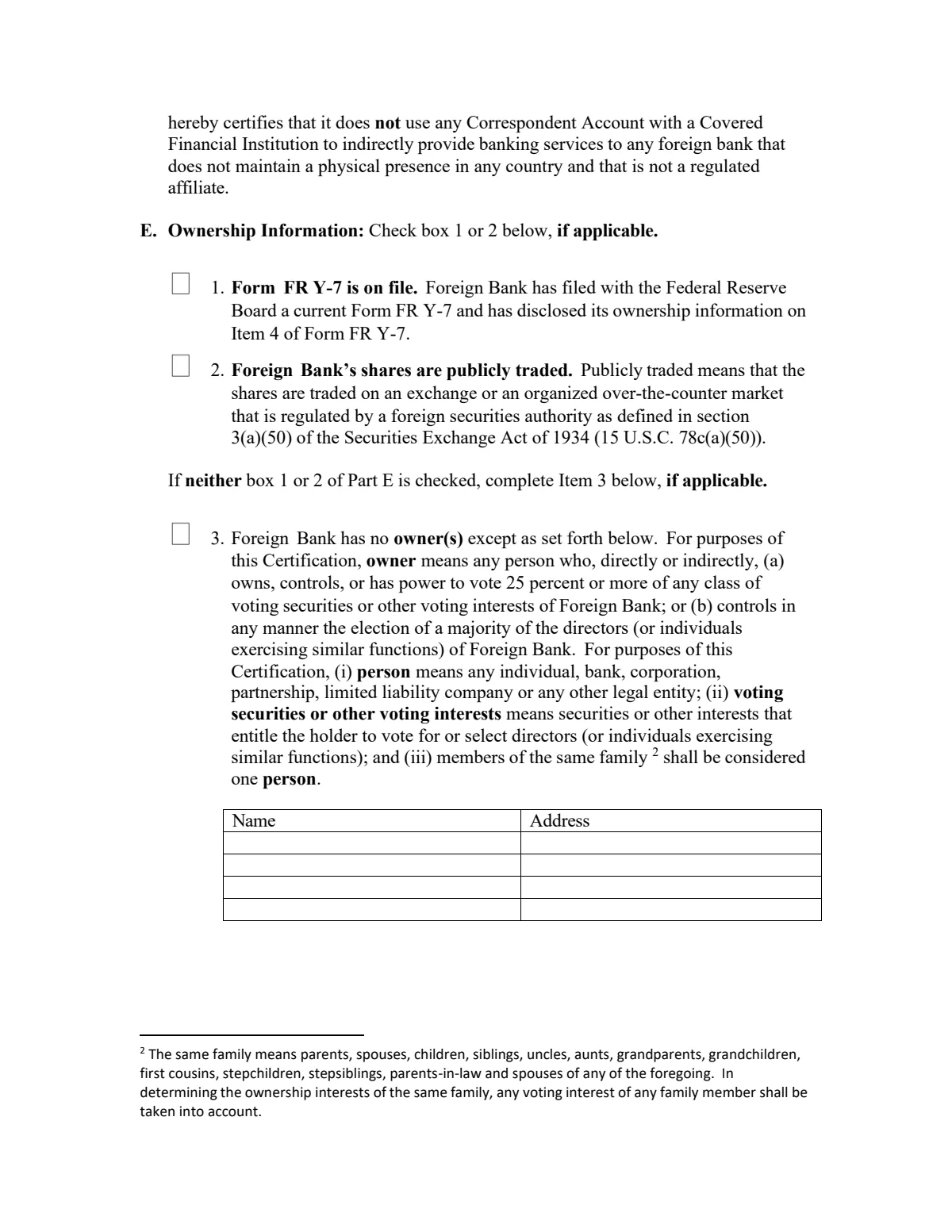
| D-cont | Foreign Bank hereby certifies that it does not use any Correspondent Account with a Covered Financial Institution to indirectly provide banking services to any foreign bank that does not maintain a physical presence in any country and that is not a regulated affiliate. | An unchecked box D leaves the certification incomplete. The statement covers every correspondent account the foreign bank keeps with a covered institution, not only yours. |
Part E: ownership
Part E gives the U.S. institution the owner records the rule requires. Only one of its three items applies: the FR Y-7 box, the publicly traded box, or the owner list. The owner test here is not the CDD rule's test, and not the one used for correspondent due diligence:
| Rule | Who is an owner | Applies to |
|---|---|---|
| Certification, Part E (31 CFR 1010.605(j), 1010.630)31 CFR 1010.605Code of Federal Regulations, eCFR31 CFR 1010.630Code of Federal Regulations, eCFR | Anyone with 25 percent or more of any class of voting securities, or control of the board; family counted as one person | Every foreign bank with a U.S. correspondent account, unless it files FR Y-7 or is publicly traded |
| Correspondent due diligence (31 CFR 1010.610(b))31 CFR 1010.610Code of Federal Regulations, eCFR | Anyone with “10 percent or more of any class of securities of a foreign bank.” | Only foreign banks under enhanced due diligence (offshore license, designated country) |
| CDD rule (31 CFR 1010.230)31 CFR 1010.230Code of Federal Regulations, eCFR | Each individual who “owns 25 percent or more of the equity interests of a legal entity customer” | Legal entity customers, but not “A foreign financial institution established in a jurisdiction where the regulator of such institution maintains beneficial ownership information regarding such institution;” (1010.230(e)(2)(xiv)) |
The CDD rule's owner prongs, and its exclusion for a foreign financial institution whose regulator keeps its owner information, are on the beneficial ownership page.
| Line | Label | What goes there |
|---|---|---|
| E-1 | 1. Form FR Y-7 is on file. Foreign Bank has filed with the Federal Reserve Board a current Form FR Y-7 and has disclosed its ownership information on Item 4 of Form FR Y-7. | Part E says “Check box 1 or 2 below, if applicable.” The rule's exception: a covered institution “need not maintain records of the owners of any foreign bank that is required to have on file with the Federal Reserve Board a Form FR Y-7” (31 CFR 1010.630(a)(2)(ii)). The Federal Reserve's FR Y-7 page says the report “is an annual report of foreign banking organizations (FBOs) that have a U.S. banking presence” and that “Data from the FR Y-7 are not published.” |
| E-2 | 2. Foreign Bank's shares are publicly traded. Publicly traded means that the shares are traded on an exchange or an organized over-the-counter market that is regulated by a foreign securities authority ... | The rule asks for owners only of a foreign bank “whose shares are not publicly traded”. The form's test: “Publicly traded means that the shares are traded on an exchange or an organized over-the-counter market that is regulated by a foreign securities authority” as defined in section 3(a)(50) of the Securities Exchange Act of 1934. |
| E-3 | If neither box 1 or 2 of Part E is checked, complete Item 3 below, if applicable. 3. Foreign Bank has no owner(s) except as set forth below ... | “If neither box 1 or 2 of Part E is checked, complete Item 3 below, if applicable.” An owner is any person who, directly or indirectly, “owns, controls, or has power to vote 25 percent or more of any class of voting securities or other voting interests of Foreign Bank”, or controls the election of a majority of its directors. A person is “any individual, bank, corporation, partnership, limited liability company or any other legal entity”, so a parent company can be the owner listed. Family members “shall be considered one person.” When there is no owner at that level, check box 3 and leave the table empty. |
| E-owners | Name / Address (table) | The rule asks for records “identifying the owners of each such foreign bank”; the form asks for a name and an address for each. When a family is an owner only because its members' stakes are added together, “Each member of the same family who has an ownership interest in a foreign bank must be identified” (31 CFR 1010.605(j)(2)(iii))31 CFR 1010.605Code of Federal Regulations, eCFR. The form's table has no line for that; list each member. |
| fn2 | 2 The same family means parents, spouses, children, siblings, uncles, aunts, grandparents, grandchildren, first cousins, stepchildren, stepsiblings, parents-in-law and spouses of any of the foregoing ... | “In determining the ownership interests of the same family, any voting interest of any family member shall be taken into account.” The list matches the rule's definition of same family in 31 CFR 1010.605(j)(2)31 CFR 1010.605Code of Federal Regulations, eCFR(ii). |
Part F: the process agent
Section 319(b) of the USA PATRIOT Act lets Treasury and the Attorney General subpoena records from any foreign bank that keeps a U.S. correspondent account. FinCEN's summary: “This Section also requires U.S. banks to maintain records identifying an agent for service of legal process for its correspondent accounts.” Part F is where the foreign bank names that agent. Every certification needs it, including one from a publicly traded bank.
| Line | Label | What goes there |
|---|---|---|
| F-agent | F. Process Agent: complete the following. The following individual or entity: ____ | Part F is required on every certification: “complete the following.” The rule asks for “the name and street address of a person who resides in the United States and is authorized, and has agreed to be an agent to accept service of legal process for records regarding each such account.” (31 CFR 1010.630(a)(2)(i)). |
| F-addr | is a resident of the United States at the following street address: ____, and is authorized to accept service of legal process on behalf of Foreign Bank from the Secretary of the Treasury or the Attorney General of the United States pursuant to Section 5318(k) of title 31, United States Code. | The agent “is authorized to accept service of legal process on behalf of Foreign Bank from the Secretary of the Treasury or the Attorney General of the United States”. This is the address a subpoena for the foreign bank's records can be served at (31 U.S.C. 5318(k)(3)). A street address is asked for, not a mailbox. |
Part G: changes, signature and receipt
Part G holds the foreign bank's promise to report changes, its acknowledgment that the form may go to U.S. agencies, and the signature. Page 5 holds the U.S. institution's own receipt block and the Paperwork Reduction Act notice.
| Line | Label | What goes there |
|---|---|---|
| G-notify | Foreign Bank hereby agrees to notify in writing each Covered Financial Institution ... of any change in facts or circumstances reported in this Certification. Notification shall be given within 30 calendar days of such change. | “Notification shall be given within 30 calendar days of such change.” A notice of change tells the U.S. institution the certification is no longer correct, which brings in interim verification under 31 CFR 1010.630(c). |
| G-share | Foreign Bank understands that each Covered Financial Institution at which it maintains a Correspondent Account may provide a copy of this Certification to the Secretary of the Treasury and the Attorney General of the United States ... | Each U.S. institution “may provide a copy of this Certification to the Secretary of the Treasury and the Attorney General of the United States.” The certification is not filed with FinCEN; it is kept and produced on request. |
| G-signatory | I, ____ (name of signatory), certify that I have read and understand this Certification, that the statements made in this Certification are complete and correct, and that I am authorized to execute this Certification on behalf of Foreign Bank. | The signer certifies “that the statements made in this Certification are complete and correct, and that I am authorized to execute this Certification on behalf of Foreign Bank.” The form does not say who at the foreign bank must sign: Not listed. |
| G-bank | [Name of Foreign Bank] | Same name as Part A. |
| G-sign | [Signature] | FinCEN accepts certifications by electronic delivery and website posting (FIN-2006-G003, Q2). The form does not address electronic signatures: Not listed. |
| G-name | [Printed Name] | The certification has a printed name line; the recertification does not. |
| G-title | [Title] | The signer's position, which helps the receiving institution judge the authority claimed in the statement above. |
| G-date | Executed on this ____ day of ____, 20__. | The execution date matters most: “all recertifications must be obtained by covered financial institutions on or before the three-year anniversary of the execution of the initial or previous certification.” |
| Received | Received and reviewed by: Name: ____ Title: ____ For: ____ [Name of Covered Financial Institution] | The reviewer's block. The FFIEC manual: “Banks are responsible for reviewing certifications for reasonableness and accuracy.” Read it against what you know of the foreign bank before you sign. |
| Received-date | Date: ____ | FinCEN checks timeliness by comparing the execution date with the date the form is “first delivered to the institution, by reference to a date-stamp or other manual or digital dating technique.” This line is that date stamp. |
| FR-cite | [67 FR 6057367 FR 60573Federal Register, govinfo, Sept. 26, 2002] | The form prints “67 FR 6057367 FR 60573Federal Register, govinfo, Sept. 26, 2002”, a page of the 2002 final rule (67 FR 60562). The form shows no revision date of its own. |
| PRA | Paperwork Reduction Act Notice ... | Burden: “estimated to average 4 hours per response”. “The OMB control number for this information collection is 1506-0043.” |
The recertification, line by line
The recertification is two pages. It does not repeat Parts B to F. It points to the earlier certification by date and says either that the information “remains true and correct.” or that it is revised by an attached statement.
Tap a box once for its note, again to jump to the line. Zoom in to read the small print.
| Line | Label | What goes there |
|---|---|---|
| R-name | The undersigned financial institution, ____ ("Foreign Bank"), hereby certifies as follows: | The same institution that signed the earlier certification. |
| R-1 | 1. Foreign Bank has executed a Certification dated ____, 20__ (the "Certification") relating to one or more Correspondent Accounts ... | “Foreign Bank has executed a Certification dated” a given date. FinCEN reads this date to time the recertification. After a correction or amendment, “a recertification should note the execution date of the revised or amended certification” (FIN-2006-G003, Q3). “Terms defined in the Certification have the same meaning in this Recertification.” |
| R-2a | 2. The information contained in the Certification: remains true and correct. | FinCEN treats every recertification as “essentially a formal attestation of no material change to the previous certification”. |
| R-2b | is revised by the information provided within this Recertification (attach a statement describing the information that is no longer correct and stating the correct information). | The attachment is part of the recertification: “attach a statement describing the information that is no longer correct and stating the correct information”. A change in the facts should already have reached you under Part G of the certification, within 30 calendar days. |
| R-ack | Foreign Bank understands that each Covered Financial Institution at which it maintains a Correspondent Account may provide a copy of this Recertification ... | Each institution “may provide a copy of this Recertification to the Secretary of the Treasury and the Attorney General of the United States.” |
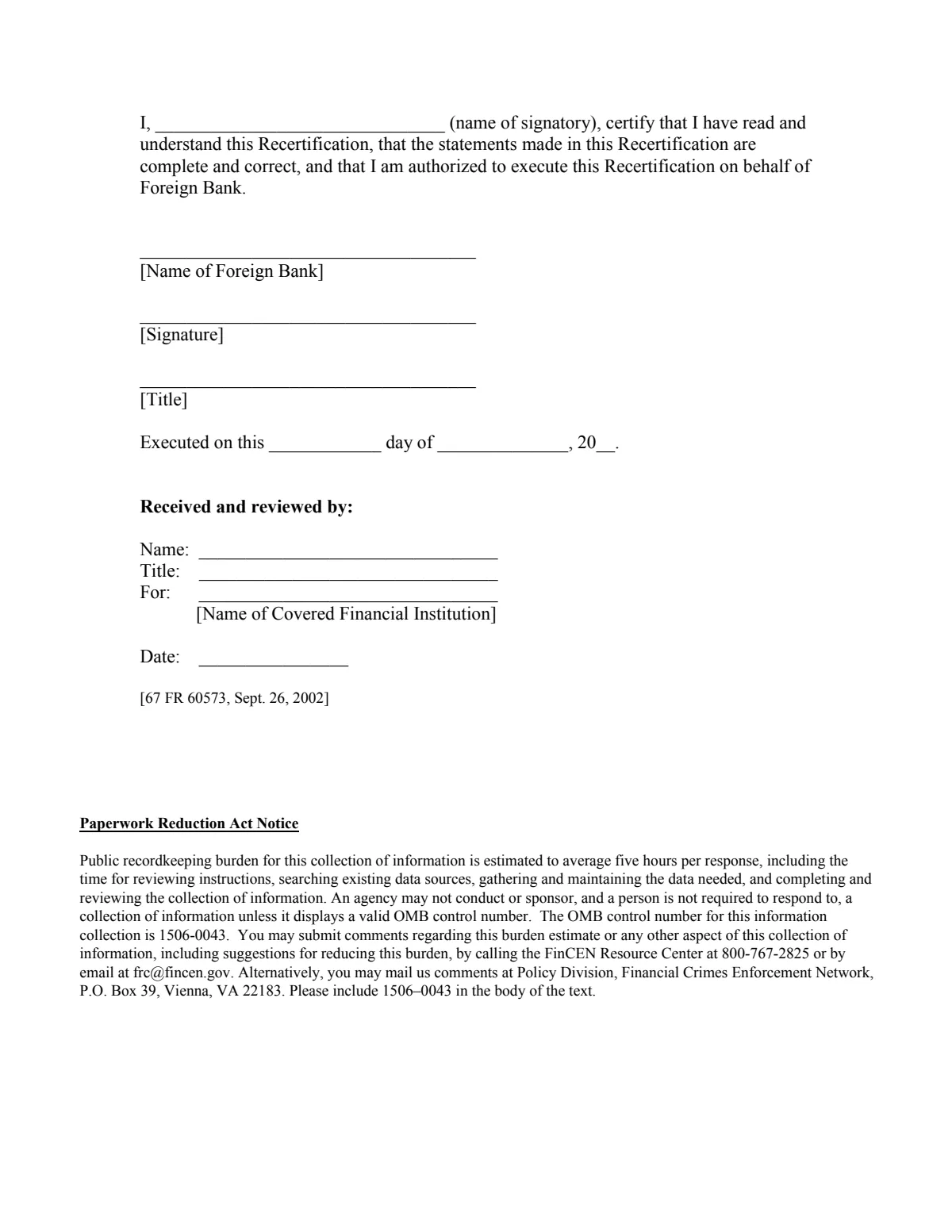
| R-signatory | I, ____ (name of signatory), certify that I have read and understand this Recertification ... | The signer certifies “that I am authorized to execute this Recertification on behalf of Foreign Bank.” |
| R-bank | [Name of Foreign Bank] | Same name as at the top. |
| R-sign | [Signature] | The recertification has no printed name line; the name is in the signatory statement. |
| R-title | [Title] | The signer's position at the foreign bank. |
| R-date | Executed on this ____ day of ____, 20__. | The next recertification is due by the third anniversary of this date. To be timely, the gap between line 1's date and the date you receive this form “may not exceed three years.” |
| R-received | Received and reviewed by: Name: Title: For: [Name of Covered Financial Institution] | As on the certification: the receiving institution's review block. |
| R-received-date | Date: ____ | If more than three years separate line 1's date from this date, the recertification is late. The rule then calls for closing the accounts (31 CFR 1010.630(d)(2))31 CFR 1010.630Code of Federal Regulations, eCFR. |
| R-PRA | Paperwork Reduction Act Notice ... | Burden: “estimated to average five hours per response”, one hour more than the certification's estimate of four. |
Deadlines: 30 days, three years, 90 days
31 CFR 1010.630(c)31 CFR 1010.630Code of Federal Regulations, eCFR, (d) and (e); FIN-2006-G003.
New accounts. The certification, or documentation of the same information, is due “within 30 calendar days after the date the account is established, and at least once every three years thereafter” (31 CFR 1010.630(d)(2)). FinCEN's 2006 guidance says the same: “certifications were (and continue to be) required within 30 days of the opening of the underlying account or accounts”. Accounts that existed on Oct. 28, 2002 had until Mar. 31, 2003 (1010.630(d)(1)).
Three years, counted from what. The rule says only "at least once every three years." FinCEN chose the date in FIN-2006-G003 (Feb. 3, 2006): “all recertifications must be obtained by covered financial institutions on or before the three-year anniversary of the execution of the initial or previous certification.” Not the account opening date, not the end of the calendar year, and not the date you received the last one. Global certifications follow the same policy (Q1). A corrected or amended certification restarts the clock: “the recertification should be delivered within three years of the execution of the revised or amended certification.” (Q3)
Interim verification. If the institution “knows, suspects, or has reason to suspect” that the information is no longer correct, it asks the foreign bank to verify or correct it, or takes other steps to check (31 CFR 1010.630(c)). Without an answer “within 90 calendar days after the date of undertaking the verification”, it closes the accounts (1010.630(d)(3)).
Closing. Closure is “within a commercially reasonable time”, with no new positions and no transactions except those needed to close. The account cannot be reopened, and no other correspondent account opened, “until it obtains from the foreign bank the certification or the recertification, as appropriate.” (1010.630(d)(4)). The institution “shall not be liable to any person in any court or arbitration proceeding for terminating a correspondent account in accordance with this paragraph (d).”
Records. Keep the original of anything the foreign bank provided, and the original or a copy of anything else relied on, “for at least 5 years after the date that the covered financial institution no longer maintains any correspondent account for such foreign bank.” (31 CFR 1010.630(e))
Law enforcement requests. On a written request from a federal law enforcement officer for the owner and agent records, the institution answers “not later than 7 days after receipt of the request.” (31 CFR 1010.670(c))31 CFR 1010.670Code of Federal Regulations, eCFR. After written notice from Treasury or the Attorney General that the foreign bank failed to comply with a subpoena or contest it, the institution ends the relationship “not later than 10 business days after receipt of written notice from the Secretary or the Attorney General” (1010.670(d)).
Reviewing what you receive
A certification gives the safe harbor only if it is complete and you have no reason to doubt it. “Banks are responsible for reviewing certifications for reasonableness and accuracy.” (FFIEC manual, 2023). You may take it from the foreign bank or from a third party: FinCEN allows a copy obtained “either directly from the foreign bank or indirectly, such as from a central database or from another financial institution, providing that the form and content of the certification are sufficient and reliable.” (FIN-2006-G003, Q2)
31 CFR 1010.630(a)31 CFR 1010.630Code of Federal Regulations, eCFR to (c); the certification form; FFIEC manual (2023).
- Check that Part A's name and the signature block's name match the foreign bank on your account, and that Part B either covers all covered institutions or names yours.
- In Part C, confirm exactly one box is checked and every blank is filled: street address, country and licensing authority. The third box means a shell bank: the account cannot be kept.
- Confirm box D is checked.
- In Part E, confirm one route: FR Y-7 on file, publicly traded, or an owner list (or box 3 checked with no owners at 25 percent).
- Confirm Part F names a U.S. resident agent with a U.S. street address.
- Fill in the received and reviewed block with the date you received it, record the execution date, and calendar the recertification for the third anniversary of that date.
- Keep the original for five years after the last correspondent account with the bank closes.
Where the rule, the statute and FinCEN's pages differ
- Who is an owner. The form and the rule use the 2002 test: 25 percent of any class of voting securities, or board control (31 CFR 1010.605(j))31 CFR 1010.605Code of Federal Regulations, eCFR. The statute, as amended by the AML Act of 2020, asks for records identifying “the owners of record and the beneficial owners of the foreign bank; and” (31 U.S.C. 5318(k)(3)(B)(i)). The FFIEC manual notes the change: the term owner “includes the owners of record and the beneficial owners of the foreign bank.” The sources do not say how FinCEN applies the new wording; the rule and the form are unchanged.
- Old citations in FinCEN's guidance. FIN-2006-G003 cites 31 C.F.R. 103.177 and 103.175. “On March 1, 2011, FinCEN transferred its regulations from 31 CFR Part 103 to 31 CFR Chapter X”, and the same page notes that “documents published prior to March 1, 2011 will continue to contain citations to 31 CFR Part 103.” Read 103.177 as 1010.630 and 103.175 as 1010.605.
- The form links. The FFIEC section (2023) links both forms at fincen.gov addresses under /sites/default/files/, which return errors as of Nov. 23, 2026. FinCEN's Chapter X page links them under /system/files/; the links on this page use those.
- The termination penalty. The rule still prints “liable for a civil penalty of up to $10,000 per day until the correspondent relationship is so terminated.” (31 CFR 1010.670(f))31 CFR 1010.670Code of Federal Regulations, eCFR. The inflation table in 31 CFR 1010.82131 CFR 1010.821Code of Federal Regulations, eCFR lists “31 U.S.C. 5318(k)(3)(C)31 U.S.C. 5318United States Code, Cornell LII Failure to Terminate Correspondent Relationship with Foreign Bank 10,000 17,765”, the maximum for penalties assessed on or after Jan. 17, 2025. The adjusted $17,765 a day governs for penalties assessed since then.
- Physical presence. The statute excludes an address that is “(other than solely an electronic address)”; the rule adds post office boxes. The rule is the narrower test and the one the form follows.
Mistakes to avoid
- Counting three years from the wrong date. The clock runs from the execution date of the last certification, not the account opening or the date you filed it (FIN-2006-G003).
- Relying on a certification that does not name you. If Part B's second box is checked and your institution is not named, the form does not cover your account.
- Treating box 3 of Part C as a disclosure. It is the description of a bank you cannot serve. Close or refuse the account.
- Skipping Part F for a listed bank. Publicly traded shares excuse the owner list, not the process agent.
- Using the CDD owner test. Part E counts 25 percent of any class of voting securities, and a company can be the owner. The CDD rule counts individuals with 25 percent of the equity. Use the form's test here.
- Filing it with FinCEN. Nothing is filed. The institution keeps it and produces it on request.
- Ignoring a notice of change. A change reported under Part G, or anything else that makes you doubt the form, starts interim verification and its 90-day limit.
How it connects
- The other correspondent account rule, 31 CFR 1010.61031 CFR 1010.610Code of Federal Regulations, eCFR, and the private banking rule for senior foreign political figures: enhanced due diligence. Questions for a foreign bank relationship: the EDD questionnaire template.
- The other FinCEN owner form, for legal entity customers: the CDD certification form, and the rule behind it, customer due diligence.
- Bank onboarding in general: KYB for banks and KYC requirements. Shell companies, a different risk from shell banks: shell company red flags.
- The wider statute: the Bank Secrecy Act. Other forms: the forms hub.
Questions compliance teams ask
Is the USA PATRIOT Act certification required?
The form is not; the information is. A covered institution must not serve shell banks and must keep records of owners and the U.S. process agent. The certification is the safe harbor for both, and without it or other documentation of the same information within 30 calendar days the accounts must be closed (31 CFR 1010.630(b) and (d))31 CFR 1010.630Code of Federal Regulations, eCFR. The FFIEC: “While banks are not required to use these forms”, they are designed to show compliance.
How long is a foreign bank certification valid?
Three years from its execution date. “To comply with the regulation, the gap between these two dates may not exceed three years.” The two dates are the execution date of the earlier certification and the date the recertification is first delivered to you (FIN-2006-G003).
Can we accept a certification from a central database or another bank?
Yes, if it is sufficient and reliable. “We continue to approve of the use of websites or other data communication systems for the delivery of certifications.” (FIN-2006-G003, Q2). The FFIEC manual repeats it.
Does a publicly traded foreign bank need to complete the form?
Yes. It checks box 2 of Part E and skips the owner list, but it still completes Parts B, C, D, F and G. The agent for service of legal process is required for every foreign bank.
Do we need a certification from a foreign money transmitter or currency exchange?
No. “An entity that is not a foreign bank is not required to complete this Certification.” A foreign money transmitter or dealer in foreign exchange is a foreign financial institution under 31 CFR 1010.605(f)(1)31 CFR 1010.605Code of Federal Regulations, eCFR(iv), so the correspondent due diligence program of 1010.610 applies to their accounts instead.
Is there a Word version of the form?
FinCEN's Chapter X page links both forms as PDFs only. A Word copy is not required: FinCEN accepts the forms “or other format that certifies compliance” with the rule (FIN-2006-G003, footnote 5).
Sources
- FinCEN, Certification Regarding Correspondent Accounts for Foreign Banks (PDF) and Recertification Regarding Correspondent Accounts for Foreign Banks (PDF), OMB 1506-0043, as linked on FinCEN's 31 CFR Chapter X page (both read Nov. 23, 2026)
- FinCEN, FIN-2006-G003, Frequently Asked Questions: Foreign Bank Recertifications (Feb. 3, 2006); USA PATRIOT Act page (sections 313 and 319(b))
- 31 CFR part 1010: 1010.100(u), 1010.605, 1010.630, 1010.670 and 1010.821 (eCFR, version Nov. 6, 2026); 31 U.S.C. 5318(j) and (k); 67 FR 60562 (Sept. 26, 2002)
- FFIEC BSA/AML Examination Manual, Prohibition on Correspondent Accounts for Foreign Shell Banks; Records Concerning Owners of Foreign Banks and Agents for Service of Legal Process (2023)
- Federal Reserve, FR Y-7, Annual Report of Foreign Banking Organizations (reporting form page, read Nov. 23, 2026)
- FinCEN, proposed rule for permitted payment stablecoin issuers, 91 FR 18582 (Apr. 10, 2026; a proposal)