- At a glance
- Who files: businesses, MSBs and carriers
- Required or not
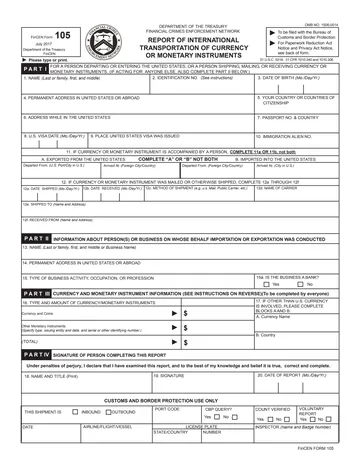
- The form, with hotspots
- Part I: the person
- Lines 11 and 12: carried or shipped
- Part II: the business
- Part III: the money
- Part IV: signature and CBP's block
- Page 2: the instructions
- When and where to file
- Where CBP's pages and the rule differ
- For banks onboarding a business that ships cash
- Mistakes to avoid
- How it connects
- Questions compliance teams ask
- Sources
- Who files
- Each person or business that carries, mails, ships or receives over $10,000 across the border
- Due
- At entry, departure, mailing or shipping; recipients within 15 days
- Filed with
- Customs and Border Protection (website, port or mail), not FinCEN
- Form revision
- July 2017; OMB 1506-0014
- Pages
- 2 (form and instructions)
31 CFR 1010.34031 CFR 1010.340Code of Federal Regulations, eCFR and 1010.306; CBP FinCEN Form 105 website FAQ 13; FinCEN Year in Review for FY 2025.
At a glance
FinCEN Form 105, the Report of International Transportation of Currency or Monetary Instruments, is the CMIR. It reports currency and bearer-type instruments of more than $10,000 that physically cross the U.S. border: carried by a person, mailed, or shipped. FinCEN owns the form; Customs and Border Protection (CBP) receives it. The form is built around travelers. This page is written for the other filers: money services businesses, currency exchangers, casinos, exporters and other businesses that ship cash, and the banks that onboard them.
- The rule. 31 U.S.C. 5316 and 31 CFR 1010.340, with filing rules in 31 CFR 1010.306(b)31 CFR 1010.306Code of Federal Regulations, eCFR. The statute applies when a person, agent or bailee “knowingly” moves the instruments.
- Who files. Each person who carries, mails or ships, or causes to be shipped, more than $10,000 at one time into or out of the United States, and each person who receives such a shipment when no report was filed for it. A business is a person.
- When. At the time of entry, departure, mailing or shipping; a recipient within 15 days after receipt (31 CFR 1010.306(b))31 CFR 1010.306Code of Federal Regulations, eCFR.
- Where. With CBP: on the FinCEN Form 105 website, which CBP's money and monetary instruments page marks “RECOMMENDED: You can file electronically on the FinCEN Form 105 Website.”, with the CBP officer at a port, or by mail.
- Form revision. July 2017, OMB 1506-0014, two pages: the form and its instructions. A separate instructions document: Not listed (none was found); the instructions are page 2.
- Not e-filed with FinCEN. IRM 4.26.5: “Because the form is physically filed by persons crossing U.S. borders, it is exempted from the e-filing mandate.”
Who files: businesses, MSBs and carriers
Businesses file in their own right. The form defines a person as “An individual, a corporation, partnership, a trust or estate” and other entities. The IRS's BSA manual says it directly: “Individuals as well as businesses are responsible for some requirements such as filing the FBAR and the CMIR.” A company that sends an employee across the border with its cash, or hands a sealed shipment to a courier, has caused the shipment and must see that a report is filed. When an employee files for the company, Part I is the employee and Part II is the company.
Money services businesses. An MSB is not a bank for this form, even one chartered under state law: the definition of bank leaves out “Any other organization (except a money services business) chartered under the banking laws of any state”. So the bank exceptions do not cover an MSB's own shipments, and line 15a is No. FinCEN's 2025 notice on convertible virtual currency kiosks names the “Report of International Transportation of Currency or Monetary Instruments (CMIR)” among the “Other Relevant BSA Reporting Requirements” that financial institutions and other entities or persons may have. For MSB onboarding generally, see KYB for MSBs and fintechs and money transmitters.
Currency carriers and armored cars. FinCEN's Year in Review for FY 2025 says “Travelers and currency transporters are required to file a CMIR”. CBP's website defines a currency transporter as a carrier that moves currency “as a business, for a person that engages the carrier for a fee”, and cites FinCEN's FIN-2014-R010 ruling of Sept. 24, 2014 (not saved for this page). The carrier has only the narrow overland exception (9); it cannot borrow its bank customer's exception.
Casinos. FinCEN's FIN-2009-G004 (footnote 9) says gambling establishments “maybe subject to FinCEN Form 105” (FinCEN's spelling). See casino AML.
How many. FinCEN counts “132,400” CMIRs in FY 2025, against 152,100 in FY 2024 (Year in Review for FY 2025).
Required or not
Form 105 is required if the condition holds: more than $10,000 in currency or monetary instruments, at one time, physically crossing the border, with no exception that fits the filer. It is not a form a bank or MSB collects from its customers, and no saved source requires a bank to ask a business customer for copies of its Forms 105: Not listed.
31 CFR 1010.100(b)31 CFR 1010.100Code of Federal Regulations, eCFR and 1010.340; 31 U.S.C. 5324(c)31 U.S.C. 5324United States Code, Cornell LII.
- At one time. A person moves money at one time when, “either alone, in conjunction with or on behalf of others”, the instruments total more than $10,000 on one calendar day, or on more days if the purpose is to evade the report (31 CFR 1010.100(b))31 CFR 1010.100Code of Federal Regulations, eCFR. CBP's plain-words version: “When families or groups are involved, the $10,000 threshold applies to the total amount they are carrying or sending collectively, not per individual.”
- Structuring is its own crime. No person may, to evade the report, “structure or assist in structuring, or attempt to structure or assist in structuring, any importation or exportation of monetary instruments.” (31 U.S.C. 5324(c)). See structuring.
- Concealment. Hiding more than $10,000 to evade the report is bulk cash smuggling, punishable by “imprisoned for not more than 5 years” and forfeiture (31 U.S.C. 5332).
- Search and forfeiture. At the border, “a customs officer may stop and search, at the border and without a search warrant, any vehicle, vessel, aircraft, or other conveyance, any envelope or other container, and any person entering or departing from the United States.” (31 U.S.C. 5317(b)). Unreported currency in transit is “subject to seizure and forfeiture to the United States” (31 CFR 1010.830)31 CFR 1010.830Code of Federal Regulations, eCFR.
Tap a box once for its note, again to jump to the line. Zoom in to read the small print.
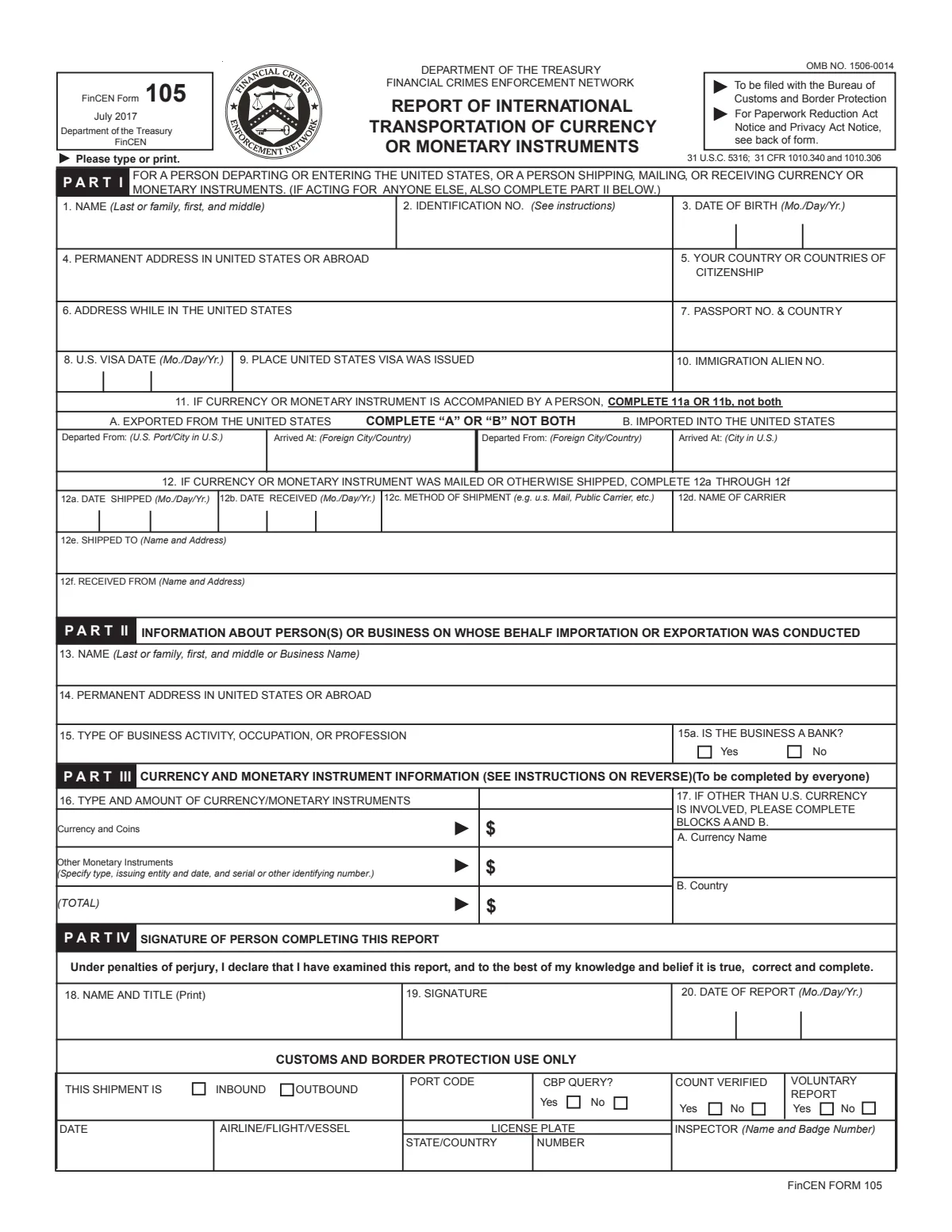
Part I: the person
The form's header names the authority and says where it goes. Part I is the individual who carries, ships, mails or receives the currency. Lines 5 to 10 are built for travelers; a business filer completes the ones that apply to its employee or agent and leaves the rest blank.
| Line | Label | What goes there |
|---|---|---|
| Top | FinCEN Form 105, July 2017; Report of International Transportation of Currency or Monetary Instruments; OMB NO. 1506-0014; To be filed with the Bureau of Customs and Border Protection | The current revision is dated July 2017 and carries OMB 1506-0014. The header points to the authority, “31 U.S.C. 531631 U.S.C. 5316United States Code, Cornell LII; 31 CFR 1010.34031 CFR 1010.340Code of Federal Regulations, eCFR and 1010.306”, and says where it goes: CBP, not FinCEN's BSA E-Filing System. FinCEN's filing information page links the fillable PDF and CBP's electronic version. “Please type or print.” |
| Part-I | PART I: FOR A PERSON DEPARTING OR ENTERING THE UNITED STATES, OR A PERSON SHIPPING, MAILING, OR RECEIVING CURRENCY OR MONETARY INSTRUMENTS. | The instruction that matters for a business: “(IF ACTING FOR ANYONE ELSE, ALSO COMPLETE PART II BELOW.)” When an employee, courier or agent moves a company's currency, Part I is that individual and Part II is the company. |
| 1 | 1. NAME (Last or family, first, and middle) | The person completing Part I. For a business shipment this is usually the individual who handles it; the business itself goes on line 13. CBP's website asks the same for business filers: “you will need to provide the business name, business identification number, and business address.” |
| 2 | 2. IDENTIFICATION NO. (See instructions) | The instructions: “Individuals must enter their social security number”, if any. “aliens who do not have a social security number should enter passport or alien registration number.” “All others should enter their employer identification number”. A company that files in its own name enters its EIN (TIN vs EIN on tincompliance.com). The privacy notice adds: “Disclosure of the social security number is mandatory”. |
| 3 | 3. DATE OF BIRTH (Mo./Day/Yr.) | For the individual in Part I. On the website, the Next button stays gray “if a future date is selected for the Date of Birth”. |
| 4 | 4. PERMANENT ADDRESS IN UNITED STATES OR ABROAD | A home address for an individual. The business's own address goes on line 14. |
| 5 | 5. YOUR COUNTRY OR COUNTRIES OF CITIZENSHIP | Lines 5 to 10 identify an individual crossing the border. A U.S. citizen employee shipping company cash by courier usually completes 5 and leaves the visa lines blank. The instructions: “You should complete each line that applies to you.” |
| 6 | 6. ADDRESS WHILE IN THE UNITED STATES | Applies to a person who lives abroad. Leave blank if line 4 is already a U.S. address. |
| 7 | 7. PASSPORT NO. & COUNTRY | Also the identification number on line 2 for an alien with no Social Security number. |
| 8 | 8. U.S. VISA DATE (Mo./Day/Yr.) | Visitors only. A U.S. citizen or permanent resident leaves lines 8 and 9 blank. |
| 9 | 9. PLACE UNITED STATES VISA WAS ISSUED | Visitors only. |
| 10 | 10. IMMIGRATION ALIEN NO. | Also usable as the line 2 identification number for an alien with no Social Security number. |
Lines 11 and 12: carried or shipped
Line 11 is for currency that travels with a person; line 12 is for currency mailed or shipped. A business shipment by courier, armored car or mail uses line 12 and its six parts.
31 CFR 1010.30631 CFR 1010.306Code of Federal Regulations, eCFR and 1010.340; FinCEN Form 105 and its instructions.
| Line | Label | What goes there |
|---|---|---|
| 11 | 11. IF CURRENCY OR MONETARY INSTRUMENT IS ACCOMPANIED BY A PERSON, COMPLETE 11a OR 11b, not both | “IF CURRENCY OR MONETARY INSTRUMENT IS ACCOMPANIED BY A PERSON, COMPLETE 11a OR 11b, not both”. A shipment by mail or carrier skips line 11 and goes to line 12. |
| 11a | A. EXPORTED FROM THE UNITED STATES: Departed From: (U.S. Port/City in U.S.) Arrived At: (Foreign City/Country) | For outbound currency. The report is due “at the time of entry into the United States or at the time of departure, mailing or shipping from the United States” (31 CFR 1010.306(b)(1))31 CFR 1010.306Code of Federal Regulations, eCFR; on CBP's website, see the 72-hour window below. |
| 11b | B. IMPORTED INTO THE UNITED STATES: Departed From: (Foreign City/Country) Arrived At: (City in U.S.) | For inbound currency. The statute also reaches currency moved “to a place in the United States from or through a place outside the United States” (31 U.S.C. 5316(a)(1)(B)). |
| 12 | 12. IF CURRENCY OR MONETARY INSTRUMENT WAS MAILED OR OTHERWISE SHIPPED, COMPLETE 12a THROUGH 12f | The shipper's line. The rule reaches anyone who ships “or causes to be physically transported, mailed, or shipped” currency, and “A person is deemed to have caused such transportation, mailing or shipping when he aids, abets, counsels, commands, procures, or requests it to be done by a financial institution or any other person.” (31 CFR 1010.340(a)). Hiring a courier or armored car does not move the duty off the business that sends the cash. |
| 12a | 12a. DATE SHIPPED (Mo./Day/Yr.) | The instructions: “Block 12A and 12B; enter the exact date you shipped or received currency or monetary instrument(s).” |
| 12b | 12b. DATE RECEIVED (Mo./Day/Yr.) | The recipient's 15 days run from this date: “A report required by § 1010.340(b) shall be filed within 15 days after receipt of the currency or other monetary instruments.” |
| 12c | 12c. METHOD OF SHIPMENT (e.g. u.s. Mail, Public Carrier, etc.) | The method matters for the exceptions: a bank's shipment “through the postal service or by common carrier” is excepted, and so is an overland armored car run between bank offices and foreign persons (below). |
| 12d | 12d. NAME OF CARRIER | CBP's website says a common carrier of currency “may not claim for itself any exemption for filing a CMIR that might be applicable to other parties.” Its example: a carrier that picks up currency air-shipped to a U.S. bank “has an obligation to file a CMIR even though the bank does not”. |
| 12e | 12e. SHIPPED TO (Name and Address) | The consignee. For an exporting business, the foreign recipient; for an importer, its own U.S. office or bank. |
| 12f | 12f. RECEIVED FROM (Name and Address) | A recipient's report must state “the amount, the date of receipt, the form of monetary instruments, and the person from whom received.” (31 CFR 1010.340(b)). |
Part II: the business
Part II names the person or business the currency moved for. For an MSB, exporter or casino shipping its own currency through an employee or courier, this is where the business's legal name and address go, and line 15a records that it is not a bank.
| Line | Label | What goes there |
|---|---|---|
| Part-II | PART II: INFORMATION ABOUT PERSON(S) OR BUSINESS ON WHOSE BEHALF IMPORTATION OR EXPORTATION WAS CONDUCTED | The statute asks for this when the carrier is not the owner: “the identity of the person that gave the instruments to the person transporting them, the identity of the person who is to receive them, or both.” (31 U.S.C. 5316(b)(3))31 U.S.C. 5316United States Code, Cornell LII. |
| 13 | 13. NAME (Last or family, first, and middle or Business Name) | The instructions: “provide the complete name of the shipper or recipient on whose behalf the exportation or importation was conducted.” Use the business's legal name as on its formation record and EIN letter, not a trade name alone. |
| 14 | 14. PERMANENT ADDRESS IN UNITED STATES OR ABROAD | CBP's website asks a business filer for “business address”. The form prints no separate line for the business's identification number; CBP's website asks for one (FAQ 17). |
| 15 | 15. TYPE OF BUSINESS ACTIVITY, OCCUPATION, OR PROFESSION | Describe the activity plainly. For a money services business, name the MSB activity it is registered for (see MSB registration). |
| 15a | 15a. IS THE BUSINESS A BANK? Yes / No | The question matters because banks have their own exceptions. The form's definition of bank includes “(7) any other organization chartered under the banking laws of any State and subject to the supervision of the bank supervisory authorities of a State other than a money service business”. The rule says the same: “Any other organization (except a money services business) chartered under the banking laws of any state” (31 CFR 1010.100(d)(7))31 CFR 1010.100Code of Federal Regulations, eCFR. |
Part III: the money
Part III is for everyone. It splits currency and coins from other monetary instruments, totals them, and names any foreign currency and its country.
| Line | Label | What goes there |
|---|---|---|
| Part-III | PART III: CURRENCY AND MONETARY INSTRUMENT INFORMATION (SEE INSTRUCTIONS ON REVERSE)(To be completed by everyone) | “(To be completed by everyone)”. The instructions for Part III: “serial or other identifying number, and payee (if any).” |
| 16-cash | 16. TYPE AND AMOUNT OF CURRENCY/MONETARY INSTRUMENTS: Currency and Coins $ | Currency is “The coin and paper money of the United States or any other country that is (1) designated as legal tender”, circulates, and is customarily accepted. The form gives no exchange rate method: Not listed. CBP's website says “The exchange rate is calculated automatically.” |
| 16-other | Other Monetary Instruments (Specify type, issuing entity and date, and serial or other identifying number.) $ | Monetary instruments include traveler's checks, and negotiable instruments “that are either in bearer form, endorsed without restriction, made out to a fictitious payee (for the purposes of § 1010.340), or otherwise in such form that title thereto passes upon delivery;” (31 CFR 1010.100(dd))31 CFR 1010.100Code of Federal Regulations, eCFR. Not included: “checks or money orders made payable to the order of a named person which have not been endorsed” or that bear restrictive endorsements, and “Monetary instruments do not include warehouse receipts or bills of lading.” |
| 16-total | (TOTAL) $ | The threshold is “in an aggregate amount exceeding $10,000 at one time” (31 CFR 1010.340(a)). Exactly $10,000 is not over the line. At one time means “On one calendar day; or”, if to evade the report, “on one or more days.” (31 CFR 1010.100(b))31 CFR 1010.100Code of Federal Regulations, eCFR. |
| 17 | 17. IF OTHER THAN U.S. CURRENCY IS INVOLVED, PLEASE COMPLETE BLOCKS A AND B. | The instructions: Block 17, “if currency or monetary instruments of more than one country is involved, attach a list showing each type, country or origin and amount.” |
| 17A | A. Currency Name | One currency here; a list for several. |
| 17B | B. Country | One country here; a list for several. |
Part IV: signature and CBP's block
| Line | Label | What goes there |
|---|---|---|
| Part-IV | PART IV: SIGNATURE OF PERSON COMPLETING THIS REPORT | “Under penalties of perjury, I declare that I have examined this report, and to the best of my knowledge and belief it is true, correct and complete.” A false report is its own offense: “Any person who knowingly makes any false, fictitious or fraudulent statement or representation in any report required by this chapter” faces a fine of up to $10,000, up to 5 years in prison, or both (31 CFR 1010.840(d))31 CFR 1010.840Code of Federal Regulations, eCFR. |
| 18 | 18. NAME AND TITLE (Print) | For a business filing, the employee's title shows the capacity they act in. The statute lists “the legal capacity in which the person filing the report is acting.” among the report's contents (5316(b)(1)). |
| 19 | 19. SIGNATURE | Paper form: sign. CBP's website: “The signature box is an optional field.” The website instead has the filer “complete the form and endorse it online”. |
| 20 | 20. DATE OF REPORT (Mo./Day/Yr.) | On the website the report then runs for 72 hours: “Upon submission, the form is valid for three days (72 hours).” |
| CBP | CUSTOMS AND BORDER PROTECTION USE ONLY | Leave it blank. The CMIR “is examined by Customs, not the IRS.” (IRM 4.26.5.5.4, June 23, 2020). |
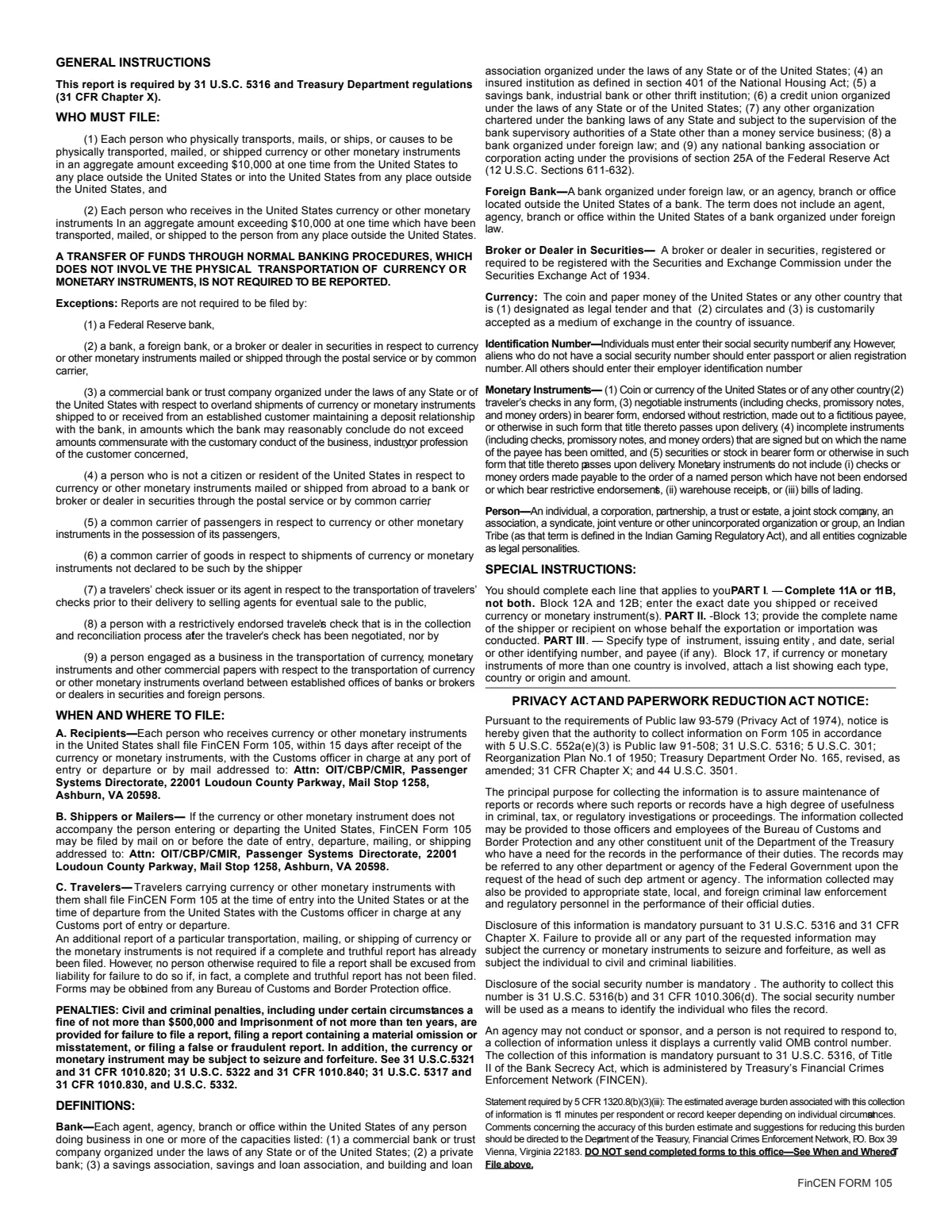
Page 2: the instructions
Page 2 holds the only instructions FinCEN publishes for the form: who must file, the nine exceptions, when and where to file, penalties, definitions and the notices.
| Line | Label | What goes there |
|---|---|---|
| Who | GENERAL INSTRUCTIONS. WHO MUST FILE: (1) ... (2) ... | (1) “Each person who physically transports, mails, or ships, or causes to be physically transported, mailed, or shipped currency or other monetary instruments in an aggregate amount exceeding $10,000 at one time” into or out of the United States, and (2) “Each person who receives in the United States currency or other monetary instruments In an aggregate amount exceeding $10,000 at one time” sent from outside it. A person is “An individual, a corporation, partnership, a trust or estate” and other entities, so a business files in its own right. |
| Wires | A TRANSFER OF FUNDS THROUGH NORMAL BANKING PROCEDURES ... IS NOT REQUIRED TO BE REPORTED. | The rule: “A transfer of funds through normal banking procedures which does not involve the physical transportation of currency or monetary instruments is not required to be reported by this section.” (31 CFR 1010.340(d)). Funds transfer records are a separate rule: see the travel rule. |
| Exc-1-4 | Exceptions: Reports are not required to be filed by: (1) ... (4) ... | Exception (2) covers “a bank, a foreign bank, or a broker or dealer in securities in respect to currency or other monetary instruments mailed or shipped through the postal service or by common carrier”. Exception (3) is the KYB one: a commercial bank's overland shipments to or from “an established customer maintaining a deposit relationship with the bank, in amounts which the bank may reasonably conclude do not exceed amounts commensurate with the customary conduct of the business, industry or profession of the customer concerned;” (31 CFR 1010.340(c)(3))31 CFR 1010.340Code of Federal Regulations, eCFR. The bank can rely on it only if it knows the customer's business well enough to judge the amounts. |
| Exc-5-6 | (5) a common carrier of passengers ... (6) a common carrier of goods ... | (5) “a common carrier of passengers in respect to currency or other monetary instruments in the possession of its passengers”; (6) “a common carrier of goods in respect to shipments of currency or monetary instruments not declared to be such by the shipper”. The statute is the source: 31 U.S.C. 5316(c)31 U.S.C. 5316United States Code, Cornell LII. CBP's pages read differently; see the section on conflicts below. |
| Exc-7-9 | (7) a travelers' check issuer ... (8) ... (9) a person engaged as a business in the transportation of currency ... | (9) “a person engaged as a business in the transportation of currency, monetary instruments and other commercial papers with respect to the transportation of currency or other monetary instruments overland between established offices of banks or brokers or dealers in securities and foreign persons.” CBP's website says “All of the above four conditions have to be met”: import or export, overland, a bank or broker-dealer on the U.S. side and a non-U.S. person on the other, and pickup or delivery at the bank's or broker-dealer's established office. |
| When-A | WHEN AND WHERE TO FILE: A. Recipients | A recipient “shall file FinCEN Form 105, within 15 days after receipt of the currency or monetary instruments”, at a port or by mail to “Attn: OIT/CBP/CMIR, Passenger Systems Directorate, 22001 Loudoun County Parkway, Mail Stop 1258, Ashburn, VA 20598.” The recipient's duty applies only to a shipment “with respect to which a report has not been filed under paragraph (a) of this section”. |
| When-B | B. Shippers or Mailers | The report “may be filed by mail on or before the date of entry, departure, mailing, or shipping”, to the same Ashburn address. CBP's website FAQ 7: “the form should be submitted on or before the date of mailing or shipping.” |
| When-C | C. Travelers | “Travelers carrying currency or other monetary instruments with them shall file FinCEN Form 105 at the time of entry into the United States or at the time of departure from the United States”. On CBP's website the filing must be no more than 72 hours ahead (below). |
| Once | An additional report ... is not required if a complete and truthful report has already been filed. | “An additional report of a particular transportation, mailing, or shipping of currency or the monetary instruments is not required if a complete and truthful report has already been filed.” But “no person otherwise required to file a report shall be excused from liability for failure to do so if, in fact, a complete and truthful report has not been filed.” A business that relies on its courier's or customer's report should keep a copy of it. |
| Penalties | PENALTIES | Penalties reach failure to file, a material omission or misstatement, or a false report, “including under certain circumstances a fine of not more than $500,000 and Imprisonment of not more than ten years”. “the currency or monetary instrument may be subject to seizure and forfeiture”. The form cites “31 CFR 1010.82031 CFR 1010.820Code of Federal Regulations, eCFR”; that section is now reserved (see the conflicts section). |
| Def-bank | DEFINITIONS: Bank | Each U.S. office of a commercial bank or trust company, private bank, savings association, insured institution, thrift, credit union, state-chartered banking organization (but not an MSB), foreign bank, and section 25A corporation. |
| Def-bank-2 | Bank (continued); Foreign Bank; Broker or Dealer in Securities | A broker or dealer is one “registered or required to be registered with the Securities and Exchange Commission under the Securities Exchange Act of 1934.” To confirm a counterparty is a bank or broker-dealer, see verify a financial institution. |
| Def-currency | Currency | Used for line 16. Foreign banknotes count when they are legal tender where issued. |
| Def-ID | Identification Number | The line 2 rule. A business entity reports its EIN. |
| Def-MI | Monetary Instruments | Used for line 16. The rule's list, 31 CFR 1010.10031 CFR 1010.100Code of Federal Regulations, eCFR(dd), names personal, business, official bank, cashier's and third-party checks among the negotiable instruments. |
| Def-person | Person | Why a business has its own duty to file: the reporting rule applies to each person, and a corporation is one. |
| Special | SPECIAL INSTRUCTIONS | “You should complete each line that applies to you.” The other special instructions are quoted in the line rows above. |
| Privacy | PRIVACY ACT AND PAPERWORK REDUCTION ACT NOTICE | “The principal purpose for collecting the information is to assure maintenance of reports or records where such reports or records have a high degree of usefulness in criminal, tax, or regulatory investigations or proceedings.” Failure to provide the information “may subject the currency or monetary instruments to seizure and forfeiture”. |
| PRA | Statement required by 5 CFR 1320.8(b)(3)5 CFR 1320.8Code of Federal Regulations, eCFR(iii) ... | Burden: “11 minutes per respondent or record keeper depending on individual circumstances” (CBP's copy of the same statement). The P.O. Box in Vienna is for comments only: “DO NOT send completed forms to this office”. |
When and where to file
31 CFR 1010.306(b)31 CFR 1010.306Code of Federal Regulations, eCFR; FinCEN Form 105 instructions; CBP FinCEN Form 105 website FAQs 7 and 13.
- Carried by a person. At the time of entry or departure, with the CBP officer at the port. On CBP's website, file no more than 72 hours ahead and show the confirmation number at the port: “Once you submit the form at a port of entry, provide your confirmation number to the officer for processing.”
- Mailed or shipped. “Reports required by § 1010.340(a) for currency or other monetary instruments not physically accompanying a person entering or departing from the United States, may be filed by mail on or before the date of entry, departure, mailing or shipping.” (31 CFR 1010.306(b)(3))31 CFR 1010.306Code of Federal Regulations, eCFR. CBP's website takes shippers too: FAQ 17 covers a person “transporting or mailing/shipping monetary instrument for a business”.
- Received. Within 15 days after receipt, at a port or by mail. CBP's FAQ 7 says the same, “Unless filed by the sender”.
- Changes. On the website, a changed amount needs a new filing: “you will be required to submit a new form with the correct amount.” The earlier one expires.
- Paper still works. “The paper form is still available for use.” A filer who completes the website form does not also file on paper (FAQ 11).
- Where to start. The FinCEN Form 105 website (CBP), with questions answered on the website's help page; or the fillable PDF from FinCEN's filing information page.
Where CBP's pages and the rule differ
CBP's money page (last modified Nov. 24, 2025) and its e-filing website FAQs (read Nov. 23, 2026) restate the rule in places where the words do not match. The statute and 31 CFR 1010.30631 CFR 1010.306Code of Federal Regulations, eCFR and 1010.340 govern; where the rule lets CBP specify the time or place, CBP's specification applies within that room.
| Point | Statute, rule and form | CBP's pages | Which governs |
|---|---|---|---|
| Common carriers | Excepted: “This section or a regulation under this section does not apply to a common carrier of passengers when a passenger possesses a monetary instrument, or to a common carrier of goods if the shipper does not declare the instrument.” (31 U.S.C. 5316(c)31 U.S.C. 5316United States Code, Cornell LII; 31 CFR 1010.340(c)(5)31 CFR 1010.340Code of Federal Regulations, eCFR and (6); the form's exceptions 5 and 6) | FAQ 5 lists them under Who must file: “c) A common carrier of passengers in respect to currency or other monetary instruments in the possession of its passengers”. The money page: “A common carrier of goods (like a shipping company) is also subject to this rule, unless the shipper explicitly states that the shipment contains currency or monetary instruments.” That reverses the rule's condition. | The statute and the rule. A carrier of passengers does not report what its passengers carry; a carrier of goods does not report currency the shipper did not declare. CBP's own FAQ 22 and 23 on carriers of currency cite 31 CFR 1010.340(c)31 CFR 1010.340Code of Federal Regulations, eCFR. |
| Timing | A report “shall be filed at the time of entry into the United States or at the time of departure, mailing or shipping from the United States, unless otherwise specified by the Commissioner of Customs and Border Protection.” (31 CFR 1010.306(b)(1))31 CFR 1010.306Code of Federal Regulations, eCFR | FAQ 7: travelers “must submit the form within three days (72 hours) prior to the planned travel date”. FAQ 13: “Travel after the three days (72 hours) will require a new FinCEN Form 105.” The money page still offers paper: “You can obtain and complete the form prior to departing the United States or upon arrival in the United States.” | The rule. Its own words let CBP specify otherwise, so CBP's 72-hour window is the condition for a report filed on its website; a paper form handed to the officer at the time of entry or departure meets the rule. |
| Mailing address | Mail to “Commissioner of Customs and Border Protection, Attention: Currency Transportation Reports, Washington, DC 20229.” (31 CFR 1010.306(b)(3)31 CFR 1010.306Code of Federal Regulations, eCFR, “or as otherwise specified by the Commissioner of Customs and Border Protection”) | The July 2017 form prints the Ashburn, Virginia address (OIT/CBP/CMIR, Mail Stop 1258). FinCEN's advisories index lists a “CMIR Notice of mailing address change” dated 07/2017. | The form's Ashburn address, as CBP's specification under the rule's own clause. The notice itself was not saved: its text is Not listed here. |
| Threshold | “in an aggregate amount exceeding $10,000 at one time” (31 CFR 1010.340(a))31 CFR 1010.340Code of Federal Regulations, eCFR; the statute: “monetary instruments of more than $10,000 at one time” | FAQ 10: “if the total calculation does not amount to $10,000 USD or more, you do not have to file the form.” That implies a report at exactly $10,000. | The rule: more than $10,000. A report at exactly $10,000 is not required, though nothing bars one (CBP's block has a voluntary report box). |
| Penalty citation | The eCFR shows 31 CFR 1010.82031 CFR 1010.820Code of Federal Regulations, eCFR as “[Reserved]”. | The form and CBP's pages cite “31 U.S.C.5321 and 31 CFR 1010.82031 CFR 1010.820Code of Federal Regulations, eCFR”. | The current eCFR. The criminal penalty is in 31 CFR 1010.84031 CFR 1010.840Code of Federal Regulations, eCFR and forfeiture in 1010.830; the civil penalty statute, 31 U.S.C. 532131 U.S.C. 5321United States Code, Cornell LII, was not saved for this page: its amounts are Not listed here. |
| Form link | FinCEN's filing information page links the PDF under /system/files/ (a working link as of Nov. 23, 2026). | CBP's money page links it under /sites/default/files/, which returned FinCEN's 404 page on Nov. 23, 2026. | Use FinCEN's address: FinCEN Form 105 (PDF). |
One more gap: CBP's FAQ 4 asks whether a filer can save a form and finish it later, and its published answer repeats the burden statement of FAQ 3. Whether a draft can be saved is Not listed.
For banks onboarding a business that ships cash
The bank's own duty and its customer's duty are different. Banks and broker-dealers are excepted for shipments by mail or common carrier, and commercial banks for overland shipments sized to an established customer's business; the customer that ships its own currency is not.
| Situation | Who files | Rule |
|---|---|---|
| A bank mails or ships currency abroad by mail or common carrier | Not the bank (exception 2). A currency carrier it hires may still have to file. | 31 CFR 1010.340(c)(2)31 CFR 1010.340Code of Federal Regulations, eCFR; CBP FAQ 23 |
| A commercial bank ships currency overland to or from an established deposit customer, in amounts usual for the customer's business | Not the bank (exception 3) | 31 CFR 1010.340(c)(3)31 CFR 1010.340Code of Federal Regulations, eCFR |
| An armored car carries currency overland between a bank's office and a foreign person | Not the armored car, if all four conditions are met (exception 9) | 31 CFR 1010.340(c)(9)31 CFR 1010.340Code of Federal Regulations, eCFR; CBP FAQ 22 |
| A business customer (an MSB, exporter or casino) ships its own currency abroad | The business, as the person that causes the shipment; no bank exception applies to it | 31 CFR 1010.340(a)31 CFR 1010.340Code of Federal Regulations, eCFR; 1010.100(d)(7) |
| A person who is not a U.S. citizen or resident mails or ships currency from abroad to a U.S. bank or broker-dealer | Not that person (exception 4); a carrier of currency that picks it up may have to file | 31 CFR 1010.340(c)(4)31 CFR 1010.340Code of Federal Regulations, eCFR; CBP FAQ 23 |
| A business in the United States receives more than $10,000 in currency sent from abroad, and no report was filed | The business, within 15 days | 31 CFR 1010.340(b)31 CFR 1010.340Code of Federal Regulations, eCFR; 1010.306(b)(2) |
- Exception 3 rests on knowing the customer. The bank must be able to “reasonably conclude” the amounts are commensurate with the customer's business. That is the same understanding of the customer's business that the customer due diligence rule's customer risk profile builds, and it should be recorded the same way.
- Examiners look for CMIRs. IRS BSA examiners are told: “BSA Search should be used to determine if any CTRs, CMIRs, SARs, or FBARs were filed in the names of employees, agents, or nominees, which may indicate possible unreported transactions.” (IRM 4.26.6)
- Cash coming in. Currency a business brings back from abroad and deposits may also trigger the bank's currency transaction report; the CMIR and the CTR are separate reports by separate filers. See also Form 8300 vs CTR.
- Southwest border. For FinCEN's orders on MSB cash transactions in named southwest border ZIP codes, see FinCEN geographic targeting orders.
Mistakes to avoid
- Thinking the courier files. The business that causes the shipment has the duty. A carrier of goods is excepted for undeclared currency, and a carrier of currency may have its own duty, but neither excuses the shipper if no complete report is filed.
- Checking Yes on 15a for an MSB. A money services business is not a bank, even with a state charter.
- Splitting shipments. Several shipments on one day are added together, and shipments on several days are added together when the purpose is to evade. Splitting to stay under $10,000 is structuring.
- Counting named-payee checks. Checks payable to a named person, unendorsed or restrictively endorsed, are not monetary instruments for this form; bearer and blank-endorsed ones are.
- Filing too early online. A website filing lasts 72 hours; a later crossing needs a new one.
- Sending it to FinCEN. The Vienna, Virginia box on page 2 is for burden comments only. The report goes to CBP.
- Using the dead link. CBP's link to the PDF under /sites/default/files/ returned an error on Nov. 23, 2026; use FinCEN's filing information page.
How it connects
- The other $10,000 cash reports: CTR (banks and MSBs), the CTR form field by field, and Form 8300 (businesses that receive cash), compared on Form 8300 vs CTR.
- Evading any of them: structuring. When a customer's cross-border cash looks wrong: the suspicious activity report.
- The businesses that ship cash: KYB for MSBs and fintechs, MSB registration, casino AML, geographic targeting orders.
- The wider statute: the Bank Secrecy Act. Other forms: the forms hub.
Questions compliance teams ask
Does a business that ships currency abroad have to file Form 105?
Yes, if the shipment is more than $10,000 at one time and no exception fits. The rule covers each person who ships “or causes to be physically transported, mailed, or shipped” currency (31 CFR 1010.340(a))31 CFR 1010.340Code of Federal Regulations, eCFR, and a corporation is a person. The business files in Part II, with the employee or agent who handles it in Part I.
Does a money transmitter count as a bank for the Form 105 exceptions?
No. The definition of bank excludes a money services business, even one chartered under state banking law (31 CFR 1010.100(d)(7))31 CFR 1010.100Code of Federal Regulations, eCFR. An MSB answers No on line 15a and cannot use the bank exceptions for its own shipments.
Who files when an armored car carries currency for a bank?
The bank is excepted for shipments by common carrier. The armored car is excepted only for overland moves between established offices of banks or broker-dealers and foreign persons, with all four of CBP's conditions met. Otherwise, CBP says a carrier of currency “may not claim for itself any exemption for filing a CMIR that might be applicable to other parties.”
Is a wire transfer reported on Form 105?
No. “A transfer of funds through normal banking procedures which does not involve the physical transportation of currency or monetary instruments is not required to be reported by this section.” (31 CFR 1010.340(d))31 CFR 1010.340Code of Federal Regulations, eCFR.
How long is an electronic Form 105 valid?
“Upon submission, the form is valid for three days (72 hours).” The rule itself says the report is filed at the time of entry or departure, unless CBP specifies otherwise; the 72-hour window is CBP's condition for its website (31 CFR 1010.306(b)(1))31 CFR 1010.306Code of Federal Regulations, eCFR.
Is exactly $10,000 reportable?
No. The rule's threshold is “in an aggregate amount exceeding $10,000 at one time”. CBP's FAQ 10 reads as if $10,000 itself is reportable; the rule governs.
Sources
- FinCEN, FinCEN Form 105, Report of International Transportation of Currency or Monetary Instruments (PDF), July 2017, OMB 1506-0014, as linked on FinCEN's filing information page (read Nov. 23, 2026)
- CBP, Money and Other Monetary Instruments (last modified Nov. 24, 2025); CBP, FinCEN Form 105 website and its help and FAQs (read Nov. 23, 2026)
- 31 U.S.C. 5316, 5317, 5324 and 5332 (govinfo, 2024 edition)
- 31 CFR part 1010: 1010.100(b), (d) and (dd), 1010.306(b), 1010.340, 1010.830 and 1010.840 (eCFR, version Nov. 6, 2026)
- IRS, IRM 4.26.5 (CMIR section, June 23, 2020) and IRM 4.26.6
- FinCEN, FinCEN's Year in Review for FY 2025; FIN-2009-G004, casino FAQs (footnote 9); FIN-2025-NTC1, CVC kiosks notice